

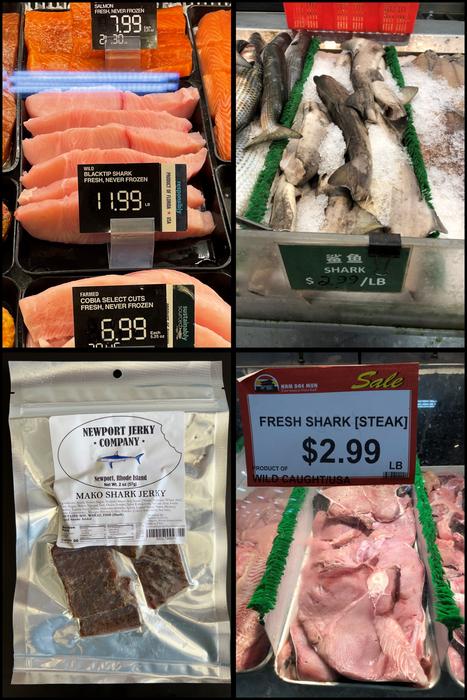
That $2.99-per-pound “shark” fillet at your local grocery store might be hiding a troubling secret. Nearly one-third of shark meat sold in American stores comes from species teetering on the edge of extinction, according to DNA analysis of products purchased across the southeastern United States.
University of North Carolina researchers bought 30 shark products from grocery stores, seafood markets, and online vendors, then used genetic barcoding to determine what species consumers were actually getting. The results paint a picture of an industry built on ambiguity and, sometimes, outright deception.
Of the 29 samples successfully identified, 93% were labeled simply as “shark” with no species information. One product labeled as blacktip shark turned out to be shortfin mako. Only a single sample bore an accurate, specific label.
Hidden Predators In Plain Sight
The genetic analysis revealed great hammerheads and scalloped hammerheads, both critically endangered, sitting in freezer cases alongside everyday seafood. These ancient predators, which have survived for 450 million years, now face extinction rates unprecedented in their evolutionary history.
“We found critically endangered sharks, including great hammerhead and scalloped hammerhead, being sold in grocery stores, seafood markets, and online,” said Dr. Savannah Ryburn, the study’s lead researcher. But consumers purchasing these products had no way of knowing what they were buying.
The pricing tells its own story. Fresh shark meat averaged just $6.30 per pound, a fraction of what red snapper commands at $27 per pound. For such ecologically important apex predators, the market treats them as bargain-bin protein.
The investigation uncovered 11 different shark species masquerading under generic labels. Three carry the IUCN’s most dire conservation rating: critically endangered. Another four are classified as endangered or vulnerable.
More Than Conservation At Stake
The mislabeling problem extends beyond conservation concerns into public health territory. Scalloped hammerheads, great hammerheads, and dusky smooth-hounds contain dangerously high mercury levels, according to previous research. Mercury damages the brain and central nervous system, while arsenic found in shark tissue can cause cancer.
“When consumers are purchasing ambiguously labeled or mislabeled shark meat, they have no way to know what species they are consuming and what the associated health risks might be,” the researchers noted.
These metals pose particular risks to pregnant women and developing fetuses, potentially causing cognitive impairment and infant mortality. Yet three of the high-mercury species identified in this study were all sold under the generic “shark” label.
The research team, comprised of students and instructors in a seafood forensics course, collected samples from Washington D.C. to Georgia between 2021 and 2022. They purchased everything from whole frozen sharks at Asian markets to jerky ordered online.
Current FDA regulations allow all shark species to be labeled simply as “shark,” creating a regulatory blind spot that obscures both conservation status and health risks. This contrasts sharply with European Union requirements for scientific names, harvest methods, and origin details on seafood labels.
Fifty-eight percent of the sampled products came from species listed under CITES Appendix II, which requires export permits due to their vulnerability. Yet tracking the actual source proved nearly impossible, with catch location available for only four samples.
The Shark Conservation Act of 2010 inadvertently may have increased shark meat availability by requiring that sharks be landed with fins attached, rather than allowing the wasteful practice of finning at sea. What was once discarded “junk meat” now finds its way to American dinner tables.
But the fundamental problem persists: a 450-million-year evolutionary success story reduced to anonymous protein, sold cheap and eaten unknowingly. The researchers recommend that sellers provide species-specific labeling and that consumers avoid purchasing ambiguously labeled shark products unless they’re truly necessary for food security.
The study appears in Frontiers in Marine Science with full genetic data available for verification. As shark populations continue declining globally, what ends up on American plates may represent the final chapter for some of the ocean’s most ancient predators.