

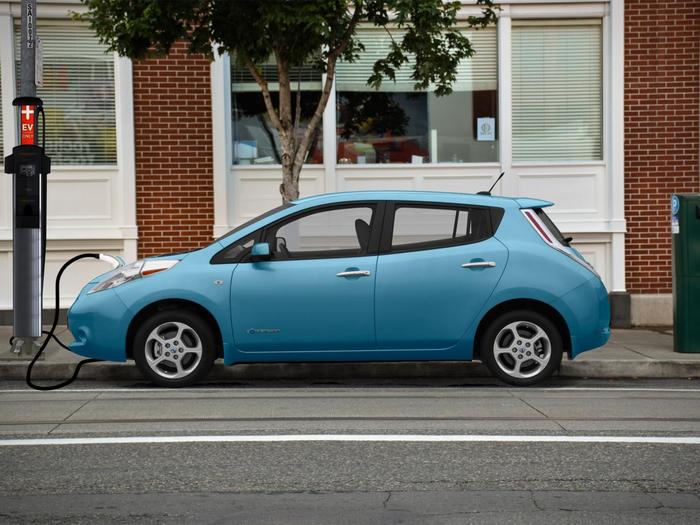
The electric vehicle revolution has a parking problem. More specifically, it has an apartment dweller problem. While suburban homeowners install sleek charging stations in their garages, millions of urban residents who park on the street have been left wondering where they’re supposed to plug in their hypothetical electric cars. The answer, according to researchers at Penn State, might be hanging over their heads.
A team led by Xianbiao “XB” Hu has spent the past year testing whether ordinary streetlights could double as EV chargers, and the results suggest this isn’t just feasible but potentially superior to traditional charging infrastructure. They installed 23 modified streetlight charging units across Kansas City, Missouri, and tracked everything from charging speeds to environmental impact. The data tells a story that challenges assumptions about how EV infrastructure should be built.
The Infrastructure Already Exists
The elegance of the approach lies in its simplicity. Streetlights are already connected to municipal power grids, already positioned near parking spaces, and already owned by cities rather than private companies. This eliminates the most expensive and time-consuming aspects of building charging networks from scratch. The researchers didn’t need to run new electrical lines or negotiate with property owners. They just needed to retrofit existing poles.
“The motivation for this work comes from the fact that many apartment and multi-unit dwelling residents, particularly in urban and downtown areas, lack access to dedicated home EV chargers, since they don’t have the privilege of owning a garage.”
That’s Hu explaining what should have been obvious all along. The EV charging conversation has been dominated by questions about fast-charging corridors for road trips and workplace charging stations. Meanwhile, the daily charging needs of people who live in cities without private parking have been treated as an afterthought. Streetlights flip that priority structure.
The Kansas City pilot program, funded by the Department of Energy, revealed some unexpected advantages. The streetlight chargers delivered faster charging speeds than conventional stations, likely because they draw from dedicated municipal electrical lines rather than competing with multiple vehicles at commercial charging plazas. Users also spent less time at streetlight chargers, possibly due to parking time limits or costs, but still received adequate charging.
Environmental Math That Actually Works
The environmental benefits proved more substantial than anticipated. Because the chargers utilize locations where cars already park, they avoid the emissions associated with drivers seeking out charging stations. The research team calculated that streetlight chargers achieved 11.94% greater avoided gasoline consumption and 11.24% higher greenhouse gas reductions compared to regular charging stations. Those percentages might sound modest, but they compound quickly across thousands of charging sessions.
Yang “Chris” Song, who was a doctoral student during the research and is now a data scientist at ElectroTempo, emphasized the importance of creating a replicable model. The team developed a three-pronged framework examining demand, feasibility, and benefits that other municipalities could adapt to their own streetlight networks.
“Creating something that works not just in one specific city but that can be adopted by many communities easily is critical for increasing EV use across the country.”
The demand analysis involved training artificial intelligence models on factors including land use, existing charging station density, nearby points of interest, and traffic volume. But the researchers also incorporated equity considerations, ensuring the chargers would serve diverse neighborhoods rather than clustering in affluent areas already well-served by private charging options.
Cost comparisons revealed the most dramatic differences. Installing streetlight chargers proved significantly cheaper than building traditional charging stations because the underlying infrastructure was already in place. Cities own the streetlights, control the right-of-way, and maintain the electrical systems. This eliminates layers of complexity and expense that typically slow infrastructure deployment.
The researchers acknowledge limitations in their current model. Future iterations will incorporate more detailed socioeconomic data to better identify communities with limited EV access. Weather information also needs integration, since extreme temperatures affect battery performance and charging demand. These refinements should make the framework more robust as cities across different climates consider adopting streetlight charging.
The Kansas City experiment offers a preview of what urban EV infrastructure might look like when designed for people who actually live in cities rather than people passing through them. Streetlights are already everywhere. The power is already running through them. The parking spaces are already next to them. Sometimes the most innovative solution is just paying attention to what’s already there.
Journal of Urban Planning and Development: 10.1061/JUPDDM.UPENG-5865