

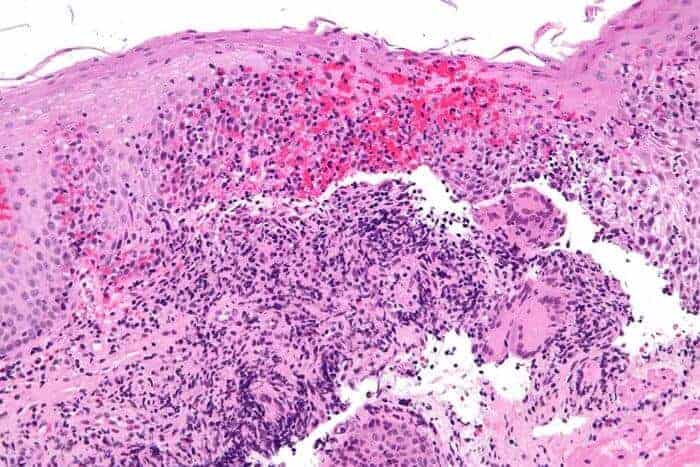
The tissue lining your oesophagus looks healthy under a microscope. No tumours. No lesions. But if you’re over 50, more than half the cells in that tissue are already mutants, each carrying genetic changes that give them an edge over their neighbours. They divide faster, mature slower, and elbow out normal cells. This isn’t cancer. Not yet. But it’s the prelude, a slow-motion takeover that begins decades before anything goes visibly wrong.
Researchers at Weill Cornell Medicine and the New York Genome Center have now captured this hidden competition at single-cell resolution. Using a technique called single-cell Genotype-to-Phenotype sequencing (scG2P), they mapped over 10,000 cells from the oesophageal tissue of six older adults and found that more than half carried driver mutations. The findings, published 31 December in Cancer Discovery, show how specific genetic glitches reshape normal tissue long before malignancy sets in.
The gene that jams the exit door
One mutation dominated the landscape. NOTCH1, a gene that normally tells oesophageal cells when to mature and shed from the tissue surface, was altered in most of the mutant clones. When NOTCH1 fails, cells get stuck in an immature state, lingering in the tissue and continuing to divide instead of moving on. The effect is like a jammed exit door at a concert: the crowd piles up, and the room gets dangerously full.
“Relatively high numbers of cells get stuck in less mature developmental stages, where they stay in the tissue and continue to divide, whereas normal, mature cells move to the tissue surface and are shed,” Dennis Yuan, a postdoctoral fellow on the study, says.
The second most common mutation hit TP53, the famous tumour suppressor gene. Cells with broken TP53 didn’t just fail to mature. They also cycled faster, giving them a double advantage.
A handful of clones carried both mutations.
Why solid tissue was invisible until now
Blood is easy to study because you can sequence it fresh. Solid organs like the oesophagus are preserved in ways that destroy the molecular links between a cell’s genotype and its behaviour. Most studies of somatic mosaicism, the patchwork of genetically distinct cell populations that accumulates with age, have relied on bulk DNA sequencing. That approach can tell you how common a mutation is in a tissue, but not what individual mutated cells are doing. scG2P bridges the gap by capturing both mutation hotspots and gene activity in the same cell.
“This is a technological demonstration that opens up many new avenues of scientific research and even allows us to start thinking about therapeutic strategies,” Dr Dan Landau, the study’s senior author and Bibliowicz Family Professor of Medicine at Weill Cornell, says.
What this means for prevention
The study doesn’t claim these clones inevitably become cancer. But it reframes ageing tissue as an active evolutionary landscape rather than a passive backdrop. The presence of mutant clones is normal. The question is whether some are more dangerous than others, and whether early intervention could stop them before they acquire the second or third mutation that tips them into malignancy.
Landau’s team is now asking whether doctors could target high-risk clones in ageing tissues to prevent cancer entirely. The challenge is identifying which mutations are worth treating. NOTCH1 and TP53 are clear suspects, but the ecosystem is complex. Mutant clones don’t just grow. They reshape the tissue around them, altering the odds that additional mutations will arise.
For now, scG2P offers a way to see what was always there but never visible: the slow accumulation of genetic advantages that turn a healthy oesophagus into a patchwork of competing cell lineages, each quietly expanding over decades.
DOI: https://doi.org/10.1158/2159-8290.CD-24-0853