Skip to content
ScienceBlog.com
  • Featured Blogs
    • EU Horizon Blog
    • ESA Tracker
    • Experimental Frontiers
    • Josh Mitteldorf’s Aging Matters
    • Dr. Lu Zhang’s Gondwanaland
    • NeuroEdge
    • SciChi
    • The Poetry of Science
    • Wild Science
  • Topics
    • Brain & Behavior
    • Earth, Energy & Environment
    • Health
    • Life & Non-humans
    • Physics & Mathematics
    • Social Sciences
    • Space
    • Technology
  • Our Substack
  • Follow Us!
    • Bluesky
    • Threads
    • FaceBook
    • Google News
    • Twitter/X
  • Contribute/Contact

UC Berkeley

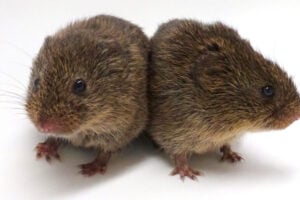
Prairie voles are highly social animals that form lifelong monogamous pairs and maintain peer bonds resembling human friendships. By studying the hormones that drive these bonds, scientists may gain insights into human social behavior and the disorders that interfere with forming close relationships.

The Love Hormone Shapes Who We Befriend

wasp or spider face?

Spider Mimicry Tricks AI Into Seeing Wasp Faces

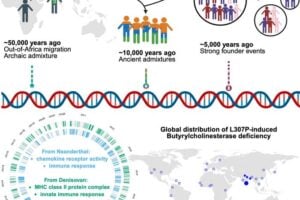
A new study shows that Indian ancestry goes back about 50,000 years, when early humans migrated out of Africa. Along the way, they interbred with Neanderthals and Denisovans—extinct human relatives—picking up genes that still affect our immune systems today. About 10,000 years ago, farmers from Iran and herders from Central Asia moved into India and mixed with local hunter-gatherers. Then, around 5,000 years ago, many communities began marrying within their own groups (endogamy), which caused genetic bottlenecks. This long and complex history has shaped the genetic diversity of India and continues to influence health and disease in the population.

India Harbors Half the World’s Neanderthal DNA

AI generated image of a colorful brain

Brain Grooves May Hold Key to Better Reasoning Skills

A pair of steelhead trout spawning in Peña Creek, a part of the Russian River watershed in Sonoma County. Will Boucher/California Sea Grant, via Flickr

A single dry winter decimated California’s salmon and trout populations

A steady diet of high-fat foods leads to reduced pleasure in eating, likely contributing to obesity. UC Berkeley scientists have discovered why, opening up new possibilities for treating obesity — not by fighting desire, but by restoring desire in a healthier way.

Scientists discover why obesity takes away the pleasure of eating

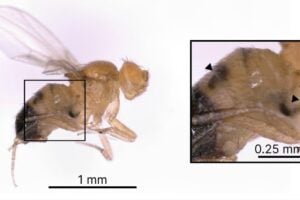
Fruit flies are typically vulnerable to parasitic wasps, but some have acquired a bacterial gene that grants them resistance. This adult Drosophila melanogaster has two dark, melanin-coated cysts in its abdomen, marking the remains of wasp eggs that the fly successfully neutralized.

Fruit Flies Steal Bacterial Genes to Fight Off Parasitic Wasps

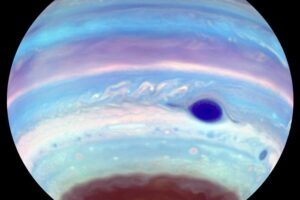
An artificially colored ultraviolet image of Jupiter reveals the Great Red Spot as a striking blue feature, while an oval of concentrated haze appears in the brown haze near the south pole. This dark oval, likely caused by mixing from a high-altitude vortex, mirrors similar but less frequent features seen at the planet's north pole.

Magnetic Tornadoes Stir Giant Dark Spots into Jupiter’s Polar Haze

Golden State Warriors guard Stephen Curry goes to the basket in front of Cleveland Cavaliers center Jarrett Allen, rear, and forward Isaac Okoro in the first half of an NBA basketball game on Friday, Nov. 8, 2024, in Cleveland. (AP Photo/Sue Ogrocki)

The Science Behind Why We Often Misread Information’s Importance

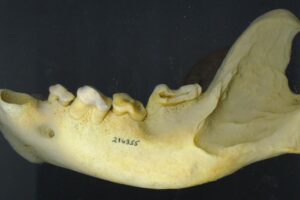
Example of Worn Hyena Jaw

How Ancient and Modern Predators Cope with Worn-Out Teeth

boy looking contrmplative

Exposing Kids to Misinformation Boosts Fact-Checking Skills

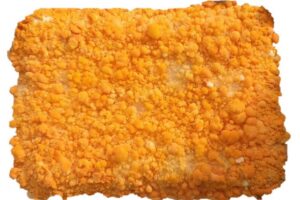
The East Javan food called oncom is made by growing orange Neurospora mold on soy pulp left over from making tofu. In about 36 hours, the soy pulp is turned into a tasty and nutritious food.

Can fungi turn food waste into the next culinary sensation?

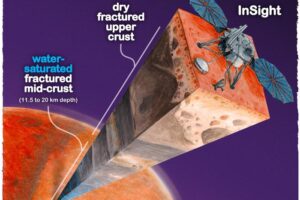
Here's a clearer version: An illustration shows the Martian interior beneath NASA's Insight lander. The top 5 kilometers of the crust seem to be dry, but a new study suggests there's a zone of fractured rock 11.5-20 kilometers below the surface that contains a significant amount of liquid water—more than what was thought to have filled ancient Martian oceans. (Illustration credit: J)

Hidden Martian Oceans: Vast Water Reserves Discovered Deep Below Surface

A very small baby

Infant Health Decline Linked to 2016 Election Stress, Study Finds

Older posts
Page1 Page2 … Page8 Next →
Substack subscription form sign up

Comments

  • John E on A New Theory Says DMT Entities Might Be Real, and Proposes How to Test It
  • Fully Whelmed on A New Theory Says DMT Entities Might Be Real, and Proposes How to Test It
  • Tom on The Serotonin Circuit That Makes Tinnitus Louder
  • Josh Mitteldorf on Red States and Blue States Are Becoming the Same Unhappy Country
  • Josh Mitteldorf on Scientists Have Written the Rules for First Contact, and Step One Is Don’t Panic
© 2026 ScienceBlog.com | Follow our RSS / XML feed