

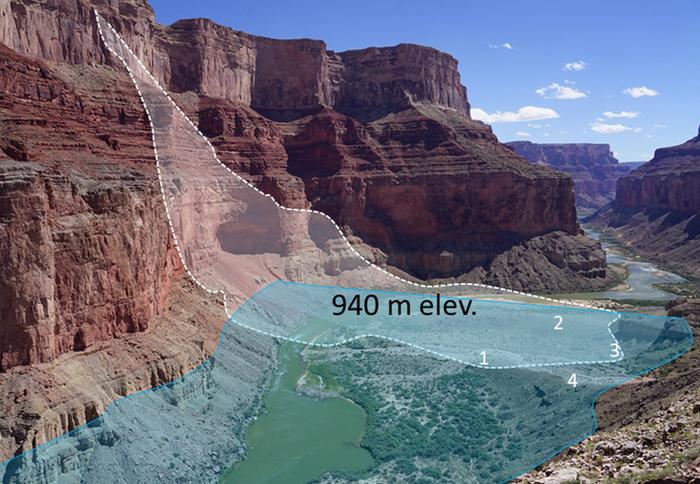
A meteor that slammed into Arizona 56,000 years ago didn’t just create the famous Meteor Crater—it may have shaken loose a colossal landslide that temporarily dammed the Colorado River and created a vast lake in the Grand Canyon.
Research published in Geology reveals a “striking coincidence” between the timing of the meteor impact and geological evidence of a massive rockfall that blocked one of America’s most iconic waterways.
The discovery connects two of the American Southwest’s most famous geological landmarks through a chain of catastrophic events that unfolded over centuries, offering new insights into how cosmic impacts can reshape entire landscapes.
A Geological Detective Story Decades in the Making
The story began in the 1960s when University of New Mexico researcher Thor Karlstrom discovered ancient driftwood deposits in caves high above the Colorado River—far too high for any known flood to have deposited them there. His son, Karl Karlstrom, now a distinguished professor emeritus, has spent decades solving this puzzle.
“It would have required a ten-times bigger flood level than any flood that has happened in the past several thousand years,” Karl Karlstrom explains. The alternative explanations seemed equally improbable: either these were impossibly ancient deposits or they had floated in from a paleolake created by some massive downstream obstruction.
The breakthrough came through advances in dating technology and an international collaboration sparked by a chance encounter. When researcher Jonathan Palmer from Australia visited both Meteor Crater and the University of Arizona Tree Ring laboratory on the same road trip, he noticed the remarkable similarity in ages between the crater and the mysterious driftwood.
Converging Evidence Across Time
Using cutting-edge dating methods from laboratories in New Zealand and Australia, the team established that the driftwood was deposited 55,250 years ago—remarkably close to the updated age estimates for Meteor Crater at 53,000-63,000 years old. Sediment samples dated using luminescence methods at Utah State University confirmed the timing at 56,000 years old.
The geological evidence paints a dramatic picture of the ancient catastrophe:
- Impact magnitude: The meteor created a seismic event equivalent to a magnitude 5.4 earthquake at the crater site
- Shock wave propagation: Seismic energy traveled 100 miles to Grand Canyon in seconds, still registering magnitude 3.5
- Massive rockfall: The Nankoweap landslide brought down enormous limestone boulders from canyon cliffs
- Temporary lake: The dam created a paleolake reaching 940 meters elevation, backing water up past modern-day Lees Ferry
The researchers found evidence that this ancient dam was eventually overtopped and eroded away, likely within 1,000 years—a geological instant.
Clues Hidden in Caves
The most compelling evidence lies in caves scattered throughout the Grand Canyon, some containing deposits that tell remarkable stories. In Vasey’s Paradise caves, researchers found beaver tracks in locations that would be completely inaccessible to beavers today—evidence that water levels once reached extraordinary heights.
Co-author Laurie Crossey notes how multiple research trips revealed the scope of the phenomenon: “From numerous research trips, Karl and I knew of other high-accessible caves that had both driftwood and sediment that could be dated.”
The cave deposits also contained archaeological treasures, including split-twig figurines made 3,000-4,000 years ago by ancestors of tribes who still live around the Grand Canyon, and fossils of extinct species like the California condor and Harrington’s Mountain goat.
Physics of Catastrophe
Could a meteor impact 100 miles away really trigger such a massive landslide? The physics suggests it’s entirely plausible. Co-author David Kring, who serves as science coordinator for Meteor Crater, calculated that the impact would have generated seismic waves powerful enough to destabilize the already precarious cliff faces of the Grand Canyon.
Grand Canyon’s steep walls are constantly shedding rock in smaller rockfalls, suggesting the geology was “waiting and ready to go” when the shock wave arrived. The impact timing aligns almost perfectly with evidence from multiple dating methods, creating what the researchers call a “narrow window of time at 55,600 ± 1,300 years ago.”
Scientific Collaboration Across Generations
The research highlights how scientific discoveries often span decades and involve multiple generations. From Thor Karlstrom’s initial cave explorations in the 1960s to his son Karl’s continued investigations, the project demonstrates the long-term nature of geological research.
The international collaboration proved crucial, with dating expertise from New Zealand and Australia laboratories providing the precision needed to establish the temporal connection. The convergence of radiocarbon dating, luminescence dating, and impact crater research created a compelling case for this ancient catastrophe.
While the researchers acknowledge they haven’t provided final proof—random rockfalls or local earthquakes could theoretically explain the landslide—the convergence of rare events in such a narrow timeframe strongly supports their hypothesis.
The study also underscores the ongoing hazards posed by meteorite impacts in regions with extreme topography, offering insights relevant to understanding seismic and landslide risks in similar landscapes worldwide.