

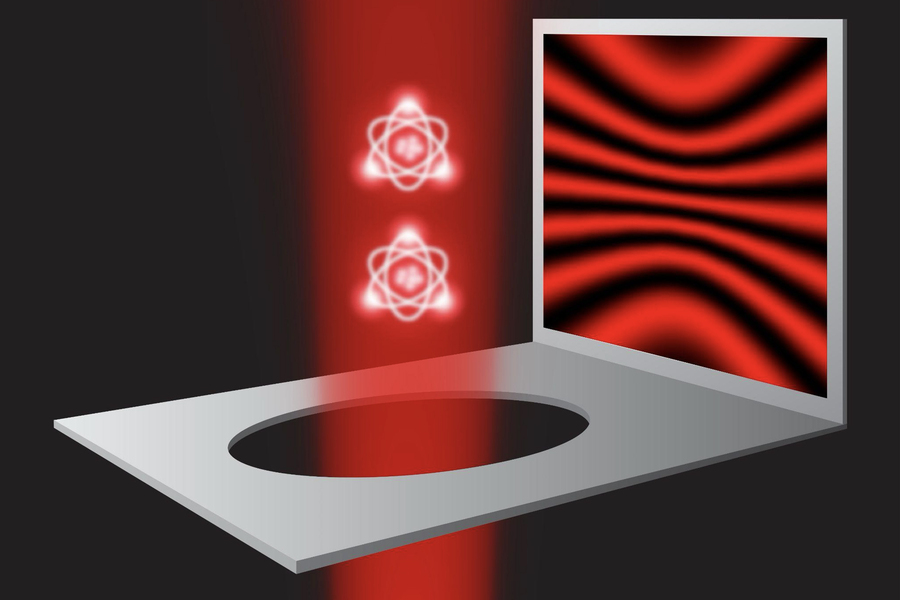
In a feat of atomic precision and quantum clarity, MIT physicists have pulled off the most idealized version yet of the famous double-slit experiment.
Using single photons and laser-cooled atoms as quantum-scale slits, the team confirmed what Einstein hoped wasn’t true: light really cannot behave as a particle and a wave at the same time. The findings, published in Physical Review Letters, revisit a century-old debate between Einstein and Niels Bohr and reinforce the strange rules at the heart of quantum physics.
Single Atoms, Single Photons, and a Centuries-Old Mystery
First devised by Thomas Young in 1801, the double-slit experiment revealed that light creates interference patterns like waves. But over time, quantum theory transformed the test into something much more peculiar. Shine a beam of light through two slits, and you get a wave pattern. Try to measure which slit the photon went through, and the pattern vanishes, and light acts like a particle instead.
In 1927, Einstein argued that a photon, acting as a particle, should nudge the slit it passes through, like a breeze rustling a curtain. If that nudge could be detected, he believed we could track the photon’s path without destroying the interference pattern. Bohr, in response, invoked the uncertainty principle: knowing the path would destroy the wave pattern. Turns out Bohr was right—and MIT just proved it with extraordinary control.
Atomic Slits: Replacing Metal With Matter
“What we have done can be regarded as a new variant to the double-slit experiment,” said Wolfgang Ketterle, MIT’s John D. MacArthur Professor of Physics, who led the study. “These single atoms are like the smallest slits you could possibly build.”
The researchers used over 10,000 ultracold atoms, arranged in a crystal-like lattice with laser light. Each atom was isolated enough to act as a distinct “slit,” and only one photon at a time was scattered. A highly sensitive detector recorded the scattered light to determine whether it behaved like a wave or a particle.
Tuning Quantum Fuzziness
To toggle light’s dual identity, the team adjusted the “fuzziness” of each atom’s position (its quantum uncertainty). A loosely held atom is fuzzier and more likely to record a photon’s path, pushing the system toward particle-like behavior. A tightly held atom is less fuzzy and doesn’t “know” where the photon went, preserving wave-like interference.
By tuning how much an atom was spatially confined, the physicists controlled whether the light produced interference stripes or particle-like dots on the detector. The results matched quantum predictions precisely.
- More path information (more fuzziness): less interference
- Less path information (tighter confinement): more interference
- Wave and particle identities of photons never seen simultaneously
What About Einstein’s Spring?
Einstein once imagined slits suspended on tiny springs. A passing photon might gently move one, offering a clue to its path. MIT’s team tested this idea too—then removed the “spring.” The atoms were briefly released from the laser trap and floated freely in a vacuum before falling under gravity. Even without the trap, the results were the same.
“In many descriptions, the springs play a major role. But we show, no, the springs do not matter here; what matters is only the fuzziness of the atoms,” said lead author Vitaly Fedoseev.
A Centennial Coincidence
The timing of the discovery is poetic. The year 2025 marks the 100th anniversary of quantum mechanics. The Einstein-Bohr double-slit debate took place in 1927. Now, a century later, quantum science is entering a new era of precision.
“Einstein and Bohr would have never thought that this is possible, to perform such an experiment with single atoms and single photons,” Ketterle said. “What we have done is an idealized Gedanken experiment.”
This research was supported by the National Science Foundation, the U.S. Department of Defense, and the Gordon and Betty Moore Foundation.
Journal Reference
Title: Coherent and Incoherent Light Scattering by Single-Atom Wave Packets
Authors: Vitaly Fedoseev, Hanzhen Lin, Yu-Kun Lu, Yoo Kyung Lee, Jiahao Lyu, Wolfgang Ketterle
Journal: Physical Review Letters
DOI: 10.1103/zwhd-1k2t
Published: July 22, 2025