


The Sun’s magnetic storms are far weaker than those of many other stars like it, and new research suggests our planets may be the reason. A team at the Helmholtz-Zentrum Dresden-Rossendorf (HZDR) has shown that the gravitational tides of Venus, Earth, and Jupiter not only synchronize the Sun’s magnetic cycles but also naturally suppress its most extreme activity. The work, published in Solar Physics, ties this influence to a short-period fluctuation called the quasi-biennial oscillation, or QBO, which appears to reduce the likelihood of devastating solar events.
Planets as Solar Pacemakers
For decades, scientists have noted that the Sun’s activity follows multiple overlapping cycles, including the familiar 11-year Schwabe cycle of sunspot peaks and lulls. The HZDR model treats the planets as pacemakers, delivering rhythmic tidal nudges that keep the Sun’s internal magnetic engine in step. Approximately every 11 years, the combined pull of Venus, Earth, and Jupiter aligns to amplify this effect.
Frank Stefani, lead author from HZDR’s Institute of Fluid Dynamics, explained, “All the solar cycles identified are a logical consequence of our model; its explanatory power and internal consistency are really astounding. Each time we have refined our model we have discovered additional correlations with the periods observed.”
The Quieting Effect of QBO
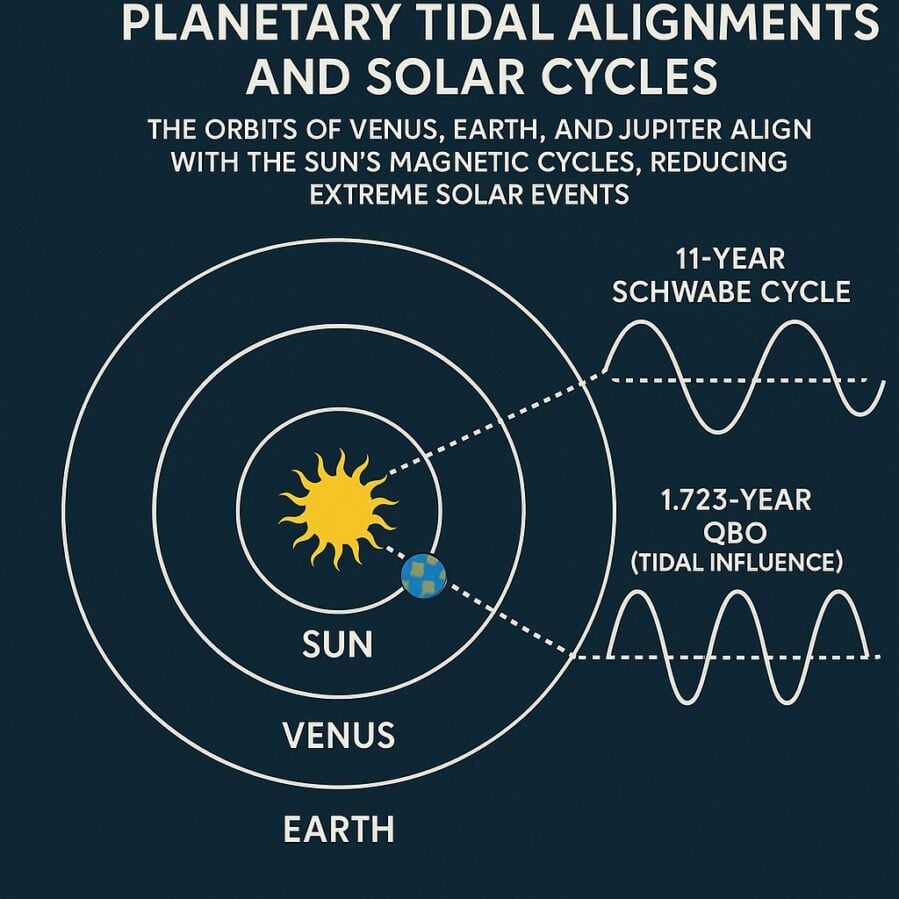
In the new work, the team focused on QBO, a roughly 1.723-year cycle in aspects of solar activity. This period matched both the model’s prediction and earlier observations of high-energy particle bursts known as Ground Level Enhancement (GLE) events.
While the Sun’s magnetic field ramps up and down over the 11-year cycle, QBO superimposes a faster oscillation that effectively shortens the time the Sun spends at maximum strength. This creates what scientists call bimodality in the field’s intensity, with two distinct peaks instead of one. “This effect is so important because the Sun is most active during the highest field strengths,” Stefani said. Fewer sustained peaks mean fewer opportunities for events like the 1859 Carrington storm, which lit skies as far south as Havana and disrupted telegraph systems.
Why a Calmer Sun Matters
Compared with other sunlike stars, the Sun’s largest flares are 10 to 100 times weaker. This quietness may be crucial for life on Earth. Intense solar storms can strip atmospheres, boost harmful radiation, and threaten electrical systems. The researchers suggest that the planetary tide–QBO connection could be part of why Earth has enjoyed a relatively stable, life-supporting environment.
- QBO period found: 1.723 years, closely matching observed 1.724 years in GLE data
- Planetary tides from Venus, Earth, and Jupiter trigger internal solar magnetic oscillations
- Shorter high-activity phases reduce probability of extreme geomagnetic storms
Looking Ahead
The team’s model links cycles from months to centuries, including the 193-year Suess-de Vries cycle, in a self-consistent framework. They note that while the tidal forces themselves are minuscule, they can resonate with large-scale magneto-Rossby waves inside the Sun, amplifying the effect. The next step is to confirm these results using more complex two- and three-dimensional solar dynamo models.
“This effect is so important because the Sun is most active during the highest field strengths. If the Sun’s magnetic field remains at lower field strengths for a significantly longer period of time, however, this reduces the likelihood of very violent events.”
Journal: Solar Physics
DOI: 10.1007/s11207-025-02521-0