

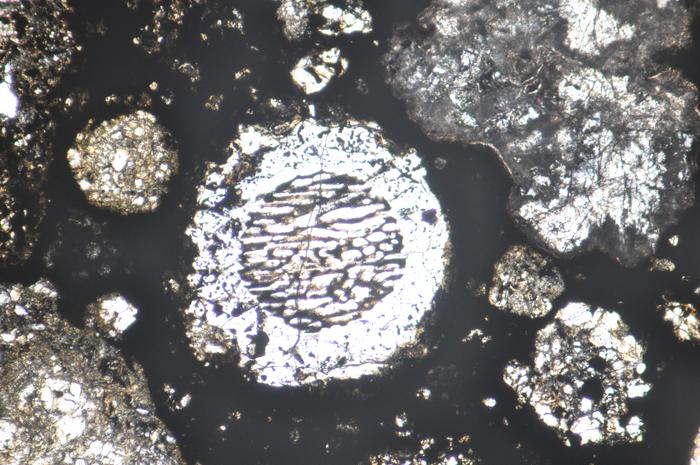
Molten raindrops of rock tell the story of Jupiter’s origin. Researchers at Nagoya University and the Italian National Institute for Astrophysics have shown that chondrules—tiny molten droplets preserved in meteorites—formed when Jupiter’s gravity drove violent collisions among early planetesimals. Their new study in Scientific Reports dates Jupiter’s birth to about 1.8 million years after the solar system began, providing the first direct planetary timestamp based on chondrule formation.
Molten Droplets as Time Capsules
Chondrules are round grains just 0.1–2 millimeters wide that make up much of the material in primitive meteorites. For decades, scientists puzzled over how these droplets formed and cooled so consistently. The new study shows that when water-rich planetesimals smashed into each other under Jupiter’s gravitational influence, steam explosions shattered molten rock into droplets that then cooled into chondrules. The evidence matches both observed sizes and cooling rates in meteorite samples.
“When planetesimals collided with each other, water instantly vaporized into expanding steam. This acted like tiny explosions and broke apart the molten silicate rock into the tiny droplets we see in meteorites today,” said Professor Sin-iti Sirono of Nagoya University (Nagoya University).
Simulations of Jupiter’s Growth
The team built computer simulations of Jupiter’s rapid growth and its gravitational stirring of nearby bodies. They found that the onset of runaway gas accretion by Jupiter coincided with a peak in chondrule production. Dr. Diego Turrini of INAF explained that meteorite data show this peak occurred 1.8 million years after calcium–aluminum-rich inclusions (CAIs) first formed, marking the start of the solar system. That means the molten raindrops date Jupiter’s formation with remarkable precision.
A New Method to Date Planet Formation
Because meteorites preserve chondrules of different ages, researchers believe Saturn and perhaps other giant planets also triggered collisions that produced droplets at later times. By tracing these ages, planetary scientists can reconstruct the sequence of planetary births in our solar system. The study also suggests that such violent processes likely occur in other planetary systems, offering insights into how giant planets shape their cosmic neighborhoods.
Key Findings
- Sample type: Chondrules from meteorites (0.1–2 mm spheres)
- Method: Computational simulations of planetesimal collisions and Jupiter’s gravitational influence
- Location: Early solar system asteroid belt region (2–4 AU)
- Finding: Jupiter’s runaway gas growth triggered high-speed collisions, producing molten droplets
- Date: Jupiter formed ~1.8 million years after the solar system began
- Implication: Chondrules provide a planetary timestamp, also relevant to other planetary systems
Takeaway
Tiny molten rock droplets preserved in meteorites reveal that Jupiter formed 1.8 million years after the solar system’s birth. By tracing these ancient time capsules, scientists can date giant planet formation and better understand how planetary systems evolve.
Journal: Scientific Reports
DOI: 10.1038/s41598-025-12643-x