

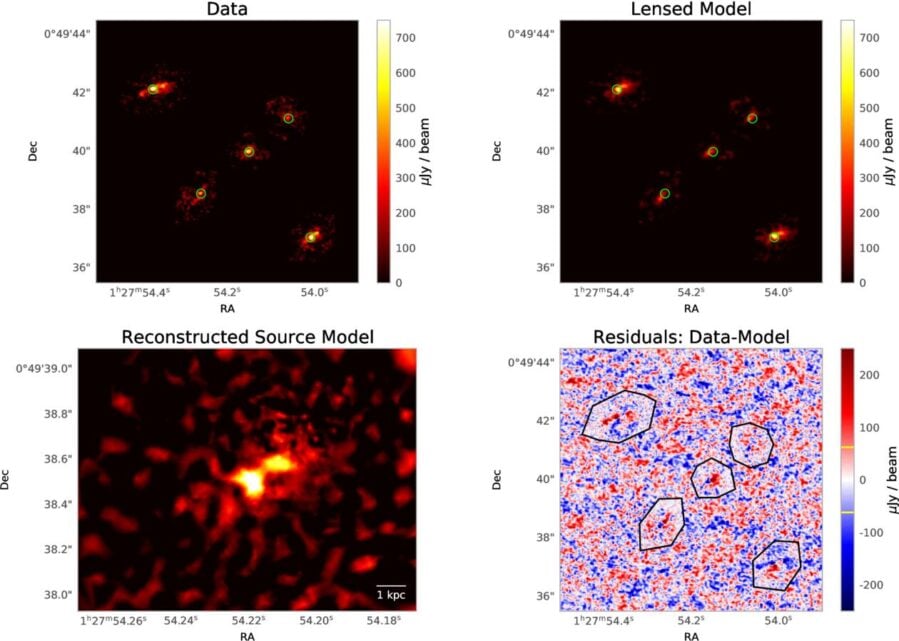
When French astronomer Pierre Cox first spotted something peculiar in radio telescope data from the Alps, his reaction was immediate. The images showed what looked like a cross pattern in space, but with an unusual twist – a bright spot glowing right in the center.
“We were like, ‘What the heck?’ It looked like a cross, and there was this image in the center. I knew I had never seen that before.”
That unexpected discovery has led to evidence of a massive dark matter halo hiding in plain sight, according to research published in The Astrophysical Journal. The finding represents the first time astronomers have detected an Einstein Cross – an already rare cosmic phenomenon – with five images instead of the typical four.
Einstein Crosses form when light from a distant galaxy bends around intervening massive objects, creating multiple images that appear as a cross-like pattern. But HerS-3, the galaxy at the center of this discovery, defied expectations by producing five distinct images arranged around a central point. The extra image suggested something unusual was warping spacetime in ways the visible galaxies alone couldn’t explain.
Charles Keeton, a theoretical astrophysicist at Rutgers University who helped analyze the data, immediately recognized the implications when his colleague Andrew Baker shared the unusual images.
“I said, well, that’s not supposed to happen. You can’t get a fifth image in the center unless something unusual is going on with the mass that’s bending the light.”
The team used radio telescopes including the Northern Extended Millimeter Array in France and the Atacama Large Millimeter Array in Chile to study the distant galaxy HerS-3, located about 25 billion light-years away. Initially, researchers thought the fifth image might be a data glitch, but repeated observations confirmed its reality.
Computer modeling revealed that the four visible galaxies causing the gravitational lensing couldn’t account for the complete five-image pattern. Only by adding a large, invisible mass – a dark matter halo – could the models match what telescopes were actually seeing.
Dark Matter’s Invisible Fingerprint
Dark matter makes up most of the matter in the universe, yet remains invisible to direct observation. Scientists can only detect it through its gravitational effects on visible matter and light. This discovery offers a rare opportunity to study such an invisible structure in detail.
The modeling work, led by graduate student Lana Eid and Keeton, showed that the mysterious fifth image could only be explained by including a massive dark matter halo located roughly 25 to 60 kiloparsecs southeast of the brightest visible galaxy in the lensing group. This halo contains between 10 billion and 130 billion times the mass of our sun.
The system acts like a natural laboratory for studying both the distant galaxy and the dark matter bending its light. The background galaxy, HerS-3, appears to be an active star-forming region viewed nearly edge-on, with powerful gas outflows moving at speeds of at least 350 kilometers per second. The lensing effect magnifies this galaxy by a factor of about 17 to 19 times, allowing astronomers to study its structure in unprecedented detail.
The discovery also demonstrates the value of international scientific collaboration. The research combined data from telescopes in France, Chile, and New Mexico, all supported by national science agencies. As Baker noted, such discoveries depend on continued funding for major astronomical facilities.
Beyond its scientific value, the HerS-3 system could serve as a cosmic timekeeper for measuring the expansion rate of the universe. The different light paths created by gravitational lensing introduce time delays between the images. If the background galaxy shows variability – perhaps from a supernova explosion – astronomers could track how long it takes for brightness changes to appear in each image, providing an independent measurement of the Hubble constant.
The team has already made predictions about additional features that should be visible in future observations, including extended outflowing gas that might create additional lensed images. These predictions provide testable hypotheses that could further validate or refine their model of this remarkable cosmic configuration.
For now, HerS-3 stands as a unique laboratory where invisible dark matter has revealed itself through its gravitational fingerprint, offering astronomers a new window into the hidden architecture of the universe.