

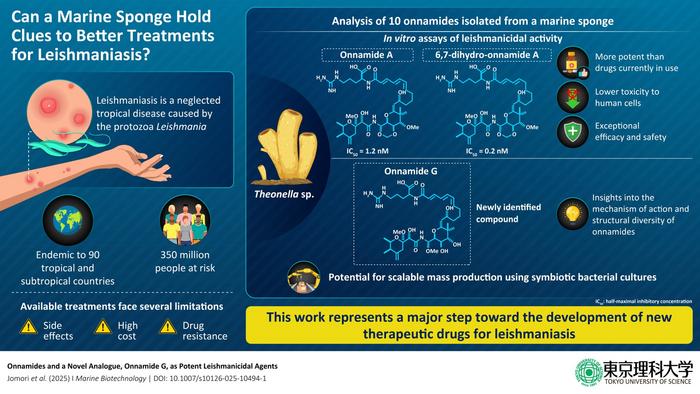
Deep beneath Okinawan waters, marine sponges harbor compounds that could transform treatment for a parasitic disease affecting 12 million people worldwide. Japanese researchers have discovered that natural chemicals called onnamides, extracted from Theonella sponges collected at Manza, show remarkable effectiveness against leishmaniasis, a tropical disease that causes devastating skin ulcers and permanent scarring.
The findings, published in Marine Biotechnology, represent a significant advance in addressing a health crisis that predominantly strikes the world’s poorest communities. Current treatments for leishmaniasis face severe limitations, including high toxicity, prohibitive costs, and growing drug resistance, leaving many patients unable to complete therapy.
Potent Natural Weapons
Associate Professor Kanami Mori-Yasumoto from Tokyo University of Science led the research team that isolated ten compounds from Okinawan marine sponges. Among these, onnamide A and 6,7-dihydro-onnamide A demonstrated exceptional potency against Leishmania major, the parasite responsible for skin leishmaniasis.
The most impressive discovery was 6,7-dihydro-onnamide A, which showed effectiveness at concentrations as low as 0.2 nanomolar (roughly 500 times more potent than amphotericin B, a current standard treatment). Unlike existing drugs that often damage healthy cells, these marine compounds demonstrated remarkable selectivity, sparing human cells while targeting the parasite.
“It may also be possible to apply these compounds to other protozoan diseases, such as Chagas disease and African sleeping sickness,” notes Dr. Mori-Yasumoto, highlighting the broader therapeutic potential of this discovery.
Laboratory tests revealed another crucial advantage: onnamide A appears to attack the parasite through a completely different mechanism than amphotericin B, which typically works by disrupting the parasite’s cell membrane. This novel approach could help overcome the drug resistance that increasingly plagues current treatments.
From Ocean Floor to Medicine Cabinet
The research team’s journey began with a systematic search through Okinawan marine biodiversity. They collected yellow-interior Theonella sponges from the same Manza location where onnamides were first discovered in 1988, then used bioassay-guided fractionation to isolate the most active compounds.
Beyond confirming known onnamides, the researchers identified a completely new compound, onnamide G, whose unique structure provides fresh insights into how these molecules might be modified for enhanced therapeutic effect. Structure-activity relationship studies revealed that subtle chemical modifications dramatically influenced the compounds’ effectiveness, with some variants showing 20-fold differences in potency.
The team also discovered an important clue about drug design: compounds retaining an arginyl amino acid group showed superior activity against leishmaniasis, contrasting with anticancer research where this chemical feature typically reduces effectiveness.
“The seas of Okinawa are home to abundant world-class biological resources. In this study, we discovered anti-leishmanial active compounds from marine sponges, treasures of the ocean, that have the potential to surpass existing drugs,” explained Dr. Junichi Tanaka from the University of the Ryukyus, emphasizing the significance of this Okinawan discovery.
The research faces practical challenges ahead. Onnamides have complex molecular structures that make chemical synthesis difficult and expensive. However, the team is exploring innovative production methods, including cultivating symbiotic bacteria that naturally produce these compounds—a strategy that could enable sustainable, environmentally responsible manufacturing.
Current efforts are being supported through Japan’s AMED Drug Discovery Booster program, which helps transform promising laboratory discoveries into viable medicines. The researchers must still demonstrate effectiveness in animal models and establish safety profiles before human trials could begin.
For the millions suffering from leishmaniasis (particularly in resource-poor regions where the disease thrives), this discovery offers genuine hope. The combination of exceptional potency, favorable safety profiles, and novel mechanisms of action positions onnamides as promising candidates for next-generation treatments.
As drug-resistant pathogens continue evolving worldwide, findings like these underscore the critical importance of exploring nature’s vast chemical library. The Okinawan research demonstrates that some of medicine’s most powerful future weapons might already exist, waiting to be discovered in the planet’s most remote ecosystems.