

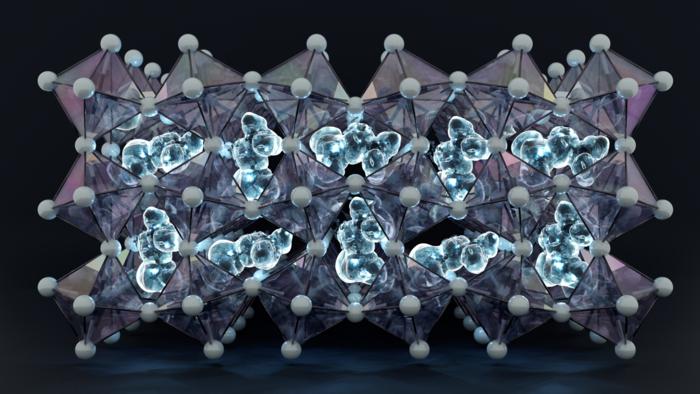
Swedish researchers have finally solved a puzzle that has stumped the solar energy community for years: understanding the true structure of a promising but temperamental material that could make solar panels thinner than paper and flexible enough to wrap around buildings.
Formamidinium lead iodide belongs to a family called halide perovskites, materials that absorb sunlight with remarkable efficiency but have confounded scientists with their unpredictable behavior. The compound shows exceptional promise for next-generation solar cells that could be painted onto surfaces or integrated into flexible electronics, yet researchers have struggled to understand why it becomes unstable at low temperatures.
A Material That Refuses to Behave
The mystery centered on what happens when formamidinium lead iodide cools down. Experiments consistently showed the material entering a disordered state around 140 Kelvin (minus 208 degrees Fahrenheit), but scientists couldn’t pin down the exact atomic arrangement. Some described it as “glassy,” others noted “crystallographically hidden disorder,” technical terms that essentially meant nobody knew what was really going on.
Julia Wiktor, an associate professor at Chalmers University of Technology who led the research, used a combination of computer simulation and machine learning to crack the case. Her team discovered that the material gets trapped in what amounts to a structural traffic jam during cooling.
“The low-temperature phase of this material has long been a missing piece of the research puzzle and we’ve now settled a fundamental question about the structure of this phase,” says researcher Sangita Dutta.
The breakthrough came from running simulations that tracked millions of atoms over timescales thousands of times longer than previous attempts. When the researchers virtually cooled the material, they watched its internal structure freeze into a metastable patter, stable enough to persist, but not the material’s true ground state.
Molecular Traffic Jam
The culprit behind this structural gridlock lies in the formamidinium molecules themselves. These organic components, which give the material its name, need to rotate and reposition as temperature drops. But the energy barrier for reaching the optimal arrangement is substantial, over 100 millielectron volts per molecule, according to the calculations.
“By combining our standard methods with machine learning, we’re now able to run simulations that are thousands of times longer than before. And our models can now contain millions of atoms instead of hundreds, which brings them closer to the real world,” Dutta explains.
Instead of reaching the thermodynamically preferred structure, the formamidinium molecules become frozen in place, creating what the researchers describe as an “orientational glass.” This phenomenon mirrors what happens when you rapidly cool molten glass, the atoms don’t have time to organize into their most stable crystalline arrangement.
To verify their computer predictions matched reality, the team collaborated with experimentalists at the University of Birmingham. They cooled actual samples to minus 200 degrees Celsius and used nuclear magnetic resonance spectroscopy to probe the atomic environment. The experimental data confirmed the simulation results, showing multiple distinct molecular environments rather than the uniform structure expected in a perfectly ordered crystal.
The findings help explain why formamidinium lead iodide has been so challenging to work with in practical applications. The material’s tendency to become trapped in metastable states affects its electronic properties and long-term stability, crucial factors for commercial solar cell development.
This research represents more than academic curiosity. Global electricity consumption is projected to exceed 50 percent of total energy use within 25 years, compared to 20 percent today. Meeting this demand sustainably requires more efficient energy conversion technologies, and halide perovskites remain among the most promising candidates for next-generation photovoltaics.
The ability to model these materials with unprecedented accuracy using machine learning opens new possibilities for engineering better perovskite compositions. Rather than relying on trial-and-error experimentation, researchers can now computationally screen millions of potential structures to identify the most promising candidates.
Understanding why formamidinium lead iodide gets structurally stuck also suggests strategies for preventing this behavior. Future work might focus on chemical modifications that lower the energy barriers for molecular reorganization, or processing conditions that help guide the material toward its optimal structure.
The research, published in the Journal of the American Chemical Society, demonstrates how computational tools are reshaping materials science. As Wiktor notes, simulation methods can now answer questions that were unresolved just a few years ago – a capability that becomes increasingly valuable as the push for sustainable energy intensifies.
For the solar industry, this represents a step toward taming one of the most promising yet unpredictable classes of materials. While commercial perovskite solar cells remain years away, understanding the fundamental physics of these materials brings that goal closer to reality.
Journal of the American Chemical Society: 10.1021/jacs.5c05265