

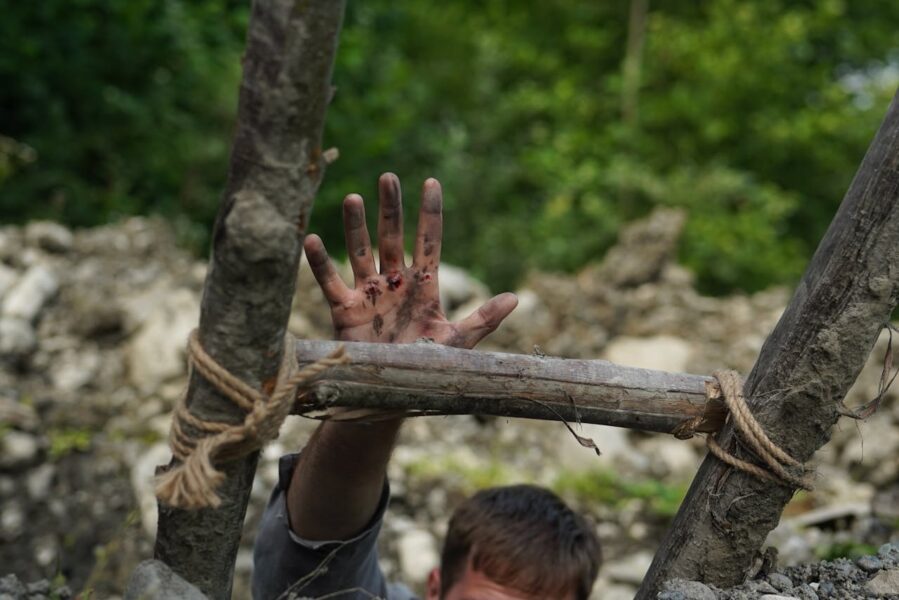
When a Ukrainian soldier takes shrapnel from a mine blast, every second counts. Now, artificial intelligence is making those seconds matter more than ever before, analyzing vital signs in real-time and directing scarce medical resources to those most likely to survive.
A new study analyzing 68 wounded soldiers reveals how Ukraine has quietly become a testing ground for AI-powered battlefield medicine. The technology isn’t just monitoring heart rates – it’s deciding who gets morphine first, designing custom prosthetic limbs with millimeter precision, and even driving autonomous vehicles into active combat zones when it’s too dangerous to send human medics.
“Although we don’t know the extent of improvement, there is clear, consistent, and robust evidence that AI led to faster identification of life-threatening injuries, faster arrival of supplies and drugs, and stronger rehabilitation outcomes,” said Dr. Evgeni Kolesnikov of Shupyk National Healthcare University of Ukraine in Kyiv, who will present the findings at the American College of Surgeons Clinical Congress in Chicago this week.
From Triage to Treatment
The soldiers wore an array of devices that sound like something from a science fiction film: electrocardiographs, multi-sensor vital patches, advanced smart helmets. But the real innovation wasn’t the hardware – it was what the AI did with the data streaming from those devices.
Consider the grim mathematics of battlefield triage. When supplies of tranexamic acid (a clot-promoting drug) or ketamine run low, who receives treatment first? AI algorithms now make those calculations instantly, weighing injury severity, vital signs, and survival probability. The system analyzes patients suffering from gunshot wounds and mine-explosive injuries, then prioritizes the limited drug supply accordingly.
The AI goes further still. It recommends optimal drug dosing for shock, pain, and infection by continuously analyzing each soldier’s vital signs. No more guessing about morphine quantities or waiting for a doctor’s assessment – the system provides real-time clinical decision support.
Beyond the Immediate Crisis
Perhaps more surprising is how AI has moved beyond emergency response into drug discovery and rehabilitation. The technology analyzed millions of chemical structures to identify compounds that could stop bleeding or accelerate wound healing in combat injuries. It even found existing anti-inflammatory drugs that could be repurposed to speed tissue regeneration after blast injuries.
For soldiers who lost limbs, AI transforms the entire prosthetics process. Using 3D imaging scans of damaged limbs, the system designs custom-fitted artificial components with millimeter-level precision. This matters enormously – poor fits lead to skin breakdown, chronic pain, and reduced quality of life. The AI optimization addresses these issues before they begin.
The system has also evolved to handle evacuation logistics. AI assesses terrain, identifies obstacles, and locates wounded soldiers, helping troops coordinate rescues. When the risk to human medics becomes unacceptable, ground vehicles equipped with autonomous navigation systems venture to the front lines instead.
Ukraine’s approach differs from a centralized AI brain. Instead, the military medical system uses multiple AI modules – for triage, route optimization, image interpretation – integrated through command-and-control platforms. Each module handles its specialty, but they coordinate through existing military infrastructure.
“AI does not replace doctors and surgeons, but expands their capabilities, reducing evacuation times, increasing the accuracy of diagnostics and surgical treatment, helping to save more lives with limited resources.”
Dr. Kolesnikov’s research shows how the role of AI in Ukrainian military medicine has evolved from limited practical use at the war’s beginning to comprehensive applications spanning evacuation, diagnosis, predictive analytics, and treatment. The technology now identifies biomarkers indicating poor healing, infection risk, or organ failure – catching problems before they become crises.
The study will be presented at the American College of Surgeons Clinical Congress, though it has not yet undergone full peer review. Still, the implications extend beyond Ukraine’s borders. As warfare increasingly involves sophisticated technology, the lessons learned on these battlefields may reshape military medicine globally – and perhaps civilian emergency care as well.
The research raises questions too. How much improvement has AI actually delivered? What happens when these systems malfunction under combat stress? And as autonomous vehicles and AI-driven triage become normalized, what role remains for human medical judgment in the chaos of war?
For now, those 68 soldiers represent early evidence that artificial intelligence can function not just in controlled hospital settings, but in the most uncontrolled environment imaginable: an active war zone where every decision carries life-or-death consequences.