
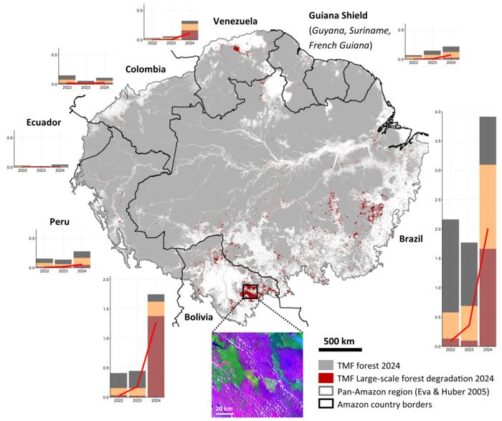
The Amazon rainforest just experienced something scientists didn’t see coming. In 2024, forest fires caused more carbon emissions than clear-cutting did for the first time on record, releasing roughly the equivalent of Germany’s annual emissions into the atmosphere and signaling what researchers are calling a dangerous new phase in the region’s ecological decline.
The shift represents a fundamental change in how the Amazon is being destroyed. While deforestation rates actually dropped 20% last year, fires tore through 3.3 million hectares of forest, an area larger than Belgium. These weren’t the massive conflagrations that make international headlines. Instead, they were what scientists call “degradation fires,” burning through the understory and killing trees without necessarily leveling entire forest stands.
The Hidden Threat
That invisibility makes them particularly insidious. From satellite imagery, degraded forests often appear intact, their canopy still visible from above. But on the ground, they’ve lost as much as 60% of their biomass. Unlike clear-cut areas that show up starkly in monitoring systems, these damaged forests often slip through the cracks of national accounting frameworks and international climate agreements.
The 2024 fires released an estimated 791 million tons of carbon dioxide into the atmosphere, which roughly equates to the annual emissions of Germany.
The European Commission’s Joint Research Centre, which published the findings today in the journal Biogeosciences, used an innovative approach to detect these fires. By combining data from the Tropical Moist Forest monitoring system with the Global Wildfire Information System and filtering out false signals from agricultural burning, researchers identified fire-driven degradation with unprecedented precision across the nine-country Amazon basin.
Bolivia bore the brunt of the destruction in relative terms. Nine percent of the country’s remaining intact forest burned last year, a staggering proportion for a region that has historically functioned as both a biodiversity reservoir and a carbon sink. Brazil, meanwhile, recorded its highest-ever emissions from forest degradation in absolute terms, accounting for 61% of the region’s total fire-related carbon release.
A Self-Reinforcing Cycle
The fires stem from a toxic combination of factors. The 2023-2024 drought shattered previous records, creating conditions that elevated both the likelihood and severity of fires. But human activity plays an equally critical role. Most Amazon fires aren’t natural, they result from “escape fires” that spread from recently cleared land or are deliberately set by land grabbers to facilitate future illegal deforestation.
What worries researchers most is the feedback loop now taking hold. Fragmented forests dry out faster. Dead trees from previous fires become fuel for future ones. Each fire makes the next one more likely and more severe.
Fire-driven forest degradation in the Pan-Amazon released 791 ± 86 Mt CO2 in 2024, a 7-fold increase compared to the previous 2 years, surpassing emissions from deforestation.
The ecological consequences extend far beyond carbon accounting. Degraded forests lose their ability to regulate local climate and weather patterns. Indigenous communities face respiratory health crises from smoke exposure and watch intact forest within their territories disappear. And because these forests may act as net carbon sources for up to 7 years after burning, the climatic damage compounds over time.
The researchers employed Monte Carlo simulations to estimate emissions and their uncertainties, following Intergovernmental Panel on Climate Change best practices. They accounted for variables including aboveground biomass density, combustion completeness, and the percentage of forest cover affected by fire. The resulting confidence intervals provide what they describe as a robust benchmark for tracking carbon consequences of tropical forest fires.
Past warnings about Amazon destruction focused almost exclusively on chainsaws and bulldozers. This study reveals that fire has become the more pressing threat, one that erodes forest integrity incrementally rather than eliminating it outright. The distinction matters for policy. International climate finance mechanisms and forest protection frameworks largely ignore degradation, focusing instead on preventing outright deforestation.
The study calls for immediate action: reducing fire use, strengthening forest protection policies, and supporting Indigenous stewardship efforts. It also highlights the need for enhanced monitoring systems that can detect and account for forest degradation, not just deforestation. Without such changes, researchers warn, current trends will push the Amazon toward a catastrophic tipping point that could trigger irreversible ecosystem collapse and accelerate global climate instability.
The 2024 fire season may represent a preview of the Amazon’s future under climate change. What was once a humid, fire-resistant ecosystem is becoming increasingly vulnerable to flames. Whether that transformation can be reversed depends on actions taken in the immediate term, before the feedback loops become impossible to break.
Biogeosciences: 10.5194/bg-22-5247-2025
ScienceBlog.com has no paywalls, no sponsored content, and no agenda beyond getting the science right. Every story here is written to inform, not to impress an advertiser or push a point of view.
Good science journalism takes time — reading the papers, checking the claims, finding researchers who can put findings in context. We do that work because we think it matters.
If you find this site useful, consider supporting it with a donation. Even a few dollars a month helps keep the coverage independent and free for everyone.