

Researchers have developed a new method for producing neodymium metal that could dramatically reduce costs while addressing critical supply chain vulnerabilities in the United States.
The so-called chloride molten salt electrolysis process skips two energy-intensive manufacturing steps and produces no harmful emissions, potentially transforming how America sources materials essential for electric vehicles, wind turbines, and defense systems.
The work, led by teams at Lawrence Livermore National Laboratory, Case Western Reserve University, and Ames National Laboratory, comes at a moment when China’s dominance over rare earth processing has become a pressing national security concern. In April 2025, China imposed export restrictions on seven rare earth elements, and subsequent expansions added five more elements with extraterritorial provisions requiring export licenses for products made anywhere if they contain Chinese materials or technologies. When Beijing tightened these controls, automakers including Ford and Suzuki faced immediate production disruptions.
Critical Materials in Strategic Crosshairs
Neodymium forms the backbone of the world’s most powerful permanent magnets. These magnets are required for key defense applications such as fighter aircraft and missile guidance systems, where they remain irreplaceable. The U.S. military currently consumes between 3,000 and 4,000 tons of rare earth magnets each year, with flagship platforms like the F-35 jet containing hundreds or thousands of pounds of rare earth materials. Approximately 78% of U.S. weapons programs depend on components using rare earth magnets.
The problem extends far beyond military hardware. In 2024, China exported 58,000 tonnes of rare earth magnets, enough to manufacture components for millions of cars or thousands of wind turbines. China now represents 94% of global permanent magnet production, up from 50% two decades ago. The country also controls about 60% of global rare earth mining and processes roughly 91% of the world’s supply.
Current U.S. capabilities remain minimal despite recent investments. MP Materials, operating America’s only rare earth mine at Mountain Pass, California, produced around 1,300 tons of neodymium-praseodymium oxide in 2024, less than 1% of the 300,000 tons of NdFeB magnets China produced that same year. Even with Department of Defense investments exceeding $439 million since 2020, plus a recent $400 million equity stake and $150 million loan to MP Materials, the United States remains far from meeting the DOD’s 2027 goal for a complete mine-to-magnet supply chain independent of China.
Reimagining the Production Process
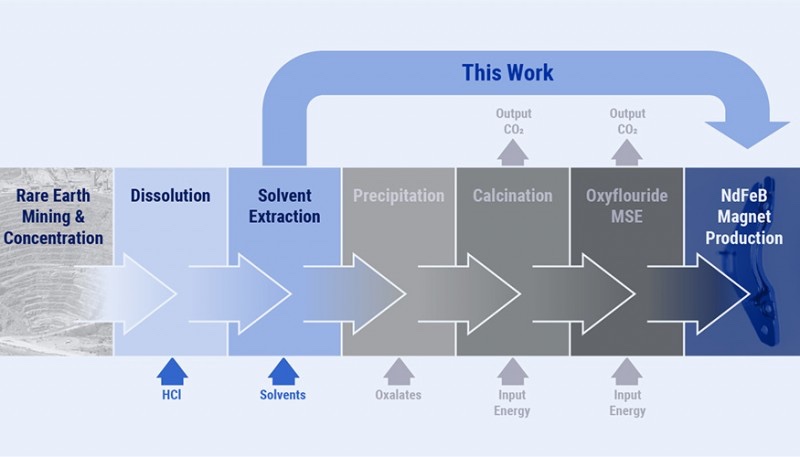
The traditional method for extracting neodymium involves oxyfluoride molten salt electrolysis, which operates at 1,050 degrees Celsius and produces perfluorocarbon gases as unwanted byproducts. These PFC emissions require incineration and generate hydrofluoric acid, creating significant health hazards for workers and environmental compliance challenges that have hindered domestic production.
The new chloride-based approach eliminates these problems entirely. Instead of using solid neodymium oxide as feedstock, the process starts with neodymium chloride dissolved in molten calcium chloride salts. An electric current separates the neodymium from chlorine gas, with the metal collecting at one electrode and chlorine at the other.
This seemingly simple substitution unlocks multiple advantages. The chloride salts have lower viscosity than fluoride melts, reducing electrical resistance and energy consumption. The carbon anode does not degrade during operation, enabling continuous processing instead of requiring periodic shutdowns for equipment replacement. Perhaps most significantly, the process can accept neodymium chloride directly from upstream separation facilities, eliminating costly precipitation and calcination steps that would otherwise convert the chloride to oxide.
The research team demonstrated the method could produce neodymium metal at 99.4% purity while consuming roughly 6 kilowatt-hours per kilogram, compared to 8 kWh/kg for conventional processing. Operating the system at high current densities of 15 amperes per square centimeter enables production rates far exceeding traditional methods, which typically operate around 1 A/cm2.
Critically, researchers at Ames National Laboratory used the electrowon metal to fabricate actual magnets with performance comparable to commercial N45-grade products, achieving a maximum energy product exceeding 40 MGOe. This demonstration proves the material quality meets industry standards for applications in electric vehicle motors, wind turbines, and defense systems.
The economic analysis suggests domestic production costs could drop from over $14 per kilogram using conventional methods to approximately $5 per kilogram. The largest savings come from eliminating the consumable graphite anode, which must be frequently replaced in traditional systems at a cost of $4.20 per kilogram of neodymium produced. Additional cost reductions stem from continuous operation, which reduces labor requirements by $0.60 per kilogram, and from using inexpensive calcium chloride instead of costly neodymium fluoride, which sells for over $180 per kilogram.
The research arrives as the United States races to rebuild domestic rare earth processing capabilities. MP Materials recently began commercial production of neodymium-praseodymium metal at its Independence facility in Fort Worth, Texas, with plans to produce approximately 1,000 metric tons of finished magnets per year starting in late 2025. The facility will supply General Motors and other manufacturers, sourcing raw materials from Mountain Pass, which produced a record 45,000 metric tons of rare earth oxides in 2024.
Still, the scale remains dwarfed by Chinese production. While American efforts represent important progress, China continues to dominate the global supply chain from mining through magnet manufacturing. Recent trade tensions and export restrictions have only underscored the vulnerability of industries dependent on these critical materials.
Whether the new electrolysis method reaches industrial deployment depends on continued development and scaling efforts. The research team at Case Western Reserve is working to expand the system design while Lawrence Livermore tests new electrode materials to further stabilize the anode. For an integrated, energy-efficient approach to become commercially viable, the technology must demonstrate consistent performance at industrial scales while maintaining the cost advantages shown in laboratory settings.
The collaboration demonstrates how national laboratories and universities can jointly advance manufacturing technologies critical to supply chain security. With global demand for neodymium magnets expected to triple by 2030 driven by electric vehicle adoption and renewable energy expansion, establishing domestic production capabilities has become both an economic opportunity and a strategic imperative.