

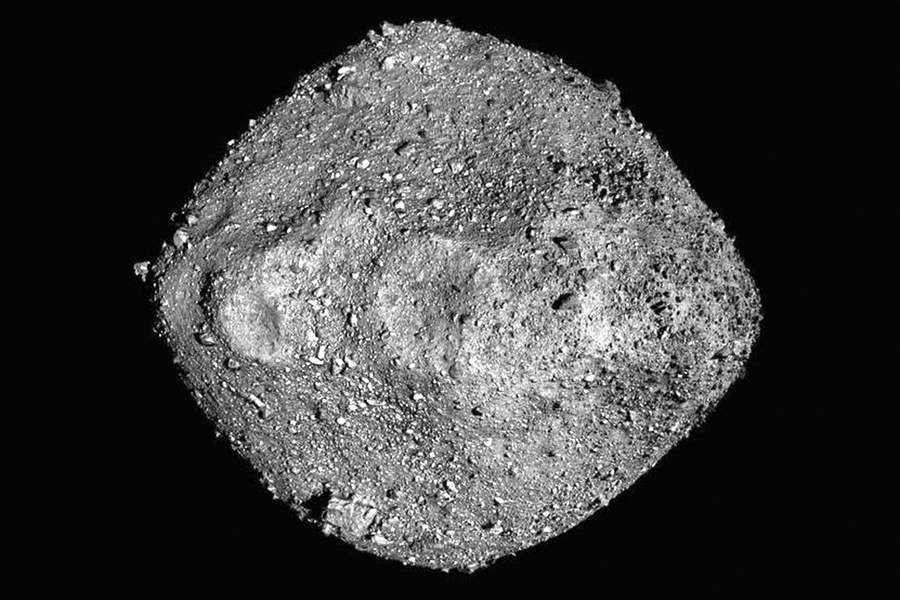
Material collected from asteroid Bennu shows that the molecular building blocks potentially necessary for life began forming in the deep freeze of our infant solar system, long before water existed in liquid form. The finding suggests complex organic chemistry got its start earlier and under colder conditions than scientists previously understood.
Scientists at UC Berkeley Space Sciences Lab, Lawrence Berkeley National Lab, and NASA identified nitrogen-rich compounds never before seen in nature while examining pristine samples returned by the OSIRIS-REx mission. The material reveals a chemical pathway that may explain how simple frozen gases transformed into the precursors of amino acids and other biological molecules.
Cryogenic Chemistry in Action
The discovery centers on thin organic films just a few micrometers thick, sandwiched between layers of minerals and carbonate crystals. These films contain extraordinarily high concentrations of nitrogen and oxygen compared to typical meteorite organics, with chemical signatures pointing to formation at temperatures far below water’s freezing point.
“This is the first evidence of organics forming on an asteroid in that brief period after the asteroids were first assembled but before they got hot enough for water to melt,” said Zack Gainsforth, a research scientist at the Space Sciences Lab and study co-author.
The process likely began when carbon dioxide and ammonia ices reacted in the frigid void to form ammonium carbamate, a compound that stuck to mineral surfaces and began polymerizing into water-insoluble films. This happened while water remained frozen solid, preserving chemical markers that would have been destroyed once liquid water appeared.
Reading Billion-Year-Old Chemical Records
Using infrared microscopy, X-ray spectroscopy, and electron microscopy, researchers found distinct layers in the organic material, each telling part of the story. The films contain amines, amides, and nitrogen-containing ring structures resembling components found in proteins and DNA. One sample showed a composition of three carbon atoms for every nitrogen atom and every oxygen atom, dramatically enriched in nitrogen compared to ordinary meteorite organics.
“It was amazing,” said NASA scientist Scott Sandford. “By studying microscopic grains of material, we were able to understand things that happened billions of years ago on a remote asteroid.”
The material survived because it polymerized before water melted, forming a protective coating resistant to dissolution. When liquid water eventually appeared and began altering minerals, it left additional markers like carbonate crystals embedded in the organic sheets, creating a readable record of multiple chemical stages.
The nitrogen isotopic signature measured in the samples differs markedly from other Bennu organics, supporting the conclusion that these compounds formed through different chemical processes at cryogenic temperatures. This type of kinetic fractionation favors light isotopes and occurs preferentially in extremely cold environments.
Asteroid Bennu is a rubble pile assembled from debris of several destroyed parent bodies. The oldest material appears to have come from a parent body with irregular composition, which proved essential for preserving the delicate chemical evidence. Researchers found the nitrogen-rich organics only in certain lithology types, suggesting they formed in regions where ammonia was particularly abundant relative to carbon dioxide.
The findings expand our understanding of how asteroids could have delivered prebiotic compounds to early Earth. The research demonstrates that carbamate chemistry, occurring naturally in frozen ices, can produce polymers containing molecular bonds like those in peptides and nucleobases.
“We had to travel billions of miles to get this stuff, and we went to extraordinary lengths to preserve and analyze it,” Gainsforth said.
The pristine samples, collected in September 2023 when OSIRIS-REx released its return capsule over Earth, avoided the contamination and weathering that affects meteorites. This allowed researchers to identify reactive organic phases that would not survive atmospheric entry or terrestrial exposure, providing an unprecedented window into chemistry from our solar system’s first few million years.