

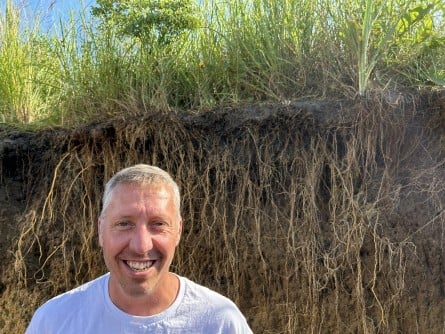
Iowa’s corn and soybean fields stretch to the horizon, an agricultural empire built on intensely managed dirt. For years, soil scientists assumed restoring degraded farmland would take generations, maybe centuries. The deep layers change too slowly, they thought. But new research from Iowa State University just blew that timeline apart.
The fix? Narrow bands of native prairie plants tucked right into the crop fields. These prairie strips, wildflowers and grasses that occupy maybe 10 percent of a field’s area, were originally planted to stop erosion and help pollinators. Turns out they’re doing something far more remarkable underground.
In just 10 to 12 years, according to a study published in the Journal of Soil and Water Conservation, the strips significantly improved eight out of 12 key indicators of soil health. The research team was genuinely shocked by how fast it happened.
Four measurements showed the most dramatic gains. Soil aggregate stability, which determines whether dirt washes or blows away, jumped up to 80 percent. Microbial biomass, the tiny living organisms that cycle nutrients, increased 54 percent. Soil organic matter, the foundation of fertile ground, climbed 23 percent. And the maximum water-holding capacity got a 7 percent boost, crucial when rainfall patterns keep shifting.
It was an exciting surprise to see the degree of these changes over just a decade or so, said Marshall McDaniel, associate professor of agronomy at Iowa State, who coordinated the study team.
Rethinking the Timeline
Scientists have long treated changes to organic matter and water-holding capacity as generational processes. This data tells a different story. While microbial biomass and organic matter started to plateau over time, aggregate stability and water-holding capacity kept climbing throughout the entire measurement period.
The team used what they call a paired chronoscope approach, essentially trading space for time. They examined 15 paired sites across Iowa, comparing strips that had been in place anywhere from two to 13 years. Each prairie strip site sat next to a control plot under the standard corn-soybean rotation, giving them clean before-and-after comparisons.
Picture this: you’re driving past an Iowa farm in late summer. One moment it’s all uniform rows of corn and beans. Then suddenly there’s this flowing ribbon of color cutting across the field, golds and purples and deep greens, like someone painted a wild streak through the grid. That’s a prairie strip. And underneath that visual contrast, something profound is happening.
The benefits spread beyond the strips themselves. Lead author Cole Dutter and his collaborators found that microbial communities shifted and enzyme levels rose several feet out into the adjacent cropland. The strips were pumping life back into the working farmland around them, without causing major yield drops.
Dutter, who’s moving to a faculty position at California State University, Stanislaus, plans to keep tracking these plots. He sees massive potential to scale up the approach.
Our related projects show that prairie strips are a relatively quick way to build soil health in the top of the soil profile.
Tools Farmers Can Actually Use
One of the more exciting aspects? The two biggest improvements, aggregate stability and water-holding capacity, are also the easiest for farmers to check themselves. No expensive lab work required.
Marshall McDaniel points out that farmers can measure aggregate stability using the free Slakes app from the Soil Health Institute. All you need is a smartphone and a small plastic dish. For water-holding capacity, a simple funnel and coffee filter will do the job.
Lisa Schulte Moore, who helped develop the STRIPS conservation practice, says some farmers are already thinking about rotating the strips after 10 years to spread the benefits around different parts of their fields. Early results from this rotation concept look promising.
The work, funded by groups including the Foundation for Food and Agriculture Research, offers a practical blueprint for making American farmland more resilient. One strip of perennial plants at a time, without waiting for your grandchildren to see the results.
Journal of Soil and Water Conservation: 10.1080/00224561.2024.2435683