

In the CBS sitcom “The Big Bang Theory,” fictional physicists Sheldon Cooper and Leonard Hofstadter spent several episodes scribbling equations on whiteboards, trying to figure out how fusion reactors might produce axions—hypothetical particles linked to dark matter. They couldn’t make it work. Now a real team of physicists says they’ve solved the problem the sitcom creators couldn’t.
Researchers from the University of Cincinnati, Fermilab, MIT, and Technion-Israel Institute of Technology have published a theoretical study in the Journal of High Energy Physics showing that future fusion reactors could double as powerful dark matter detectors. The key lies in exploiting something the TV physicists missed: the intense flood of neutrons that fusion reactions produce.
Dark matter makes up roughly 85 percent of the universe’s mass, but it’s never been directly observed. Scientists know it exists because its gravitational pull shapes how galaxies move and how the universe evolved after the Big Bang. One leading theory suggests dark matter consists of extremely light particles called axions or axion-like particles, which barely interact with normal matter.
What the Sitcom Got Wrong
The show’s fictional equations, briefly visible on whiteboards, referenced axions produced in the Sun. Jure Zupan, the University of Cincinnati physicist who led the new study, explains that approach hits a wall. Yes, the Sun produces vastly more particles than any Earth-based reactor, making solar axions theoretically easier to detect. But fusion reactors enable completely different production mechanisms.
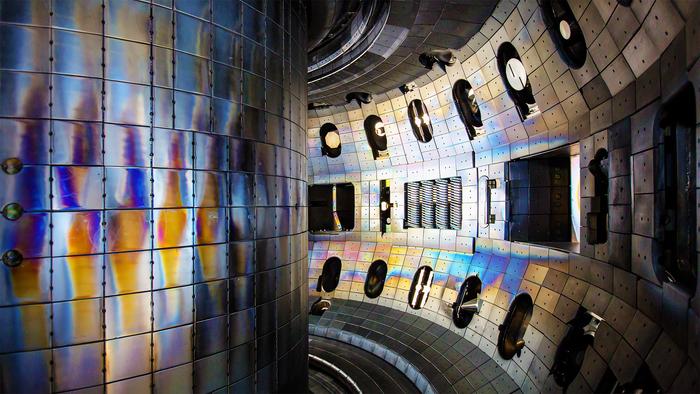
In deuterium-tritium fusion—the reaction planned for facilities like ITER in France—about 80 percent of the energy gets carried away by high-energy neutrons traveling at roughly 14 million electron volts. Those neutrons slam into the reactor’s inner walls, which are lined with lithium-rich “breeding blankets” designed to capture neutrons and generate more tritium fuel.
According to the study, those same neutron collisions could create dark sector particles through two pathways. When neutrons get absorbed by nuclei in the reactor walls, the excited nuclei can emit exotic particles instead of ordinary radiation as they relax. Neutrons also scatter and slow down through a process called bremsstrahlung, or “braking radiation,” which can produce axions.
“The general idea from our paper was discussed in ‘The Big Bang Theory’ years ago, but Sheldon and Leonard couldn’t make it work,” Zupan explains.
The neutron flux in a fusion reactor runs about 100 times stronger than in comparable fission plants, creating conditions where these hypothetical particles might be produced in detectable quantities. Unlike heat and light, which stay trapped inside the reactor, dark matter particles would pass through meters of steel and concrete as if the materials weren’t there.
Turning Energy Plants Into Physics Laboratories
To catch these ghost particles, the team proposes placing a detector near a large fusion facility. Their model uses a design similar to the Sudbury Neutrino Observatory: a giant tank filled with 1,000 tonnes of heavy water. When a dark particle from the reactor passes through, it could strike a deuterium nucleus and break it apart, creating a measurable signal.
The researchers calculate that year-long searches at future reactors could probe axion interactions beyond current experimental limits. The high energy of fusion neutrons provides the necessary “kick” to produce exotic particles in ways that older nuclear technology simply can’t match.
As the first generation of fusion reactors moves toward operation in the 2030s, these machines could serve dual purposes. While their primary mission remains creating clean energy for the electrical grid, adding dark matter sensors would let scientists probe fundamental physics at essentially no extra cost. The same technology built to replicate the Sun on Earth might also reveal what most of the universe is actually made of.
In other words, the machines designed to solve our energy crisis could simultaneously answer one of cosmology’s biggest questions—a solution the fictional physicists never quite reached.