
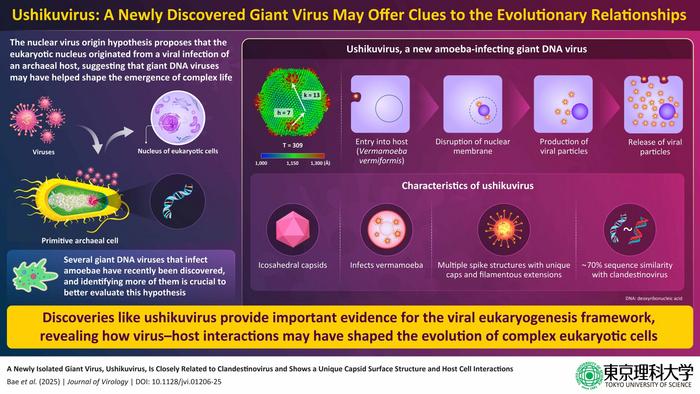
For decades, the origin of complex cells has felt like a settled story, tidy and comfortably cellular. But a newly discovered giant virus from a Japanese freshwater pond is reopening a far stranger possibility: that viruses helped build the first nuclei of complex life.
The virus, called ushikuvirus, was isolated from Lake Ushiku by researchers led by Masaharu Takemura at the Tokyo University of Science. Writing in the Journal of Virology, the team reports that this amoeba-infecting giant shares key traits with a small but provocative group of viruses blurring the boundary between viral and cellular worlds.
Ushikuvirus infects a single-celled organism called vermamoeba and carries a massive DNA genome spanning more than 660,000 base pairs, with 784 genes total. That size places it firmly among so-called giant viruses, a class discovered only in the past two decades that has forced biologists to rethink what viruses are capable of. More than half of its genes are “ORFans,” meaning they have no known relatives anywhere in biology.
Viral Factories That Remodel Cells From the Inside
What makes ushikuvirus especially intriguing is how it behaves once inside its host. Instead of simply hijacking cellular machinery and bursting the cell, the virus builds organized viral factories and ultimately disrupts the host’s nuclear membrane. It sets up its own production hub and remodels the cell from the inside out.
This behavior sets ushikuvirus apart from its closest relatives. Medusaviruses and clandestinoviruses replicate inside an intact nucleus. Ushikuvirus, by contrast, breaks the nucleus open and carries out replication in newly formed viral factories, a strategy seen in some of the largest known viruses.
Structurally, the virus also stands out. High-resolution imaging revealed a distinctive capsid surface decorated with unusual spike-like caps, some topped with filamentous extensions. These features aren’t seen in related viruses and may help explain why ushikuvirus infects a different amoeba host.
Another striking effect appears at the scale of the whole cell. Instead of shrinking or lysing, infected amoebae swell dramatically, sometimes doubling in size. That enlargement reflects a long, slow infection cycle. Rather than killing its host explosively, ushikuvirus exits more gently through exocytosis, releasing new particles gradually while managing the host’s resources over time.
An Uncomfortable Possibility About Our Cellular Ancestors
These details matter because ushikuvirus adds new weight to the viral eukaryogenesis hypothesis, an idea Takemura and others have championed for years. The hypothesis proposes that the nucleus of eukaryotic cells originated from an ancient large DNA virus that took up permanent residence inside a simpler host. In everyday terms, it suggests that one of the defining features of complex life may trace back to a long-term viral infection that never ended.
Ushikuvirus strengthens this idea by occupying an evolutionary middle ground. It shares core genes and structural traits with viruses that replicate inside the nucleus, yet it also behaves like viruses that dismantle the nucleus entirely. That combination hints at transitional forms that may have existed early in eukaryotic evolution.
“Giant viruses can be said to be a treasure trove whose world has yet to be fully understood. One of the future possibilities of this research is to provide humanity with a new view that connects the world of living organisms with the world of viruses,” Masaharu Takemura explains.
The virus also encodes a full set of histone proteins, the same molecular spools that package DNA in eukaryotic cells. While these viral histones may not function exactly like their cellular counterparts, their presence underscores how deeply intertwined viral and cellular evolution may be.
Beyond evolutionary theory, the discovery has practical implications. Some amoebae related to vermamoeba can cause rare but serious infections in humans. Understanding how giant viruses infect and disable these organisms could eventually inform new strategies to control them.
For now, ushikuvirus does something more fundamental. It unsettles the comforting notion that viruses are merely parasites on the tree of life. Instead, it suggests they may be woven into the trunk itself.
Journal of Virology: 10.1128/jvi.01206-25
ScienceBlog.com has no paywalls, no sponsored content, and no agenda beyond getting the science right. Every story here is written to inform, not to impress an advertiser or push a point of view.
Good science journalism takes time — reading the papers, checking the claims, finding researchers who can put findings in context. We do that work because we think it matters.
If you find this site useful, consider supporting it with a donation. Even a few dollars a month helps keep the coverage independent and free for everyone.