
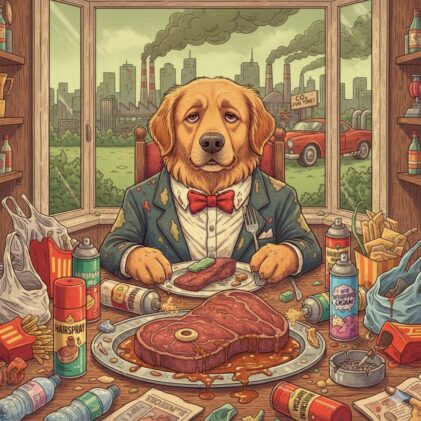
Many dog owners scrutinize their own diets for climate impact, then scoop premium food into a bowl without a second thought. That disconnect matters more than most realize. Researchers from the University of Edinburgh and the University of Exeter found that dogs fed meat-rich diets can generate a larger dietary carbon footprint than the humans who feed them.
The team analyzed nearly 1,000 dog foods sold in the UK and uncovered a staggering range. The highest-impact options were responsible for 65 times more emissions than the lowest-rated foods. Both meet a dog’s nutritional needs, but they sit at opposite ends of the climate spectrum. The culprit is prime meat, the same high-quality cuts that could otherwise be eaten by humans. Foods relying on nutritious carcass parts or by-products that aren’t in demand for human consumption keep the environmental impact in check.
Overall, ingredients used in UK dog food account for about one percent of the country’s total greenhouse gas emissions. That might sound modest, but it rivals emissions from entire economic sectors. When the researchers scaled up their results globally, the implications grew starker. Producing enough food of the types currently fed to UK dogs for the world’s 700 million dogs could generate emissions equivalent to more than half of those from commercial aviation annually.
The Hidden Cost of Premium Trends
The team used a sophisticated model to reverse-engineer recipes by examining nutrient labels and ingredient lists. Their findings show that “premium” doesn’t mean planet-friendly. Dry food that includes grains generally had much lower environmental impact than wet, raw, or grain-free alternatives. As pet ownership climbs and owners embrace diets that prioritize human-grade meat while eliminating grains, we’re inadvertently increasing our pets’ carbon pawprints.
“As a veterinary surgeon working on environmental sustainability, I regularly see owners torn between ideals of dogs as meat-eating ‘wolves’ and their wish to reduce environmental harm. Our research shows just how large and variable the climate impact of dog food really is.” – John Harvey, University of Edinburgh
The study highlights a clear trade-off. Foods marketed as grain-free, wet, or raw consistently scored higher for emissions than standard dry kibble. For owners who aren’t ready to swap their dog’s steak for soy, there’s a middle ground. Checking labels for descriptions of meat cuts and opting for foods with lower prime meat content can make a difference without changing the dog’s preferred food type.
What Labels Don’t Tell You
Current labels can be vague, making it difficult for even well-intentioned owners to know exactly what kind of meat is in the bag. The researchers are calling for better transparency in the pet food industry. Clearer labeling and a shift toward ingredients that don’t compete with the human food supply are essential steps for a sustainable future.
Plant-based dog foods showed promise for reducing emissions, though only a small number were available for testing. In everyday terms, feeding dogs isn’t just about protein percentages or marketing claims. It’s about choosing between ingredients that quietly drive emissions up or down. Checking whether a food relies more on prime meat or on lower-demand carcass parts can make a meaningful difference. For many households, the takeaway is uncomfortable but clarifying: the most effective way to shrink a pet’s environmental footprint may simply be a return to the basics, a reliable bag of dry kibble that makes use of the whole animal.
Journal of Cleaner Production: 10.1016/j.jclepro.2025.147277
ScienceBlog.com has no paywalls, no sponsored content, and no agenda beyond getting the science right. Every story here is written to inform, not to impress an advertiser or push a point of view.
Good science journalism takes time — reading the papers, checking the claims, finding researchers who can put findings in context. We do that work because we think it matters.
If you find this site useful, consider supporting it with a donation. Even a few dollars a month helps keep the coverage independent and free for everyone.