

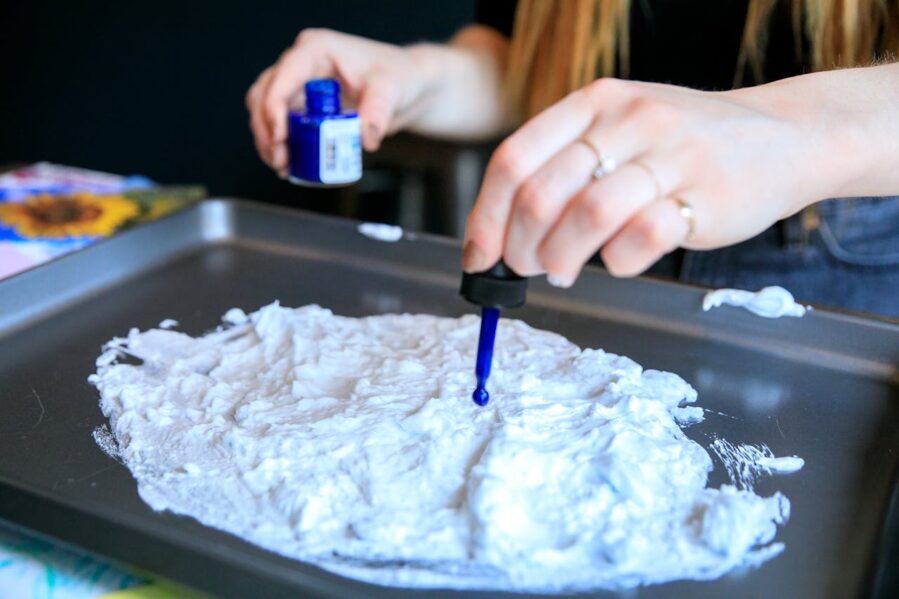
Hold shaving cream in your palm. Feels solid, right? It isn’t. Inside, bubbles are constantly drifting through countless arrangements, never settling down.
Engineers at the University of Pennsylvania just figured out that this restless motion follows the same math that trains artificial intelligence. The study, published in Proceedings of the National Academy of Sciences, suggests learning-like behavior emerges naturally in physical systems that refuse to sit still.
For decades, physicists treated foam like glass at the microscopic level. Bubbles were supposed to get trapped in static, disordered spots and stay there. The new work shows that’s wrong.
Glass Doesn’t Wander
Classical theories said foam bubbles roll downhill into low-energy valleys and stop. Once they found a stable spot, done. That explained why foam feels solid when you squeeze it.
The data never fit. John C. Crocker, a professor of chemical and biomolecular engineering at Penn Engineering, says the discrepencies have been visible for years. Foams constantly reorganize themselves, even while holding their overall shape.
Using computer simulations of wet foam, the Penn team tracked bubble motion over long periods. The bubbles kept wandering through many possible configurations. Never frozen.
What finally made sense of that motion was a framework borrowed from deep learning. In AI training, algorithms adjust millions of parameters, moving through a vast landscape of possible solutions. Early approaches tried pushing models into the deepest minimum. Researchers later learned that staying in broader, flatter regions produces systems that actually work better.
“The key insight was realizing that you dont actually want to push the system into the deepest possible valley,” Robert Riggleman explains. “The best AI models stay in flatter, more flexible regions of their mathematical landscape.”
What Else Is Quietly Learning?
When the Penn researchers viewed foam through that lens, the parallel became striking. Like modern AI systems, bubbles don’t sink into the deepest valleys. They keep exploring flatter regions where many configurations look similar.
The foam behaves less like something stuck and more like something gently searching. Always adjusting, never finished.
The implications reach beyond soap suds. Crocker’s group originally turned to foams to understand the cytoskeleton, the microscopic scaffolding inside living cells. Like foam, it must keep rearranging while preserving overall structure.
If the same mathematics governs bubbles, neural networks, and cellular structures, then learning-like dynamics may not be exclusive to brains or machines. They may be a general way complex systems stay adaptable without falling apart.
The study leaves an unsettling question. How many other systems we think are static are quietly learning all the time?
Proceedings of the National Academy of Sciences: 10.1073/pnas.2518994122