

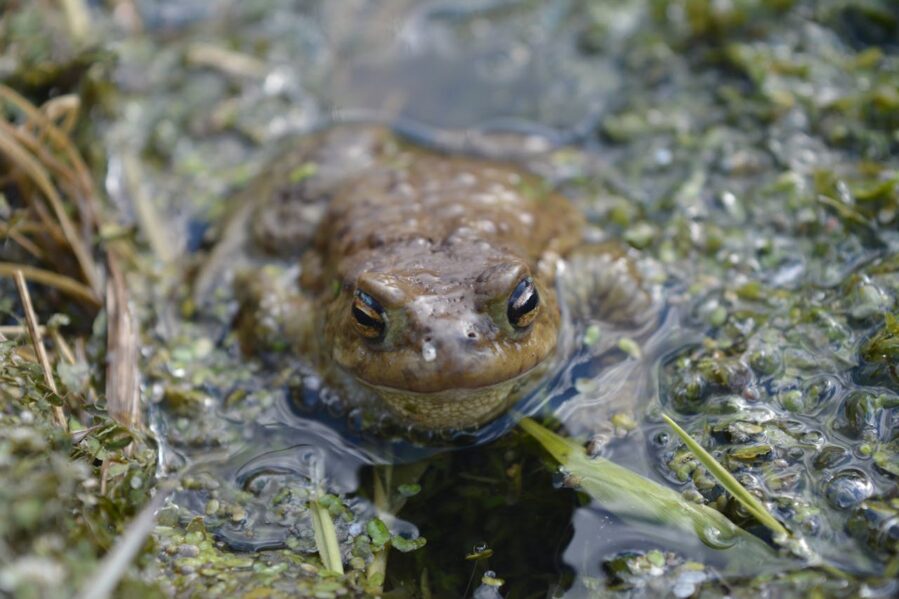
The bullfrog farms of Brazil looked innocuous enough, nothing but ponds and concrete tanks scattered across São Paulo state. But beneath the water’s surface lurked something far more dangerous than the amphibians themselves: a deadly fungal hitchhiker that would hop its way across continents.
In 2012, Luisa Ribeiro and her colleagues at the State University of Campinas detected Bd-Brazil, a strain of the chytrid fungus Batrachochytrium dendrobatidis, in farmed bullfrogs. The fungus, which causes the disease chytridiomycosis, has devastated amphibian populations worldwide, contributing to the decline of at least 500 species. But where this particular genetic lineage originated sparked fierce scientific debate. When it turned up in South Korea two years later, some researchers suspected it had travelled westward from Asia, not eastward from Brazil. The fungus was even renamed Bd-Asia-2/Bd-Brazil to reflect this uncertainty.
Now Ribeiro and an international team have assembled a compelling case that Brazil was indeed ground zero. The strain shows high prevalence in different native Brazilian species, with very old records. When you look elsewhere, the records are much more recent and occur only in bullfrogs and other exotic species.
The evidence, published in Biological Conservation, reads like a detective story spanning centuries and continents. The researchers examined 2,280 amphibian specimens from museum collections worldwide, some dating back to 1815. They combined this archival work with genotyping of modern farm samples, genetic analysis of bullfrogs sold in international markets, and painstaking reconstruction of historical trade routes.
What emerged was a pattern. Bd-Brazil appeared in Brazilian native frogs as early as 1916, two decades before North American bullfrogs were first introduced to the country in 1935. Museum specimens of Megophrys goeldii, a species endemic to Rio de Janeiro, tested positive for the fungus from as far back as 1964. The strain crops up in at least ten wild Brazilian species that appear to tolerate it without developing disease, suggesting long-term co-evolution between pathogen and host.
Outside Brazil, the story looks different. Bd-Brazil shows up in bullfrogs at US markets in 2009, in South Korea in 2014, and possibly in Japan—always in the same host species, always more recently, and rarely (if ever) establishing in native amphibians. In Brazil, the strain is present both in frog farms and in the wild. Elsewhere, it’s essentially limited to commercial frogs and invasive populations.
The international bullfrog trade provided the perfect vector. Brazil ranks among the world’s leading producers, and bullfrogs are uniquely suited as fungal carriers. They’re remarkably tolerant of chytridiomycosis. Infected animals can survive and thrive whilst harbouring infectious spores. They’re also the only amphibian species legally farmed in Brazil, making them the sole legitimate pathway for exporting the pathogen.
To map the fungus’s journey, the researchers reconstructed trade networks from Convention on International Trade in Endangered Species records and US Fish and Wildlife import data. They identified 3,617 trade routes involving 48 countries between 1970 and 2024. A few nations—the United States, Taiwan, the Dominican Republic, Ecuador, China—dominate the network. Brazil exported directly to the US between 1991 and 2009, and the US subsequently shipped bullfrogs to South Korea in 2004 and 2008.
The genetic evidence bolsters this scenario. When the team sequenced mitochondrial DNA from bullfrogs at Brazilian farms, US retail shops, and Taiwanese operations, they found telling patterns. Taiwanese farm frogs shared genetic signatures with invasive bullfrog populations across Asia and with animals sold in US markets. Another cluster included Brazilian farm frogs, US market specimens, and invasive populations in Brazil, Cuba, China, and the Korean Peninsula. Most strikingly, the bullfrog from which Bd-Brazil was first isolated, purchased at a Michigan market in 2009, belonged to a lineage matching Brazilian farm animals.
The farms themselves may be amplifying the problem. In samples from six Brazilian facilities, Ribeiro’s team found Bd-Brazil in roughly half the tested frogs—far more prevalent than the globally distributed Bd-GPL strain. Farming conditions may favour this lineage, though whether through selective advantage or simply high host density remains unclear. What’s certain is that farms use untreated pond water, creating opportunities for pathogens to move between captive and wild populations.
The stakes extend beyond one fungal strain. Batrachochytrium dendrobatidis comprises multiple genetic lineages, including the devastating Global Panzootic Lineage that likely emerged from Asia in the mid-20th century. Understanding where these variants originate and how they spread is crucial to preventing future die-offs. Yet genotyping historical specimens remains technically challenging—DNA degrades over time, contamination is difficult to avoid, and most museum samples yield only presence-absence data, not strain identification.
The researchers acknowledge that sampling biases constrain their conclusions. The Americas, and particularly Brazil, have been studied far more intensively than Asia, where key lineages may have gone undetected. Even after accounting for sampling effort, however, detection rates in Central and South America consistently outpace those in Asia. The earliest confirmed Bd infections worldwide come from Bolivia in 1863, the United States in 1888, and Brazil and Mexico in 1894—all in the Americas.
What the study makes clear is that amphibian trade continues largely unregulated. Import controls, pathogen screening, and proper quarantine protocols remain spotty or non-existent in many countries. Environmental DNA techniques offer promise for non-invasive detection, but they’re not yet widely implemented in commercial operations.
The bullfrog itself—that introduced North American species thriving in Brazilian ponds since the 1930s—has become an unwitting ambassador for disease. Farmed for its meat, traded globally, tolerant of infection, it moves between continents carrying passengers that native amphibians have no defence against. And whilst Bd-Brazil appears less virulent than some of its fungal cousins, its presence in international commerce demonstrates how easily pathogens can piggyback on the animal trade.
As climate change, habitat loss, and disease continue pressuring amphibian populations worldwide, unravelling the history of these threats takes on fresh urgency. The chytrid fungus isn’t going away. Understanding where it’s been may help predict where it’s headed next—and give us a fighting chance to stop it before more species blink out of existence. For now, the evidence suggests that in this particular mystery, the culprit didn’t travel east from Korea. It hitched a ride west from Brazil, one bullfrog shipment at a time.