

Spit into a tube, and you might be revealing more about your brain than you’d think. Researchers collecting saliva from 68 people with schizophrenia have found something unexpected: the community of bacteria living in their mouths seems to be linked to how well they can think, reason and remember.
It’s an odd connection. The mouth and brain are obviously pretty different places, and schizophrenia (with its hallucinations and fractured thoughts) doesn’t seem like the sort of condition you’d expect to have anything to do with oral hygiene. But Takehiro Tamura at Institute of Science Tokyo reckons there’s more going on. “Host–microbiome interactions are not limited to the gut,” he says. “Like the gut microbiota, the oral microbiota also participates in such interactions. Its significance in systemic and neurological conditions has become increasingly recognized.”
That’s perhaps putting it mildly. For years, scientists have suspected the gut’s teeming microbial community might influence psychiatric conditions, possibly through inflammation or by producing chemicals that affect the brain. But the mouth? That’s been rather overlooked. Until now, anyway.
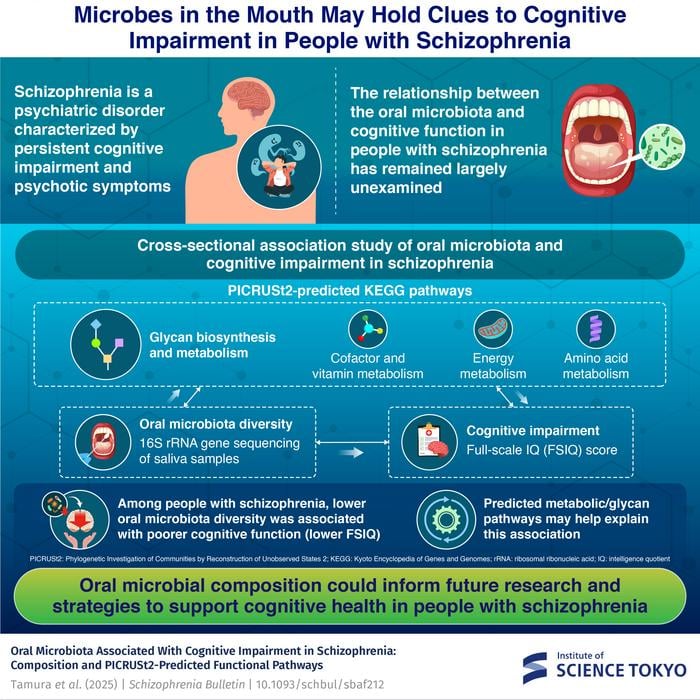
Tamura and his colleagues compared people with schizophrenia to 32 healthy individuals, analysing saliva samples and scores on cognitive tests. What they found was striking in its simplicity: patients with schizophrenia had less diverse bacterial ecosystems in their mouths. And within the schizophrenia group, those with even lower microbial diversity tended to score worse on tests measuring overall cognitive ability – things like problem-solving, memory, and processing speed.
The bacterial imbalance wasn’t subtle. People with schizophrenia showed a higher ratio of Streptococcus bacteria to Prevotella, along with shifts in other bacterial groups. It’s a bit like a garden where one plant has taken over at the expense of others. When that happens, you lose the complex interactions that keep an ecosystem functioning properly.
But here’s where it gets interesting (and more speculative). Using a computational tool called PICRUSt2, the researchers predicted what these bacterial communities might be doing metabolically. They found that certain microbial pathways – particularly those involved in glycan biosynthesis, energy metabolism, and producing essential cofactors – seemed to correlate with better cognitive performance. In other words, it might not just be about having diverse bacteria, but about what those bacteria are actually up to in your mouth.
The team had initially thought inflammation might be the key link. The kynurenine pathway, a metabolic process often used as a proxy for neuroinflammation, seemed like an obvious suspect. But the data didn’t support it – at least not in this study. That pathway showed no significant association with the oral microbiota-cognition connection, which is slightly disappointing but also tells you something. Science rarely goes exactly where you expect it to.
Of course, there are caveats here. This is what’s called a cross-sectional study, meaning the researchers took a snapshot in time rather than following people over years. They can’t say whether the microbial changes cause cognitive problems, whether cognitive decline somehow alters mouth bacteria, or whether some third factor influences both. The functional predictions from PICRUSt2 are computational guesses based on bacterial DNA, not direct measurements of what’s happening.
And yet. The connection is there, consistently showing up in the data. “In people with schizophrenia, lower oral microbiota diversity was associated with poorer cognitive performance, and certain metabolism- and glycan-related functional pathways (PICRUSt2-predicted) were suggested to be potentially involved in this relationship,” Tamura explains.
The implications, though, are rather tantalising. If further research confirms a causal link, the mouth becomes an accessible window into brain health, and potentially a target for intervention. Could better oral hygiene or targeted probiotics help preserve cognitive function in schizophrenia? It’s far too early to say, but the possibility is intriguing enough to warrant serious investigation. “This study offers a new perspective on the oral–brain axis and lays a foundation for future mechanistic studies and intervention research, the latter including studies of oral hygiene measures, prebiotics, and probiotics,” Tamura adds.
Roughly 20 million people worldwide have schizophrenia, and many struggle with cognitive impairments that aren’t addressed by current antipsychotic medications. The medications can reduce hallucinations and delusions, but they do little for the difficulty concentrating, planning, or maintaining social connections. If manipulating oral bacteria could make even a small difference to these cognitive challenges, it would matter.
The mouth-mind connection. Who would have thought that the bacteria living on your teeth and tongue might somehow be chatting with your brain? Not chatting, exactly, but perhaps influencing it in ways we’re only beginning to understand. The research is still early, still generating hypotheses rather than proving mechanisms. But in a way, that’s what makes it compelling. We’re watching scientists piece together a biological puzzle that cuts across traditional boundaries between dentistry, psychiatry, and microbiology.
Next steps involve longitudinal studies (following people over time to see how changes in oral microbiota relate to changes in cognition). Experimental work, too, testing whether interventions that alter mouth bacteria actually improve cognitive symptoms. Maybe they will, maybe they won’t. Either way, we’ll learn something about how our bodies work as integrated systems rather than separate compartments.
Somewhere in the complex chemical conversations between mouth bacteria and human cells, there might be clues to protecting the mind. Brush your teeth, save your cognition? It’s not quite that simple, but the story is unfolding in interesting directions.
Study link: https://academic.oup.com/schizophreniabulletin/advance-article-abstract/doi/10.1093/schbul/sbaf212/8346069