

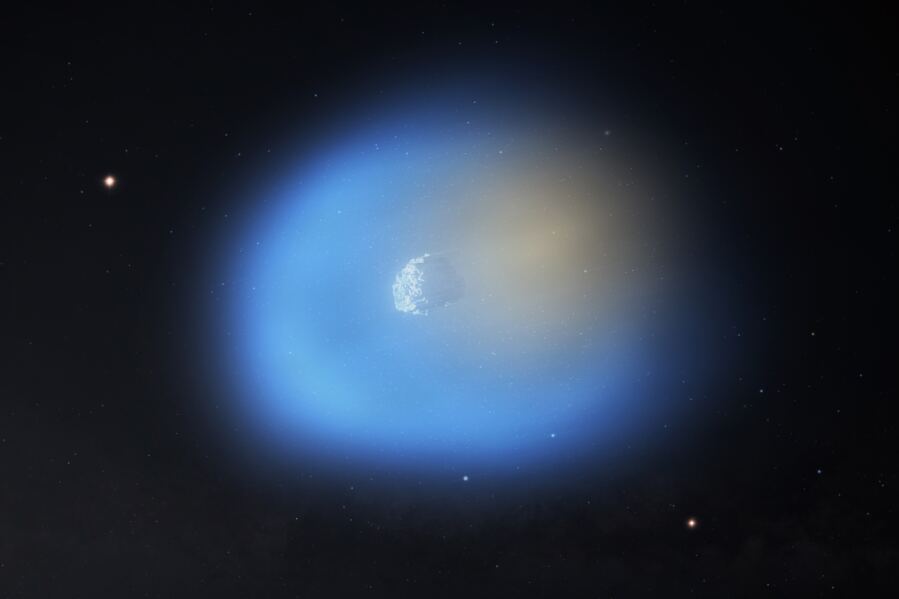
The dishes of the Atacama Compact Array were pointed roughly toward the inner solar system when the signal arrived: faint millimetre-wavelength light, bent into a distinctive spectral fingerprint, rising out of noise. It was the signature of methanol, CH3OH, a simple alcohol, and it was coming from an object that didn’t belong here. Comet 3I/ATLAS, the third interstellar interloper ever confirmed passing through our solar system, was announcing itself in a most unexpected way. It was, in a word, drunk.
Not literally. But the chemistry was striking enough to give researchers pause. Nathan Roth, an astronomer at American University who led the new study, put it this way: “Observing 3I/ATLAS is like taking a fingerprint from another solar system. The details reveal what it’s made of, and it’s bursting with methanol in a way we just don’t usually see in comets in our own solar system.”
What Roth and colleagues found, from multiple observations in late 2025 as 3I/ATLAS swept closer to the Sun, was a methanol-to-hydrogen-cyanide ratio of about 70 on the first observing date, and roughly 120 on the second. For context: that range places this visitor among the most methanol-rich comets ever measured, including every comet we’ve catalogued from our own planetary neighbourhood. Most solar system comets are far more restrained. Something about where (or how) 3I/ATLAS formed gave it an unusually heavy dose of alcohol.
Hydrogen cyanide might seem an odd comparison molecule to reach for, but it’s actually the standard yardstick in cometary chemistry. Observers routinely track it because it behaves predictably: HCN outgasses reliably from a comet’s nucleus as sunlight warms the icy surface, forming part of the glowing halo, or coma, that gives comets their distinctive fuzz. Methanol does the same, in principle. But ALMA’s imaging resolution was fine enough to see where each molecule was coming from, and the two molecules told different stories.
Hydrogen cyanide appeared to originate primarily from the comet’s solid core. Typical, unremarkable, what you’d expect. Methanol was more complicated. It was coming from the nucleus, yes, but also from something else: tiny icy grains suspended in the coma itself, particles that were releasing their own methanol as sunlight evaporated them. These grains, in effect, were acting as miniature sub-comets, each shedding its own chemical cargo on the way in. The behaviour has a parallel in some solar system comets (Comet Hale-Bopp being perhaps the most cited example), but this is the first time it’s been mapped in detail in an object from another stellar system. Which makes it, at minimum, a proof of concept: we can study interstellar outgassing physics without leaving home.
The wider context matters here. We have now seen three confirmed interstellar objects pass through the solar system: 1I/’Oumuamua, 2I/Borisov, and now 3I/ATLAS. Each has been strange in its own way. ‘Oumuamua, discovered in 2017, was elongated, cigar-like, and gave off no detectable gas, which forced a raft of unconventional explanations ranging from the mundane to the genuinely outlandish. Borisov, arriving two years later, was more cooperative: it looked and behaved like a fairly ordinary comet, though still with some chemical peculiarities. 3I/ATLAS is doing something else again. Its methanol abundance doesn’t fit neatly into either category.
What that abundance might tell us about the planetary system this object came from is, at present, largely a matter of inference. Methanol in comets is thought to form on icy grain surfaces in cold, dense molecular clouds, the same kind of environment where stars and planets coalesce. Conditions in those clouds vary considerably. A high methanol-to-HCN ratio could mean the ices in 3I/ATLAS formed at particularly low temperatures, or under UV radiation conditions different from those in our own early solar system, or that it spent longer than our comets did in specific regions of its home system before being ejected. Probably some combination of things we can’t yet disentangle. We don’t, after all, know which star it came from.
This is where the James Webb Space Telescope data adds a useful layer. Earlier observations of 3I/ATLAS, taken when the comet was still far from the Sun, showed its coma was dominated not by methanol or HCN but by carbon dioxide. That’s interesting in its own right: CO2 sublimates at lower temperatures than water, which is why it’s the dominant outgassing species when a comet is still cold and distant. The ALMA results, gathered as 3I/ATLAS moved sunward and warmed up, add methanol and HCN to the picture. Together, these measurements build a progressively richer chemical inventory: a kind of layered portrait of the object as it goes through its encounter with our Sun.
The portrait is still partial. What we cannot yet measure from the coma chemistry is much about the nucleus itself: its size, mass, rotation, internal structure. We can read the gases it sheds, but that’s a bit like trying to understand a library by sniffing the air outside. Still, those gases are not nothing. Each molecule is a sentence in a language that planetary scientists are slowly learning to read, a language written in the conditions of a distant stellar neighbourhood we will never visit.
The implication that keeps coming up in conversations about interstellar objects is not any individual discovery but the cumulative one. We went from having seen zero such objects to three in fewer than ten years, which is either remarkable luck or, more likely, evidence that the galaxy is constantly exchanging material between planetary systems. Comets and planetesimals are not as home-bound as we assumed. They travel. Some of them, it turns out, carry the records of their origins written in their chemistry: a fingerprint from another solar system, as Roth put it, delivered to our doorstep.
The next step, presumably, is to see more of them. Each new interstellar visitor gives researchers another data point in what is becoming a genuine comparative planetology. Comparing 3I/ATLAS to Borisov, and both to whatever comes next, astronomers may eventually be able to map out how planetary chemistry varies across the galaxy. Whether that picture confirms that our own solar system is typical, or reveals it as some sort of outlier, is a question worth staying up late for.
Source: Roth et al., “Detection of Methanol and Hydrogen Cyanide in the Coma of Interstellar Comet 3I/ATLAS with ALMA,” 2026. Observations conducted using ALMA’s Atacama Compact Array, Chile.