

Key Takeaways
- Researchers analyzed ash from incense burners in Pompeii, revealing a mix of local plants and exotic resins.
- They identified Canarium resin, likely exported from sub-Saharan Africa or Southeast Asia, confirming trade connections.
- Chemical traces showed offerings of incense and wine were standard in Roman domestic rituals, indicating deeper cultural practices.
- This study highlights how global trade permeated everyday life in Pompeii, extending beyond temples to household shrines.
- The findings prompt further exploration of untested artifacts, potentially revealing more about ancient rituals.
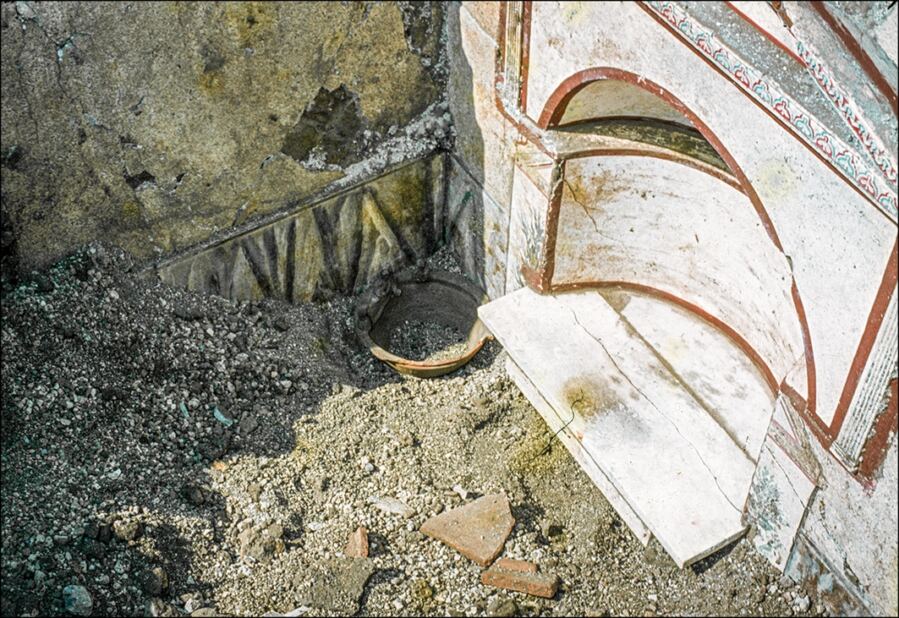
The vessel is not much to look at. A terracotta bowl, hemispherical, its rim decorated with three small female figures in relief, two busts flanking a reclining woman. It sat for roughly two thousand years inside a domestic shrine in Boscoreale, a town near Pompeii, until excavators uncovered it in 1986 with its ash still inside, preserved under volcanic debris from Vesuvius. Nobody thought to analyze that ash scientifically, not then. The bowl went into storage, its contents effectively frozen at the moment of the eruption, waiting for techniques that didn’t exist yet.
Those techniques exist now. And what they found in the ash changes how we understand life, and death, and prayer, in the Roman world.
When Vesuvius erupted in AD 79, it entombed Pompeii and the surrounding settlements under meters of ash and lapilli. A catastrophe that killed thousands, certainly. But it also flash-preserved an entire urban snapshot: food in pots, graffiti on walls, wooden furniture still upright. Among the more overlooked of these frozen moments are the ash residues left in household incense burners: the censers Roman families used to make offerings at their domestic shrines, the small lararia that housed statuettes of the Lares, the Penates, the protective spirits of home and family. About 570 such shrines are known from Pompeii alone. What people actually burned in them, though, has remained largely a matter of guesswork.
Using gas chromatography, mass spectrometry, and microscopic analysis of plant particles, scientists identified several substances burned in two Roman-era incense vessels from Pompeii and a nearby villa. Both contained charred remains of local plants including oaks, laurel, and stone-fruit species. One censer also contained residues of a tropical resin from the Burseraceae family (likely Canarium, or elemi) which would have been imported from Africa or Asia, and possible traces of wine or grape products.
Yes. While Roman texts and painted shrine scenes long suggested that incense was burned in Pompeian domestic rituals, this is the first time the actual chemical residue of an imported resin has been archaeologically confirmed at the site. Earlier studies had identified plant materials in ritual contexts, but not exotic resins of this kind.
The molecular markers most closely match Canarium resin, a type of aromatic resin from trees native to sub-Saharan Africa or the tropical rainforests of South and Southeast Asia, including India. The resin would have traveled via established trade routes across the Red Sea and through Alexandria before reaching Italian ports and eventually Pompeii’s local markets.
Combined offerings of incense and wine (known as the praefatio) were a standard preliminary act in Roman domestic ritual, depicted frequently in painted household shrines and described in Latin literature. The chemical trace of grape biomarkers alongside resin residue in one censer may represent the physical remnant of this practice, though the researchers caution that contamination cannot be entirely ruled out given the censers’ excavation histories.
It suggests that global trade networks in the Roman period extended into the most intimate spaces of daily life. Long-distance imports like tropical resins were not confined to temples, imperial ceremonies, or wealthy merchants; they appear to have made their way into the household shrines of ordinary Pompeians, where they were burned as everyday offerings to domestic gods.
An international team led by classical archaeologist Johannes Eber at the University of Zurich has now applied organic residue analysis, phytolith examination and spectrometry to the ash inside two of those censers. The results are, in a word, unexpected.
The obvious prediction would be local plants. Latin literature mentions oak (sacred to Jupiter), laurel (burned in honour of Apollo), fruit and grain. Microscopic analysis of the ash confirmed these more or less: both censers showed charred remains consistent with oaks, laurel, stone-fruit plants. Probably locally grown, probably obtained from gardens within the city. That part of the story was already hinted at by text and image. What the molecular analysis added was something the ancient authors never quite put down in writing.
“We can now pinpoint which fragrances were actually burned in Pompeian domestic cult practices,” says Eber. “Alongside regional plants, we found traces of imported resins, an indicator of Pompeii’s far-reaching trade connections.”
The resin in question came from the Burseraceae family of trees, a large grouping that includes frankincense, myrrh, and various tropical species. Gas chromatography and mass spectrometry analysis by Maxime Rageot at the University of Bonn identified triterpenic markers that point specifically toward Canarium, a genus of tropical trees. Canarium resin (sometimes called elemi) doesn’t grow anywhere near Italy. Its most likely origins are sub-Saharan Africa or the rainforests of India and Southeast Asia. To burn it in a household ritual in a mid-sized Roman city near the Bay of Naples, someone had to have shipped it across the Red Sea, through Alexandria, up to Puteoli or Portus, and into the local market. The graffito from a Pompeiian tavern lists a small quantity of “thus” (frankincense) priced alongside oil, cheese and dates. This might be what was in that stock.
Rageot’s team also found something rather harder to explain. “Molecular analyses also point to a grape product in one of the incense burners,” he says. The combination of succinic, fumaric, malic and tartaric acids in the second censer’s residue is consistent with wine or vinegar; the malic-to-tartaric acid ratio, 0.7, falls within the range expected for a ripe grape product. Roman ritual texts and painted lararia scenes depict the praefatio, a preliminary sacrificial act combining incense and wine poured together. It was evidently not just symbolic. Here, tentatively, is its chemical trace. Caution is required (no sediment control samples exist for either censer, complicating contamination assessments), but the signal is there, sitting in the data.
The broader implication is what makes this study more than a clever technical exercise. Pompeii has long been understood as a cosmopolitan place; traders from across the empire passed through, and evidence of long-distance commerce turns up in everything from amphorae stamps to architecture. But the household shrine feels intimate, personal, local. The discovery that exotic resins from African or Asian rainforests were making their way into private domestic rituals pushes the global trade network into a space we don’t usually picture it inhabiting. It wasn’t just merchant goods that crossed those distances. It was the smell of daily prayer.
The trade in aromatic resins had been moving northward across the Red Sea since at least the first century BC, according to written accounts and other archaeological traces. What the Pompeii censers add is a chemical confirmation that these goods reached households in everyday Roman cities and were burned there regularly, not just at imperial ceremonies or public temples. An Indian statuette of Lakshmi recovered from another Pompeian house has sometimes been cited as evidence of these connections. The incense ash perhaps makes the same point more intimately.
Neither censer had been scientifically analyzed before. Both were excavated decades ago under conditions that would not satisfy modern protocols, which is why the team hedges its language on contamination. The first censer yielded no preserved organic compounds at all; only the woody plant residues survive. It is censer two, from the Boscoreale villa shrine, with its carved female figures that probably represent venerated dead, that held the chemistry worth talking about. Incense and wine together, offered possibly in funerary commemoration. The form of the vessel, the figurative iconography, the chemical residues: for once, all three point the same way.
Techniques like these are still relatively new to Roman archaeology, and the results so far suggest the field has been reading texts when it could also, in principle, be reading molecules. What gets burned at a household altar, offered to protective spirits of a family no longer living, turns out to carry information that two millennia of scholarship missed. More censers are sitting in museum storerooms. It seems reasonable to wonder what else is waiting in their ash.