

For eighteen years, the radio telescopes kept watching. Observation after observation, the hard-state jets of Cygnus X-1 appeared in the data as twin lines extending from the compact core of one of astronomy’s most famous objects. Nobody had noticed, until now, that those lines were moving. Not randomly. In step with an orbit.
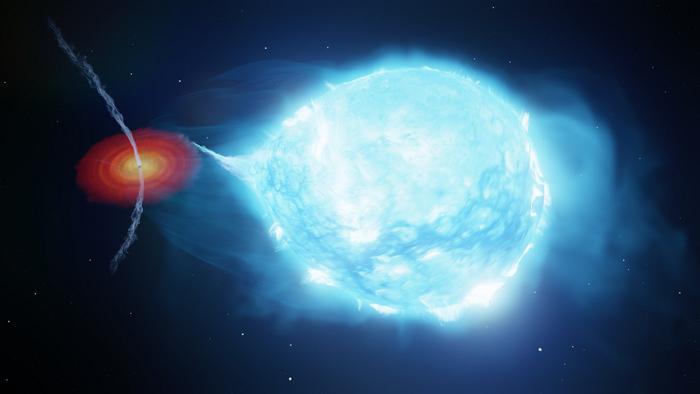
Cygnus X-1 holds a special place in astrophysics: it was the first black hole ever confirmed, identified in the early 1970s from its ferocious X-ray emission. The system pairs a black hole of about 21 solar masses with a supergiant companion star roughly 40 times as massive as the Sun, locked in a tight 5.6-day orbit some 7,200 light-years away. The black hole feeds by sipping gas from the star’s powerful stellar wind, and as it feeds, it launches twin jets of plasma outward at a significant fraction of the speed of light.
A Wind-Bent Fountain in Space
What the archival data revealed was that those jets are not simply pointing outward. The supergiant’s wind, streaming out at roughly 2,000 kilometres per second, hits the jets and pushes them aside, much like a gale bending a fountain. As the two objects wheel around each other over their 5.6-day orbit, the jet direction swings back and forth, tracing a helical pattern downstream. The result, when you stack eighteen years of very long baseline interferometry observations, is a series of images that look less like rigid beams than like dancing plumes in a crosswind.
The pattern had been there all along. It just required looking at the images in sequence, with the orbital phase in mind.
A team led by Dr Steve Prabu at the Curtin Institute of Radio Astronomy assembled that sequence, combining six dedicated observations from 2016 (which tracked Cygnus X-1 through a complete binary orbit) with archival datasets stretching back to 1998. The researchers used a network of telescopes linked over continental and intercontinental distances, achieving angular resolutions fine enough to measure the jets’ direction at different points in the orbit to a precision of fractions of a milliarcsecond.
“A key finding from this research is that about 10 per cent of the energy released as matter falls in towards the black hole is carried away by the jets,” said Prabu, who is now based at the University of Oxford. “This is what scientists usually assume in large-scale simulated models of the Universe, but it has been hard to confirm by observation until now.”
A Number That Cosmologists Have Been Guessing At For Decades
That number, 10 per cent, sounds modest. It is not. The black hole in Cygnus X-1 radiates in X-rays at roughly the luminosity of 10,000 Suns; ten per cent of that, channelled into twin collimated jets travelling at perhaps half the speed of light, amounts to a continuous energy output equivalent to thousands of stellar explosions playing out simultaneously and pointing in the same direction. The team arrived at this figure not by assuming a composition for the jet plasma or guessing at its speed (both notoriously uncertain) but by exploiting a different lever entirely: the momentum balance between wind and jet. If you know how hard the wind is pushing, and you measure how much the jet bends, the jet’s momentum follows directly. From momentum and speed (independently constrained from the brightness ratio of the approaching and receding jets), power follows. The method is, in principle, strikingly clean.
There is a complication, as there usually is. Scientists had long debated whether the jet axis in Cygnus X-1 is neatly aligned with the binary orbit or tilted at some angle. High-energy X-ray polarisation data published a few years ago hinted at a misalignment of more than 18 degrees; radio timing analyses suggested 20 to 30 degrees. The new analysis finds nothing of the sort. When the team allowed for a possible tilt in their physical model, the best-fit misalignment came out at around 5 degrees, with the data ruling out anything larger than about 8 degrees. The dramatic misalignments proposed before are, on this reading, almost certainly wrong.
The measurement carries implications well beyond Cygnus X-1. Computer simulations of how the Universe assembled its large-scale structure, from the IllustrisTNG and SIMBA cosmological models to bespoke galaxy formation codes, all require black hole jets to pump energy back into their surroundings. Without that feedback, simulated galaxies come out far too massive, their star formation never properly quenched. But the fraction of infalling energy that ends up in jet power has always been a free parameter, a knob that modellers twist until their synthetic universe matches the real one. The Cygnus X-1 measurement gives that knob its first firm empirical setting.
Anchoring the Universe’s Energy Budget
Professor James Miller-Jones, from the Curtin node of the International Centre for Radio Astronomy Research and a co-author on the paper, pointed to the broader applicability of the result. “And because our theories suggest that the physics around black holes is very similar, we can now use this measurement to anchor our understanding of jets, whether they are from black holes 10 or 10 million times the mass of the Sun,” he said. The scale-invariant behaviour of black hole accretion means the physics measured in a 21-solar-mass system can, with appropriate rescaling, inform models of the supermassive black holes at the hearts of distant galaxies.
The Square Kilometre Array Observatory, currently under construction across sites in Western Australia and South Africa, will soon be sensitive enough to detect jets from millions of galaxies. Miller-Jones noted that “the anchor point provided by this new measurement will help calibrate their overall power output,” and that “black hole jets provide an important source of feedback to the surrounding environment and are critical to understanding the evolution of galaxies.” When the SKA floods astronomers’ hard drives with jet detections, the number they will reach for first, to translate radio flicker into physical energy, is the one that eighteen years of a wobbling jet in Cygnus X-1 just delivered.
DOI: 10.1038/s41550-026-02828-3
Frequently Asked Questions
Why does measuring jet power in Cygnus X-1 matter for understanding galaxy formation?
Every major computer simulation of the Universe depends on black hole jets pumping energy into surrounding gas to stop galaxies from growing too large. Until now, the fraction of a black hole’s accretion energy that actually ends up in its jets was a free parameter that modellers adjusted to make their simulations match observations. The Cygnus X-1 result gives that number an empirical foundation for the first time, putting galaxy formation models on much firmer ground.
How did scientists measure the jet power without knowing what the jets are made of?
The clever part is that the method sidesteps the problem entirely. Rather than trying to infer jet power from the jet’s radio emission (which requires assumptions about plasma composition and magnetic fields), the team used the momentum balance between the stellar wind and the jet. If you know the wind’s force and measure how much the jet bends under that force, you can calculate the jet’s momentum directly. Combined with an independent speed measurement, that yields the power without guessing at composition at all.
Is it true that Cygnus X-1’s jets are misaligned with its orbital plane by 20 to 30 degrees?
Earlier studies based on X-ray polarisation data and radio timing analyses did claim misalignments in that range, which would have implied a dramatic tilt between the black hole’s spin axis and its orbit. The new analysis, using eighteen years of high-resolution radio imaging and a physical model of the wind-jet interaction, finds the misalignment is almost certainly less than 8 degrees, much closer to zero than the previous claims suggested. The researchers conclude that alternative explanations are probably needed to account for the earlier polarisation results.
What will the Square Kilometre Array add once it is fully operational?
The SKA will be sensitive enough to detect jets from black holes in millions of distant galaxies, a sample size completely out of reach for current telescopes. To convert those detections into actual jet power measurements, astronomers need a reliable calibration. The Cygnus X-1 result provides exactly that anchor point, meaning the SKA’s flood of data will be interpretable in a way it could not have been before this measurement.