

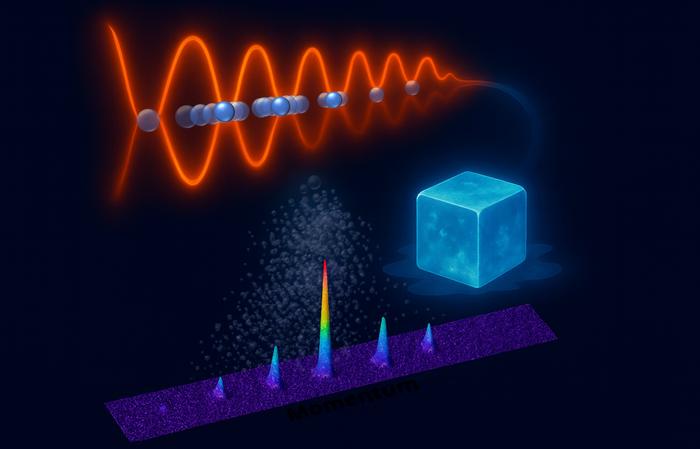
Physicists in Innsbruck have observed a striking quantum phenomenon: a gas of ultracold atoms that stubbornly resists heating, even under continuous external driving.
In experiments published in Science, Hanns-Christoph Nägerl‘s team at the University of Innsbruck prepared a one-dimensional quantum fluid and subjected it to rapid, periodic “kicks” from a laser-created lattice. Rather than absorbing energy and heating up, as classical physics would predict, the atoms’ momentum distribution became immobilized, a phenomenon labeled many-body dynamical localization (MBDL). This effect not only upends traditional thermodynamic intuition but also provides new pathways for stabilizing future quantum devices.
Momentum Frozen in Place
The team cooled strongly interacting cesium atoms to mere nanokelvin temperatures above absolute zero and exposed them to hundreds of rapid laser pulses. Classically, such sustained kicks should cause the atoms to absorb energy endlessly — akin to pumping a swing — but the observed behavior was radically different. After a short period of spreading, the atoms’ momentum distribution stopped evolving, and their kinetic energy plateaued: they refused to heat any further.
“In this state, quantum coherence and many-body entanglement prevent the system from thermalizing and from showing diffusive behavior, even under sustained external driving,” said Nägerl. “The momentum distribution essentially freezes and retains whatever structure it has.”
— Hanns-Christoph Nägerl
Order in a Driven Quantum World
Lead author Yanliang Guo expressed the team’s surprise: “We had initially expected that the atoms would start flying all around. Instead, they behaved in an amazingly orderly manner.” Theoretical collaborator Lei Ying from Zhejiang University concurred, noting, “In a strongly driven and strongly interacting system, many-body coherence can evidently halt energy absorption.” This contradicts classical expectations, displaying a striking stability rooted in quantum mechanics.
This coherence, however, proved to be fragile. Introducing even minor randomness into the driving sequence was enough to destroy the localization. As a result, normal diffusion resumed, and the atoms’ kinetic energy began rising once again.
Key Findings
- Continuous driving did not heat the quantum gas under conditions of strong coherence.
- The system achieved localization in momentum space, halting energy absorption.
- Small disorder in the drive sequence disrupted localization and restored heating.
- The results provide a profound link between fundamental quantum physics and practical aspirations in quantum technology.
Implications for Quantum Technology
Many-body dynamical localization is more than an academic curiosity. The ability to control energy absorption in isolated quantum systems could be central for engineering quantum simulators and computers that are robust to decoherence and overheating — persistent obstacles in quantum computing. MBDL demonstrates that quantum coherence can neutralize the disruptive chaos that plagues classical systems driven out of equilibrium, presenting a new playbook for quantum stability.
“This experiment provides a precise and highly tunable way for exploring how quantum systems can resist the pull of chaos,” said Guo. Simulating such non-heating, coherent quantum states on classical computers remains exceedingly challenging, underscoring the experimental significance of these results.
As physicists further probe MBDL, this work illustrates a wider theme in the quantum sciences: at the microscopic level, the universe sometimes permits systems to sidestep the inexorable trend toward disorder that governs everyday experience.
Journal: Science
DOI: 10.1126/science.adn8625