For a thousand years, his name has been overshadowed. Now England’s true first king is fighting for recognition. A new biography by Cambridge historian David Woodman, timed to the 1,100th anniversary of Aethelstan’s coronation in 925, argues that this overlooked monarch created the kingdom of England in 927 and deserves a far greater place in public memory. Published by Princeton University Press, The First King of England presents Aethelstan as the founder whose achievements rival Hastings in 1066 and Magna Carta in 1215.
A Forgotten Anniversary
“As we approach the anniversaries of Aethelstan’s coronation in 925 and the birth of England itself in 927, I would like his name to become much better known. He really deserves that,” Woodman says. Working with colleagues and public figures, he is campaigning for a memorial—a statue, plaque, or portrait—to be installed at Westminster, Malmesbury, or Eamont Bridge, where other rulers once acknowledged Aethelstan’s supremacy.
“There has been so much focus on 1066, the moment when England was conquered. It’s about time we thought about its formation, and the person who brought it together in the first place,” Woodman says.
The Case For Aethelstan
Woodman’s book contends that history has treated Aethelstan unfairly. Unlike his grandfather Alfred the Great, he lacked a biographer to praise him. Later propaganda elevated King Edgar, casting Aethelstan’s reforms into the shadows. But Woodman insists: “Just because things broke down after Aethelstan’s death doesn’t mean that he didn’t create England in the first place.”
Aethelstan’s military campaigns are central to that argument. In 927 he seized York, extending rule over Northumbria and uniting a realm recognizably England. A decade later at the Battle of Brunanburh, he crushed a Viking, Scottish, and Welsh coalition. Chronicles across Britain and Scandinavia recorded the slaughter. “Brunanburh should be as well-known as the Battle of Hastings,” Woodman says.
A Revolution In Government
The king’s reforms went beyond the battlefield. Aethelstan professionalized government, issuing elaborate land charters, sending law codes across the kingdom, and centralizing record production. His scribes wrote in polished Latin, with rhyme and alliteration. These were not just documents but statements of authority. His reign, Woodman argues, marked the first true national administration, while continental Europe was fragmenting under noble power grabs.
Learning And Faith
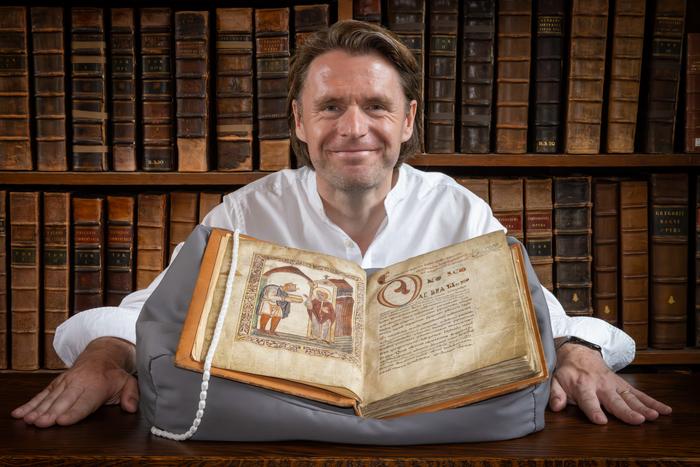
Aethelstan also revived learning after Viking destruction of monasteries. He welcomed scholars from across Europe, supported the church, and strategically used religious gifts to secure loyalty. His manuscript portrait in The Parker Library, bowed before Saint Cuthbert, is the earliest surviving likeness of an English monarch. Another document, the Durham Liber Vitae, records “Aethelstan Rex” in shimmering gold and silver. For Woodman, seeing the name at the top of the manuscript was “breathtakingly exciting.”
“Everyone should know about this portrait, it’s one of the most important images in English history,” Woodman says.
The Push For Recognition
Historians and public figures are rallying to ensure Aethelstan is remembered. Beyond the proposed memorial, Woodman calls for his story to appear on school curricula, correcting a national amnesia. His book, with 33 illustrations and maps, blends narrative with scholarship to place Aethelstan where he belongs: at the foundation of England’s story.
Aethelstan (d. 939) was the grandson of Alfred the Great and the first ruler to unite the English into one kingdom. Crowned in 925, he consolidated power by conquering York in 927, forging alliances with Welsh and Scottish rulers, and defeating a massive coalition at the Battle of Brunanburh in 937. He centralized government through law codes and professionalized charters, and fostered learning and church reform. Though later overshadowed by Alfred and Edgar, modern historians credit Aethelstan as the true first King of England.
Reference: David Woodman, The First King of England: Aethelstan and the Birth of a Kingdom. Princeton University Press, 2 September 2025. ISBN: 9780691249490