

What happens when a cell forgets how to be itself? A sweeping new study from MIT’s Picower Institute, published in Cell, shows that Alzheimer’s disease strips brain cells of their ability to maintain stable patterns of gene regulation. Researchers profiled 3.5 million cells from 111 human donors across six brain regions, producing a multimodal atlas that ties epigenomic breakdown directly to cognitive decline. Yet they also uncovered evidence of resilience: people who retained epigenomic stability largely preserved their memory and thinking abilities.
A map of vulnerability and resilience
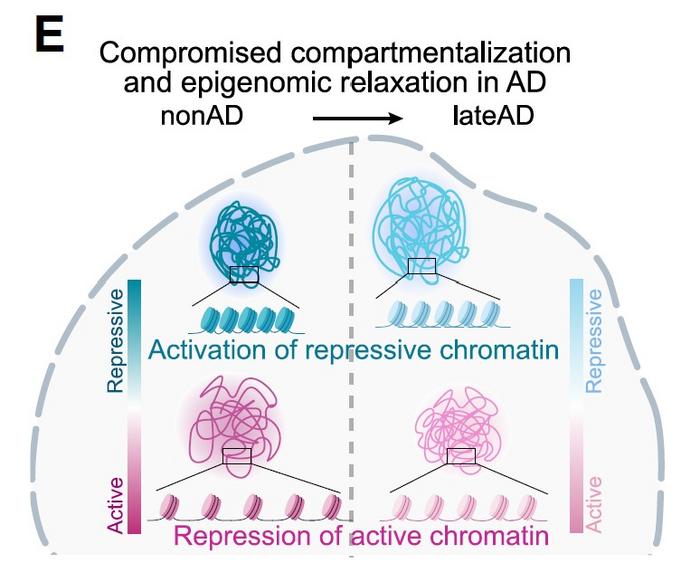
The team, led by Manolis Kellis and Li-Huei Tsai, combined single-cell RNA sequencing with chromatin accessibility mapping to reveal how the brain’s regulatory scaffolding shifts during Alzheimer’s. They found that healthy neurons and glial cells tightly compartmentalize their DNA, keeping some regions locked down while leaving others open for expression. In Alzheimer’s brains, that order frays. Repressive compartments swing open, active compartments clamp shut, and the result is a chaotic transcriptome that activates harmful pathways while silencing protective ones.
“The message is clear: Alzheimer’s is not only about plaques and tangles, but about the erosion of nuclear order itself,” said Manolis Kellis, professor at MIT and senior author.
By scoring each cell’s “epigenomic information,” the researchers quantified how much regulatory identity remained intact. Declining scores tracked with advancing pathology, especially in the hippocampus and entorhinal cortex, regions hit first by the disease. But cells that preserved their information, whether excitatory neurons or microglia, were strongly associated with preserved cognition in life.
Risk genes and fragile guardians
The study also showed how known risk genes interact with epigenomic instability. Microglia carrying the APOE4 variant, the strongest genetic risk factor for Alzheimer’s, initially ramped up activity but then collapsed into exhaustion, losing their regulatory structure. Reelin-producing neurons, previously identified as especially vulnerable, displayed early epigenomic erosion unless they belonged to individuals who showed cognitive resilience. The researchers even identified “chromatin guardians,” gene programs that normally enforce nuclear order, which faltered as Alzheimer’s progressed.
“This new data advances our understanding of how epigenomic factors drive disease,” said Li-Huei Tsai, director of the Picower Institute and co-corresponding author.
From atlas to treatment blueprint
The multimodal atlas is the first to integrate gene expression and gene regulation across so many regions and donors. It offers both a diagnostic resource and a therapeutic roadmap. Future interventions might aim to shore up the genome’s compartmental boundaries, bolster chromatin guardians, or selectively stabilize vulnerable cell types. The data also suggest that maintaining epigenomic identity could be as important as clearing amyloid plaques or tangles.
The broader implication is stark but hopeful: memory loss may arise not only from toxic buildup but from the gradual erosion of the genome’s regulatory memory. Treatments that preserve that inner memory may, in turn, protect the outer one.
Explainer: What is the epigenome?
The epigenome is the collection of chemical modifications and structural arrangements that determine which parts of the DNA are active in a given cell. Unlike mutations, which alter the DNA sequence itself, epigenomic marks like histone modifications or chromatin folding control whether a gene is switched on or off. These marks give cells their identity: a neuron and a liver cell share the same DNA but differ because of their epigenomic programming. In Alzheimer’s, this regulatory code erodes, leaving cells unable to maintain their proper function.
Journal: Cell
DOI: 10.1016/j.cell.2025.06.031