

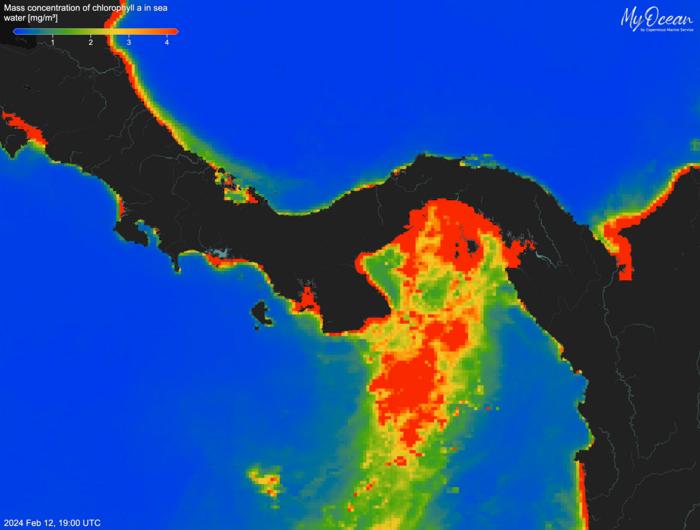
The water stayed warm when it should have turned cold. For the first time in at least four decades, the deep, nutrient-rich currents that normally surface in Panama’s Gulf each dry season never arrived. Scientists at the Smithsonian Tropical Research Institute (STRI) report in PNAS that the 2025 suppression of the Pacific upwelling is an unprecedented event with potential consequences for fisheries and coral reefs.
Between December and April, strong northern trade winds usually churn Panama’s Pacific coast. That wind-driven mixing pulls cold, nutrient-packed water from the ocean depths, fueling plankton blooms that anchor a food chain from anchovies to tuna, and buffering coral reefs against heat stress. This year, it failed. Sea surface temperatures stayed warmer, biological productivity waned, and a predictable seasonal pattern that coastal communities have relied on for millennia simply disappeared.
When the winds went quiet
Lead author Aaron O’Dea and colleagues traced the anomaly to one factor: the winds. Data collected from the S/Y Eugen Seibold, a Max Planck Institute research vessel working in partnership with STRI, confirmed a sharp reduction in the trade winds that normally drive upwelling. Without that push, the deep ocean never surfaced. As the team put it, “a significant reduction in wind patterns was the cause of this unprecedented event” (PNAS).
“Upwelling is a process that allows cold, nutrient-rich waters from the depths of the ocean to rise to the surface,” the STRI team wrote. “This dynamic supports highly productive fisheries and helps protect coral reefs from thermal stress.”
The consequences reach beyond a single season. If weakened winds or climate-driven variability suppress upwelling more often, Panama’s artisanal fisheries could face steep declines in catch, and coral reefs could lose one of their natural defenses against bleaching. The warning is stark: one of the tropics’ most reliable oceanographic rhythms is no longer guaranteed.
Fragile but overlooked systems
Despite their importance, tropical upwelling systems are among the least monitored. The gulf’s productivity has sustained communities for thousands of years, but long-term records are sparse compared with those in the eastern Pacific off Peru or California. The STRI study underscores how quickly climate disruption can alter such processes, and how unprepared observation networks are to capture the shifts in real time.
“This finding highlights the growing vulnerability of tropical upwelling systems, which, despite their enormous ecological and socioeconomic importance, remain poorly monitored,” the authors cautioned.
The study does not resolve whether this year’s anomaly signals a one-off disruption tied to natural variability or the beginning of a trend under climate change. But it provides a clear call for action: strengthen observation and prediction systems in tropical oceans before more baselines are lost.
Explainer: What is upwelling?
Upwelling happens when winds push surface waters away from the coast, allowing deeper waters to rise and replace them. Those deeper waters are colder and loaded with nutrients, creating conditions for explosive plankton growth. In places like Panama, this fuels fisheries and helps shield coral reefs from heat stress. When upwelling fails, surface waters stay warm and nutrient-poor, leaving ecosystems and local economies vulnerable.
Journal: Proceedings of the National Academy of Sciences
DOI: 10.1073/pnas.2512056122