

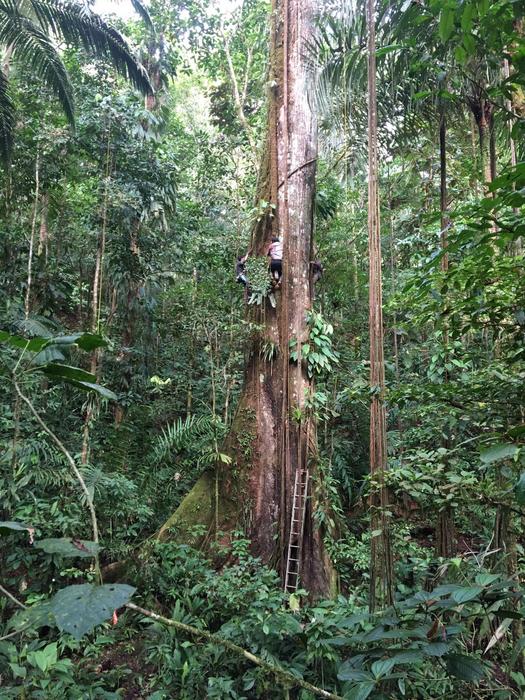
Deep in the Amazon rainforest, something unexpected is happening. While scientists have spent decades warning about climate change threatening the world’s largest tropical forest, trees across the basin have been quietly getting bigger—a lot bigger.
A comprehensive 30-year study published in Nature Plants reveals that average tree size in Amazon forests has increased by 3.3% each decade, with the largest trees showing the most dramatic growth spurts. The finding challenges assumptions about how climate change affects forest ecosystems and offers a rare piece of encouraging environmental news.
Giants Getting More Giant
Nearly 100 researchers from over 60 universities monitored 188 permanent forest plots across the Amazon basin, tracking individual trees from 1971 to 2015. What they discovered was systematic: trees of all sizes were growing larger, but the biggest specimens were claiming an increasingly dominant share of forest resources.
“This is a good news story. We regularly hear how climate change and fragmentation is threatening Amazonian forests. But meanwhile the trees in intact forests have grown bigger; even the largest trees have continued to thrive despite these threats.”
The study’s lead author, Dr. Adriane Esquivel-Muelbert from the University of Cambridge, points to rising atmospheric carbon dioxide as the likely culprit. As CO2 levels have climbed steadily over the past three decades, Amazon trees appear to have responded with a growth spurt that spans the entire forest community.
But the benefits aren’t equally distributed. Large trees—those giants that can live for hundreds of years—increased their dominance by 6.6% per decade, while smaller understory trees actually declined in number by 1.2% per decade. It’s a botanical version of the rich getting richer, driven by the physics of forest competition.
Winners Take Most, But Not All
The research team tested four different hypotheses about how forests might respond to changing environmental conditions. The “winners-take-all” theory predicted that large trees would monopolize additional resources, leaving smaller trees to struggle in increasingly dark understory conditions.
What they found was more nuanced. While large trees did claim the biggest absolute gains in size, smaller trees also showed significant relative growth—suggesting that rising CO2 levels help even shade-tolerant species that live near their photosynthetic limits.
“Large trees are hugely beneficial for absorbing CO2 from the atmosphere and this study confirms that. Despite concerns that climate change may negatively impact trees in the Amazon and undermine the carbon sink effect, the effect of CO2 in stimulating growth is still there.”
The implications extend far beyond forest ecology. Amazon trees store massive amounts of carbon that would otherwise contribute to atmospheric warming. As these biological skyscrapers grow larger, they’re essentially building bigger carbon vaults—a natural climate solution that’s been operating in the background while humans debate policy responses.
Dr. Rebecca Banbury Morgan from the University of Bristol, a joint lead author, emphasizes the time scales involved. Large tropical trees are centuries old, making them irreplaceable components of the forest carbon budget. “We can’t simply plant new trees and expect them to confer anything like the kinds of carbon or biodiversity benefits that the old, natural forest is providing.”
The study also reveals why Amazon deforestation is particularly destructive. Each mature tree represents decades or centuries of carbon accumulation that cannot be quickly replaced. As Professor Oliver Phillips of the University of Leeds notes, “What happens to big trees—including how they deal with increasing climate threats and manage to disperse their seeds—is now mission-critical.”
But the research comes with caveats. The fertilization effect that’s driving tree growth may not last indefinitely. Climate models suggest that increasing drought, heat, and storm activity could eventually overwhelm the benefits of higher CO2 levels. The question is whether Amazon forests can maintain their growth advantage as climate pressures intensify.
For now, the Amazon’s giants continue their quiet expansion, absorbing carbon and defying the pessimistic forecasts that dominate environmental headlines. In a world where good environmental news is increasingly rare, the fattening forest offers a reminder that nature’s responses to human-caused change can sometimes surprise us—in encouraging ways.