

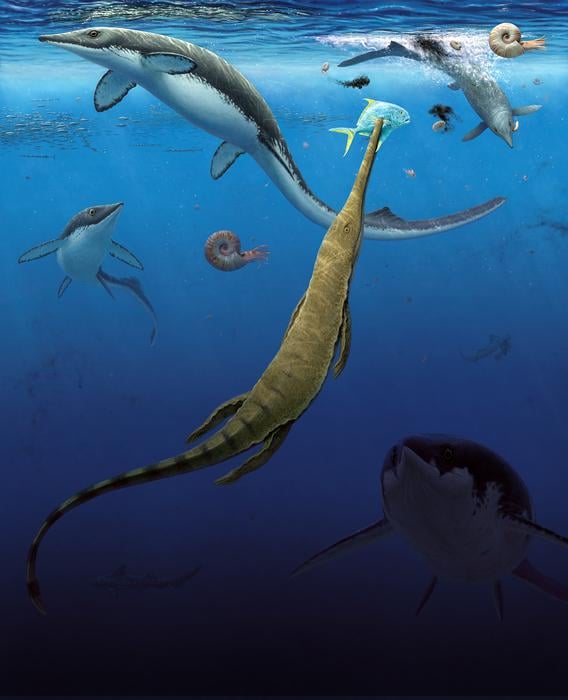
The shock of a world almost emptied by extinction is hard to picture, yet fragments of that recovery now lie scattered along a Svalbard mountainside. Within these Arctic rocks, researchers from the University of Oslo and the Swedish Museum of Natural History uncovered a remarkably dense fossil bonebed that documents an ocean rebounding with unexpected speed after the end-Permian mass extinction. Their analysis, published in Science, shows that by 249 million years ago marine ecosystems had already rebuilt complex food webs filled with diverse predators.
Stratigraphic dating places the Spitsbergen bonebed just three million years after the end-Permian event, the most catastrophic biological collapse in Earth history. After nearly a decade of excavation, preparation, and identification, the Scandinavian team cataloged more than 800 kg of fossils from carefully gridded collections, revealing sharks, ray-finned fish, coelacanths, lungfish, marine amphibians, and multiple lineages of early ichthyosaurs coexisting in a tightly integrated community.
The Arctic Archive Of A Surprising Recovery
The fossils come from sediments that once formed the floor of a mid to high latitude sea bordering the Panthalassa superocean. This environment, once thought to be sparsely populated for millions of years after the extinction, instead hosted a thriving array of predators ranging from small, agile ichthyopterygians less than one meter long to massive ichthyosaur apex hunters more than five meters in length. The sheer concentration of bones forming a conspicuous mountainside layer underscores how rapidly vertebrate marine life diversified.
The Spitsbergen fossil bonebed reveals that marine ecosystems bounced back extremely rapidly, and had established complex food chains with numerous predatory marine reptiles and amphibians by as little as three million years after the end-Permian mass extinction.
Upending Long-Held Assumptions
For decades, textbooks framed the Early Triassic as a slow biological crawl back toward ecological stability. Vertebrates, in particular, were believed to have reentered open marine habitats in a staggered sequence extending eight million years or more. The new Spitsbergen data overturns this narrative. Instead of a gradual march, the record points to rapid radiations that produced a fully variegated set of marine niches far earlier than expected.
A computer-based global comparative analysis of the various animal groups further highlights the Spitsbergen fossil bonebed as one of the most species-rich marine vertebrate assemblages ever discovered from the dawn of the Age of Dinosaurs.
These findings suggest that the evolutionary shift from land to sea for many reptile and amphibian groups began earlier than previously believed, potentially even before the extinction itself. The devastation of the end-Permian event may then have reset global ecosystems, opening new feeding opportunities that accelerated the rise of ocean-going tetrapods. Fossils from this extraordinary Arctic deposit are now on public display in both Oslo and Stockholm, offering visitors a glimpse into the quickening heartbeat of life after Earths darkest hour.