

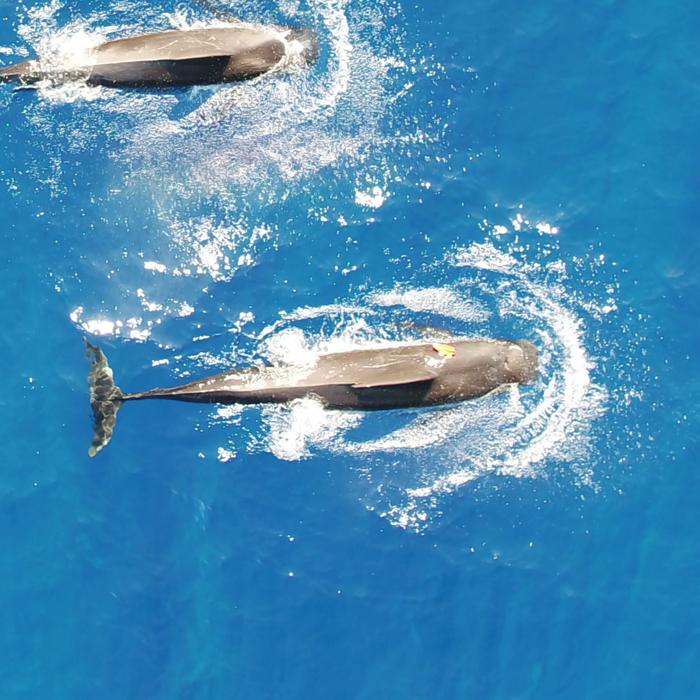
In the dim blue world far below Hawaiis waves, short-finned pilot whales rise and fall through the water column in a steady choreography of hunger and survival. A new study from the University of Hawaiis Marine Mammal Research Program reveals just how much fuel these elusive divers need, and the numbers tell a surprisingly hopeful story about the ocean resources that sustain them.
Published in the Journal of Experimental Biology, the research draws on high-resolution tags, drone photogrammetry, and energetic modeling to calculate the daily squid consumption of short-finned pilot whales. The team found that each whale eats between 82 and 202 squid every day, a total that appears easily supported by the surrounding ecosystem.
Solving a Biological Puzzle
The energetic demands of deep-diving marine mammals have long been difficult to pin down, especially for species that dive hundreds of meters on a single foraging run. Short-finned pilot whales, capable of plunging nearly a kilometer, present an even steeper challenge. The research team approached the question with an unusually rich dataset, combining accelerometry, hydrophone recordings, drone footage, and prey energy estimates to determine how much food these whales need to break even.
“These animals have been studied in locations around the world, but relatively little is known about them in Hawaiian waters”
Diving Into the Data
The team attached temporary suction cup tags to eight whales during fieldwork off Hawaiis coast. Each tag carried motion sensors, hydrophones, GPS, and a camera, providing a minute-by-minute record of diving behavior. Over dozens of hours of footage and sound, the pattern became clear. The whales averaged 39 dives per day, with many plunges past 800 meters. Each deep dive required immense energy, with the animals burning more than 70 kJ per minute during descent.
“These results show that short-finned pilot whales are in relatively good shape in Hawaii, having found an abundant and reliable source of food”
By pairing energetic cost with estimates of prey value, the researchers concluded that a typical adult whale consumes roughly 73,730 squid per year. Scaled to the entire Hawaiian population of about 8000 whales, the total comes to an astonishing 88,000 tonnes of squid. Yet even this vast amount, the researchers note, represents only a small fraction of local squid abundance.
The findings offer something rare in marine conservation, a sign that at least one predator in Hawaiis complex food web may have enough to eat. For species threatened by climate change, overfishing, and shifting ocean dynamics, the steady presence of squid may help stabilize pilot whale populations for years to come.