

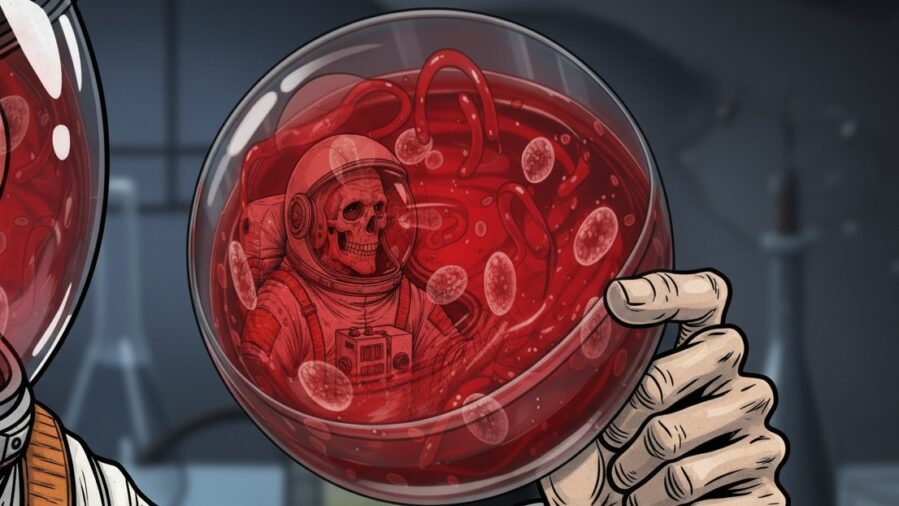
Thirty to forty-five days in orbit was enough. Human blood-forming stem cells, nurtured inside AI-guided “nanobioreactors” aboard the International Space Station, began to act older, weaker, and more inflamed than their Earth-bound twins.
In experiments led by UC San Diego’s Sanford Stem Cell Institute and published in Cell Stem Cell, researchers watched hematopoietic stem and progenitor cells (HSPCs) burn through their reserves, accumulate DNA damage, shorten telomeres, and switch on stress programs that mirror aging.
The team flew four missions on SpaceX resupply flights and tracked the cells in real time using a cell-cycle reporter. The picture that emerged is not subtle: faster cell cycling, loss of dormancy, reduced self-renewal, and molecular signatures that read like a checklist of aging hallmarks. And if you are thinking about the commercial space era and missions measured in months, not days, there is a clear implication for astronaut health and, frankly, for the business of space.
“We’re excited this breakthrough work is being published to the wider scientific and space communities,” said Twyman Clements of Space Tango.
Here is the core: space is a stress test. That phrase is overused, but here it fits. Microgravity, radiation, and altered fluid dynamics conspire to push HSPCs out of their protective idling state. The researchers saw increased single-base C-to-T mutations, a mutational flavor often linked to APOBEC3 base deaminase activity during inflammation, along with hints of clonal hematopoiesis genes being nudged. They also recorded shifts in mitochondrial gene expression and an uptick in inflammatory cytokines like IL-6, with telomere maintenance genes trending down. The cells were not just older in vibe, they were older in measurable ways.
One buried lede worth surfacing: when space-exposed cells were placed back onto a young, supportive stromal environment, some functions rebounded. Not fully, not magically, but enough to suggest that countermeasures are plausible. In other words, the stress test can be followed by repairs. That opens a window for protective strategies, from pharmacology to biomaterial niches, that might preserve stem cell fitness on Mars-length journeys.
The study extends the NASA Twins narrative into the marrow itself. Those earlier results showed telomere dynamics and gene expression changes that mostly reverted after landing. Here, by focusing on HSPCs, the team captures a mechanistic snapshot of how immune robustness and cancer surveillance might erode in flight. Mitochondrial stress, reduced ADAR1p150 RNA editing linked to self-renewal, repetitive element “dark genome” flickers, and telomere replication machinery dialing down, together form a pattern. The pattern says aging.
Numbers matter. The missions lasted 32 to 45 days. Radiation exposure on station logged 7.6 to 10.7 mGy, comparable to some clinical imaging, yet space samples showed roughly five times more single-base substitutions than ground controls exposed to similar X-ray doses. That mismatch points beyond dose alone, toward the cocktail of space stressors that activate mutagenic pathways. It is, again, a stress test, and the test is hard.
There is also a terrestrial angle. If space can compress the timeline of stem cell aging, then orbit becomes a lab for aging research, a way to accelerate cause-and-effect and test interventions faster. That is not just scientific curiosity, it is an economic idea. The space economy will reward platforms that deliver insights quickly, especially if they translate into immune resilience for crews and anti-aging leads for Earth.
“Space experiments are so complex that they force you to do better science on the ground,” said Catriona Jamieson.
The real surprise came when the researchers showed that a young stromal “neighborhood” could partially reset space-weary cells. It is a modest plot twist, but it keeps the story from fatalism. And it leaves us with a question rather than a tidy bow: if we can engineer the niche, can we make long-duration flight less of an aging machine for the blood?
What Did The Researchers Actually Do?
Scientists cultured human blood-forming stem and progenitor cells (HSPCs) in miniaturized bioreactors that flew on four ISS missions. These devices kept cells alive and imaged them with an AI-guided fluorescent reporter that flags where cells are in the division cycle. After 32 to 45 days in orbit, the samples were returned and compared with ground controls using multi-omics: whole-genome sequencing to see mutations and telomeres, RNA sequencing to measure gene programs, and functional assays to test the cells’ ability to form colonies and self-renew. Space-exposed cells cycled faster, showed reduced dormancy and self-renewal, had more C-to-T mutations, shifts in mitochondrial and inflammatory pathways, and lower expression of telomere maintenance genes. Placing those cells onto a young stromal layer partially restored function, hinting at possible countermeasures.
Journal: Cell Stem Cell. DOI: See article page: https://www.cell.com/cell-stem-cell/fulltext/S1934-5909(25)00270-X