
Outfitting soldiers with clothing that effectively repels or kills insects is one of the strategies U.S. Department of Agriculture (USDA) scientists are using to help protect U.S. military personnel deployed overseas against disease-transmitting mosquitoes and sand flies.
As part of the Deployed War-Fighter Protection Research Program, scientists at the Agricultural Research Service (ARS) Center for Medical, Agricultural, and Veterinary Entomology (CMAVE) in Gainesville, Fla., and other ARS laboratories are collaborating with U.S. Department of Defense personnel to improve personal protection for troops. They’re also developing public health insecticides and devising improved application technologies to kill insects. ARS is USDA’s principal intramural scientific research agency.
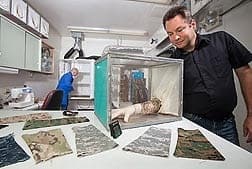 ARS chemist Ulrich “Uli” Bernier and his colleagues at the Gainesville center work with military personnel on a number of projects, which include evaluating the effectiveness and assessing the quality of various combat uniforms, factory-treated with permethrin.
A bite protection test, which requires placing a treated uniform sleeve into a cage of mosquitoes, was developed by Bernier to assess how well uniforms protect soldiers. About 65 U.S. military uniform constructions and compositions have been evaluated so far. Fabrics are tested immediately after factory treatment and after laundering 20 to 50 times.
Bernier recently verified bite protection testing on Army combat uniforms constructed of a more durable fire-resistant fabric. Alternative fabrics were needed because the original fire-resistant uniform material tore too easily, reducing its ability to protect against insects.
For additional and longer protection, scientists are designing new products to augment uniforms. ARS chemist Kamal Chauhan at the Henry A. Wallace Beltsville Agricultural Research Center in Beltsville, Md., and Bernier have created an attachable repellent-treated band that can be worn on a sleeve or collar to help protect exposed skin. Preliminary evaluations indicate that the band comprising novel-high vapor pressure compounds may also be used against pyrethroid-resistant mosquitoes and bed bugs.
Chauhan also has filed a patent for his latest invention—a disposable, reversible band-aid that offers short-term protection against biting insects. This new product may potentially be used in applications for recreational activities and to ward off insects that pester pets and livestock.
Read more about this research in the November/December 2012 issue of Agricultural Research magazine.
ScienceBlog.com has no paywalls, no sponsored content, and no agenda beyond getting the science right. Every story here is written to inform, not to impress an advertiser or push a point of view.
Good science journalism takes time — reading the papers, checking the claims, finding researchers who can put findings in context. We do that work because we think it matters.
If you find this site useful, consider supporting it with a donation. Even a few dollars a month helps keep the coverage independent and free for everyone.