

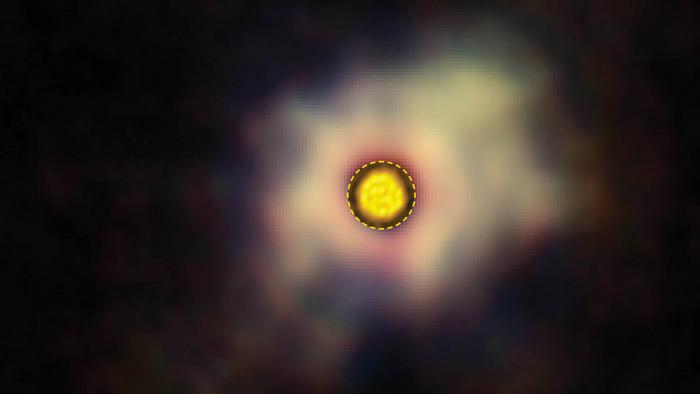
Every atom of carbon in your body, every molecule of oxygen you breathe, had to escape from the heart of a dying star. For decades, astronomers thought they understood how: intense starlight pushes against tiny dust grains, launching them into space like wind filling a sail. But new measurements of a nearby red giant called R Doradus show that this elegant mechanism has a fatal flaw. The dust grains are simply too small and too transparent to be pushed by light alone.
R Doradus sits just 180 light years away, close enough for astronomers at Chalmers University of Technology to study its immediate surroundings in extraordinary detail. The star sheds about a third of Earth’s mass every decade, making it an ideal laboratory for understanding how elements essential for life spread through the galaxy. Using the SPHERE instrument on the European Southern Observatory’s Very Large Telescope, researchers measured how starlight scatters off dust clouds roughly the size of our solar system. What they found creates what they call a “theoretical crisis.”
The grains are only about one ten-thousandth of a millimeter across. At that scale, they’re more like fine smoke than sturdy sand. The team ran advanced computer simulations testing every possible combination of dust size, density, and composition. None of the models could generate enough force to overcome the star’s gravity while matching the actual amount of dust observed. Even allowing nearly all available elements to condense into dust fell short.
“Our findings for R Doradus show insufficient radiation pressure from scattering on grains, suggesting that dust alone cannot drive the wind in this star and that additional mechanisms may be required,” Thiebaut Schirmer explains.
What actually launches the atoms of life
If starlight isn’t doing the work, something else must be helping these elements escape. Previous observations with the ALMA radio telescope revealed enormous convective bubbles on R Doradus’s surface, each one larger than our Sun. These roiling features, combined with the star’s natural pulsations, might provide the extra kick needed to launch material outward. The dust may act less like a rocket engine and more like a passenger, tracing where matter goes without being the primary force moving it.
One possibility the team considered was iron-rich dust, which can absorb light more efficiently. But those grains would heat up and evaporate before they could ever get the wind moving, closing off that escape route. The researchers noted that stellar winds from red giants are one of the main ways galaxies get enriched with heavy elements. If dust can’t launch those winds by itself, the process must be far more complex and violent than the gentle “starlight sail” model suggested.
A messier origin story for everything
Theo Khouri, an astronomer at Chalmers and co-author of the study, said the discovery upends long-held assumptions. “We thought we had a good idea of how the process worked. It turns out we were wrong. For us as scientists, that’s the most exciting result,” he noted. The finding is part of a larger project investigating the origin and fate of all dust in the universe, a mystery that’s now more open than it was before this work began.
The result applies specifically to R Doradus during the phase observed, and red giants change dramatically over time. Future observations could reveal moments when dust plays a stronger role. Still, the study forces a reckoning with how carbon, oxygen, and nitrogen actually make the journey from stellar cores into the next generation of solar systems. In several billion years, our own Sun will become a red giant and begin this same process of shedding its outer layers.
What seemed like a solved problem now looks more like an open question. The atoms that make up our world may owe their spread through space to stellar upheaval as much as to cosmic dust, a reminder that even the universe’s most fundamental cycles remain imperfectly understood.