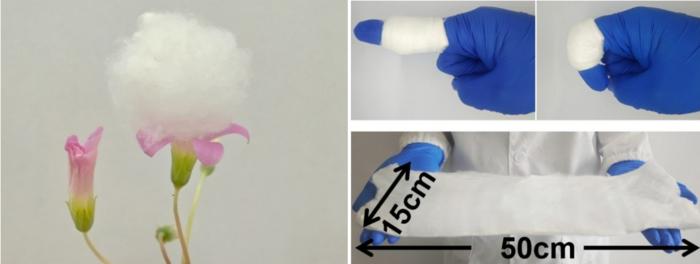
Pull a tuft of it apart and it looks like cotton wool, all airy white fibres that spring back when you squeeze them. Roll it into a ball, flatten it into a sheet, bend it round your finger, it doesn’t much care. But hold it under a dripping tap and nothing soaks in. The water just sits there, beading, refusing to be absorbed, which is precisely the trick its makers were after.
This is a phase change fibre aerogel, PCFA for short, and it comes out of a lab at the Dalian Institute of Chemical Physics in China. The idea, roughly, is a fabric that knows what to do with your body heat depending on the weather.
Cotton has a nasty habit you’ve probably felt without naming it. Once it gets wet, from sweat or rain or just damp air, it starts pulling warmth away from your skin. On a hot day, brilliant; that’s evaporative cooling doing you a favour. In bitter cold it can be the difference between uncomfortable and genuinely dangerous. Mountaineers have a grim little saying about it: cotton kills.
So the obvious fix is to give fibres a way to bank heat and pay it back later. Researchers have tried coating threads with phase-change substances, materials that melt and harden as the temperature shifts, soaking up heat as they liquefy and releasing it as they set.
The snag is that these coatings tend to misbehave. They stiffen a soft fabric into something closer to cardboard, and worse, the molten material has a way of seeping out onto the wearer. Leakage, in the trade. Not what you want next to your skin.
Shihui Zhang, Zhihua Zhang, Quan Shi and their colleagues went at it from a different angle. Rather than painting the phase-change stuff on the outside, they baked it in, dotting a network of polymer fibres with microscopic capsules of a phase-change hydrocarbon and building the whole thing to mimic the high-porosity, springy architecture of cotton itself.
Borrowing From the Boll
“Inspired by the fluffy structure of cotton, we created a new material that is ultralight and flexible. It keeps you warm in the cold better than cotton or commercial synthetic insulations, while also prevents you from getting too hot at room temperature,” says Shi, a corresponding author on the study.
The numbers behind that claim are quietly impressive. The material switches its behaviour around 26 degrees Celsius, give or take, which is conveniently close to skin-comfortable room temperature, and it can store roughly 43 joules of latent heat per gram. The team report it surviving a thousand melt-and-set cycles, the sort of churn it would face over a garment’s lifetime, without losing the plot. Its insulation figure sits at about 2.84 hundredths of a watt per metre-kelvin, which is to say it’s a very good barrier against the cold indeed. And crucially, because the capsules are sealed inside the fibre structure, there’s nothing to leak.
Then came the rough stuff. The researchers cut swatches about 6 by 20 inches and put them through it: humid air, water droplets, repeated bending, twenty trips through the wash. The fabric shrugged off both forms of moisture where ordinary cotton drank them up. It didn’t shed fibres. It bounced back to its original fluffiness after washing and held onto 97 per cent of its heat-trapping ability.
Warm Hands, Cold Test
The headline demonstration was almost homely. Wrap a hand in the new fabric at minus 25 degrees Celsius, that’s minus 13 Fahrenheit, properly Arctic, and it stayed markedly warmer than the same hand wrapped in cotton of equal thickness. Bring it indoors and the fabric did the opposite, letting heat escape a touch more readily than cotton would, so you wouldn’t cook.
It is, for now, a prototype, and there’s a long road between a swatch on a lab bench and a jacket on a shop rail. Manufacturing at scale, cost, how it behaves over years rather than washes; all of that remains to be worked out, and the team are careful not to oversell.
Still. Most of what we wear is dumb, in the engineering sense, a fixed barrier that does the same thing whether you’re shivering on a chairlift or sweating on the train home. A material that reads the temperature and adjusts, banking your warmth when you need it and quietly shedding it when you don’t, edges clothing towards something closer to skin than to armour. Whether that future arrives as outdoor kit for genuinely hostile places, which seems the likeliest first home, or eventually as the stuff of everyday wardrobes, is anyone’s guess for now.
For the moment, though, there’s a small pleasure in the picture of it: a fistful of synthetic fluff that won’t get wet, sitting in a freezer, deciding what to do with the warmth of a hand.
Source: Dai, H. et al. ACS Energy Letters, DOI: 10.1021/acsenergylett.6c00363
Frequently Asked Questions
How can one fabric both keep heat in and let it out?
The material is laced with tiny sealed capsules of a substance that melts and re-solidifies at around skin-comfortable room temperature. When it’s cold the substance hardens and releases stored heat toward you; when it’s warm it melts and soaks heat up, easing it away. It’s the same physics that makes a melting ice cube cool a drink, just engineered to run in both directions inside a fibre.
Is it true that cotton can be dangerous in the cold?
Yes, and it’s well known among climbers and hikers, who have a blunt phrase for it: cotton kills. Once cotton gets damp from sweat or weather it conducts heat away from the body, which is welcome on a hot day but risky when you’re already cold and wet. The whole point of the new material is to repel that moisture rather than soak it up.
What’s stopping this from ending up in my winter coat?
Right now it’s a laboratory prototype tested as small swatches, not a mass-produced textile. The questions that decide its fate are the usual unglamorous ones: can it be made cheaply at scale, and does it hold up over years of real wear rather than a few dozen lab cycles? The early durability results are encouraging, but that gap is where a lot of promising materials quietly stall.
How does it survive being washed?
Because the heat-storing material is encapsulated and built into the fibre structure rather than coated on top, there’s nothing to wash away or leak out. After twenty wash cycles the prototype didn’t shed fibres, returned to its original fluffiness, and kept 97 per cent of its heat-trapping performance. That resistance to leakage is exactly what tripped up earlier phase-change fabrics.