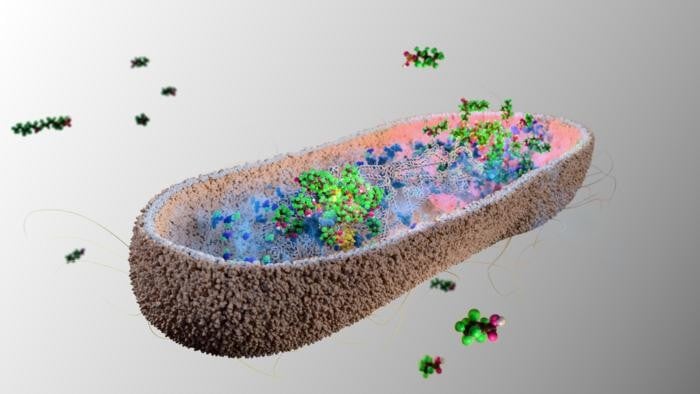
Scientists have discovered that certain microbes living in our intestines can absorb toxic “forever chemicals” called PFAS, potentially offering a natural defense against these widespread pollutants.
Researchers at the University of Cambridge found that specific gut bacteria can soak up between 25% and 74% of PFAS within minutes, storing the chemicals in dense clusters inside their cells while continuing to grow normally.
The findings, published in Nature Microbiology, suggest that boosting these protective bacteria through probiotics could help remove PFAS from our bodies—a crucial discovery given that these persistent chemicals have been linked to fertility problems, developmental delays in children, and increased cancer risk.
Natural Detox System in Action
“Given the scale of the problem of PFAS ‘forever chemicals’, particularly their effects on human health, it’s concerning that so little is being done about removing these from our bodies,” explained Dr. Kiran Patil from Cambridge’s MRC Toxicology Unit, the study’s senior author.
PFAS (per- and polyfluoroalkyl substances) are virtually unavoidable in modern life. These synthetic chemicals appear in waterproof clothing, non-stick cookware, food packaging, and even cosmetics. Because they take thousands of years to break down naturally, they accumulate in both the environment and human bodies.
The research team identified several bacterial species naturally found in healthy human guts that demonstrate remarkable PFAS absorption capabilities:
- Nine bacterial species successfully accumulated various PFAS molecules from their surroundings
- Bacteroides uniformis showed the highest absorption rates, concentrating PFAS up to 50-fold
- The bacteria stored PFAS in protective internal clusters, avoiding cellular damage
- Absorption occurred within minutes and remained consistent even at increasing exposure levels
“We found that certain species of human gut bacteria have a remarkably high capacity to soak up PFAS from their environment at a range of concentrations, and store these in clumps inside their cells,” Patil noted.
From Lab to Living Systems
To test whether this protective mechanism works in living organisms, researchers conducted experiments with mice. When they introduced human gut bacteria into germ-free mice and then exposed them to PFAS, the bacteria rapidly accumulated the chemicals, which were subsequently eliminated through feces.
The mouse studies revealed a clear pattern: animals colonized with bacteria showed significantly higher PFAS excretion compared to germ-free controls. Mice carrying bacterial communities with high PFAS-absorbing species eliminated even more of these chemicals than those with low-absorbing bacterial communities.
Advanced imaging techniques confirmed that the bacteria genuinely internalize PFAS rather than simply sticking them to their surfaces. Using cryogenic focused ion beam mass spectrometry, scientists observed fluorine signals—a signature of PFAS—concentrated in dense aggregates within bacterial cells.
A Natural Defense Strategy
Dr. Indra Roux, a co-author of the study, emphasized the practical implications: “The reality is that PFAS are already in the environment and in our bodies, and we need to try and mitigate their impact on our health now. We haven’t found a way to destroy PFAS, but our findings open the possibility of developing ways to get them out of our bodies where they do the most harm.”
The bacterial absorption appears to work through natural cellular processes rather than specialized mechanisms evolved for PFAS—which makes sense since these synthetic chemicals have only existed for decades. The bacteria likely treat PFAS similarly to other molecules they encounter, but the chemicals’ unique properties cause them to aggregate inside cells rather than interfere with vital functions.
Not all bacteria showed equal absorption capabilities. The research revealed that gram-negative bacteria generally accumulated more PFAS than gram-positive species, though the reasons extend beyond simple membrane differences. Longer-chain PFAS molecules were absorbed more readily than shorter ones, matching patterns observed in human exposure studies.
From Discovery to Treatment
The researchers have already begun translating their findings into potential treatments. Patil and study co-author Dr. Anna Lindell have founded a startup called Cambiotics to develop probiotic supplements that could enhance the gut’s natural PFAS-removal capabilities.
“We’re all being exposed to PFAS through our water and food—these chemicals are so widespread that they’re in all of us,” Lindell observed. “PFAS were once considered safe, but it’s now clear that they’re not. It’s taken a long time for PFAS to become noticed because at low levels they’re not acutely toxic. But they’re like a slow poison.”
While probiotic treatments are still in development, the research offers immediate practical advice. The scientists recommend avoiding PFAS-coated cookware and using quality water filters to reduce exposure to these persistent pollutants.
The work addresses an urgent global health challenge, as over 4,700 PFAS chemicals are currently in widespread use, and regulatory efforts are struggling to keep pace with their proliferation and persistence in the environment.