

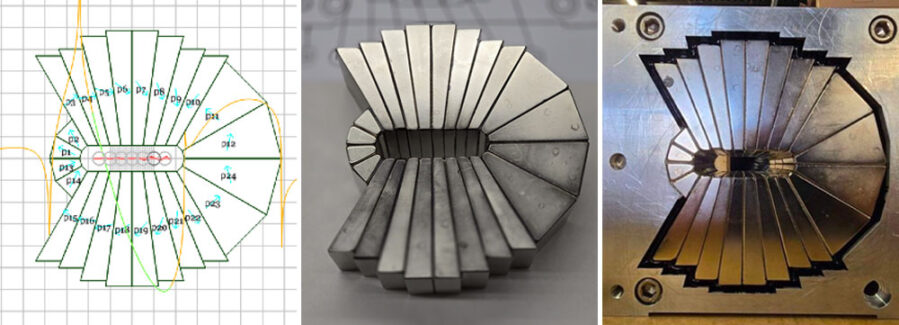
A chain of permanent magnets designed at Brookhaven National Laboratory has successfully transported cancer-killing proton beams across an unprecedented energy range, opening pathways toward ultra-fast “flash” radiation therapy that could destroy tumors while sparing healthy tissue.
The magnetic array guided proton beams from 50 to 250 million electron volts—the highest energy range ever achieved with this fixed-field technology.
The innovation addresses a critical limitation in current proton therapy: today’s accelerators cannot rapidly switch between energy levels, preventing doctors from delivering the split-second, high-dose treatments that research suggests could revolutionize cancer care. The Brookhaven design eliminates this constraint using permanent magnets that require no electrical power yet precisely control beam paths.
The Promise of Flash Therapy
“It’s really like a flash, essentially an ultra-high dose-rate beam,” explained Samuel Ryu, chair of the Department of Radiation Oncology at Stony Brook Medicine, who partnered with Brookhaven researchers. This ultra-rapid delivery method shows remarkable promise because “adjacent normal tissues appear to be better preserved” when radiation arrives in very high doses delivered in milliseconds rather than minutes.
Current proton therapy already offers advantages over conventional X-ray treatment. While X-rays deposit energy throughout their path, including beyond tumors, protons stop and release most energy at a precise depth determined by their energy level. This targeting capability reduces collateral damage, but existing systems lack the agility for rapid energy switching.
“The main advantage in proton or other particle radiation therapy is that the beam stops and deposits most of its energy in one place,” noted Brookhaven physicist Dejan Trbojevic, who architected the magnetic array alongside designer Stephen Brooks.
Engineering Precision at Magnet Scale
The breakthrough lies in Brooks’s ingenious permanent magnet design. Each of nine magnets consists of wedge-shaped pieces arranged in an oval configuration with a horizontal opening for beam passage. When arranged in a slightly curved arc, the magnets create varying field strengths—strongest at the outer edge, weaker toward the center.
This gradient allows different energy beams to follow distinct, stable paths simultaneously. “All of the energies are possible all of the time,” Brooks emphasized. “That’s why we can deliver both high dose rates and rapid energy scaling.”
The engineering challenge was substantial. Protons require significantly more powerful magnetic fields than the electrons used in Brookhaven’s earlier CBETA accelerator project. “These magnets have about triple the field of CBETA because, for a hospital, you want it to be as small as possible,” Brooks explained.
Hospital-Scale Innovation
The compact design could reshape cancer treatment infrastructure. A complete accelerator using this technology would measure approximately 30 feet by 10 feet—small enough for typical hospital wings and dramatically smaller than current football-field-sized proton therapy facilities.
Rapid energy switching would enable doctors to target tumors more effectively by instantly adjusting beam penetration depth. As Ryu noted, “different energies give you different depths of proton energy deposit. You can select these different energies instantaneously, so you can cover large tumors, especially for deep-seated tumors in the prostate, kidneys, pancreas, and brain.”
Key advantages of the magnetic array system include:
- Instant energy switching without power ramping delays
- Simultaneous availability of all energy levels
- Compact design suitable for hospital environments
- Reduced infrastructure and operating costs
From Physics Lab to Patient Care
The project exemplifies how fundamental physics research translates into medical applications. The team collaborated with SABR Enterprises, LLC, to manufacture the precision magnet assemblies, with testing conducted at Brookhaven’s NASA Space Radiation Laboratory using actual proton beams.
“When Stephen reached out about producing these magnet arrays, we immediately knew we wanted to be involved,” said Robert Mercurio, president and technical director at SABR. The industrial partnership required developing specialized tooling to position individual magnet blocks with extreme precision.
Testing confirmed the system’s capabilities across the planned energy spectrum, with proton beams passing through the magnetic array exactly as computer models predicted. Future tests will evaluate lower energy beams from 10-50 MeV using Brookhaven’s Tandem Van de Graaff facility.
The Path to Clinical Reality
While promising, significant development remains before patients could benefit from this technology. The current nine-magnet array represents just one section of a proposed racetrack-shaped accelerator requiring two curved arcs connected by straight sections.
The complete system would need to maintain beam stability for up to 6,000 circulation turns—nearly 1,000 times more than the CBETA system. However, the fundamental physics has been proven, and the path forward seems clear.
“An immediate goal is to do some cell culture research,” Ryu noted. “As a researcher and clinical investigator and a physician, I want to move this technology into patient care, hopefully in my time.”
The research represents taxpayer-funded science delivering direct societal benefits, as emphasized by Brookhaven Associate Laboratory Director Abhay Deshpande: “This work highlights important advances in accelerator science and technology gained through years of building accelerators for fundamental physics research—and how that research can directly benefit society.”