

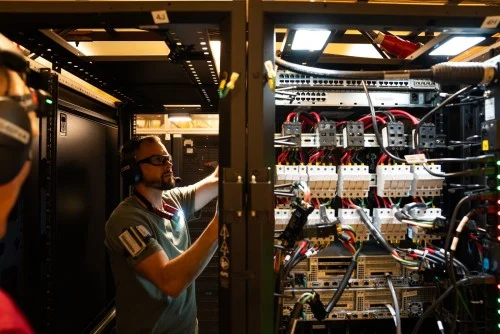
The future of AI-driven science just gained a powerful ally. Researchers at Pacific Northwest National Laboratory (PNNL) and Micron have unveiled the Crete computer system, a novel testbed designed with 15 terabytes of active memory to support data-intensive applications. Installed in Richland, Washington, and launched on August 12, 2025, Crete is already being used to accelerate chemistry, materials science, and molecular biology research. Unlike conventional high-performance computing (HPC) systems that prioritize processing speed, Crete emphasizes memory capacity, offering a groundbreaking architecture purpose-built for artificial intelligence and scientific discovery.
Reinventing Memory for Scientific AI
The Crete system, funded by the Department of Energy’s Office of Science through the Advanced Scientific Computing Research program, represents a co-design effort between Micron engineers and PNNL scientists. Its defining feature is a hybrid memory architecture that combines tightly coupled Registered Dual In-line Memory Modules with custom Compute Express Link (CXL) controller boards developed by Micron. This configuration, enabled by XConn Technologies’ I/O memory switch, allows memory to be shared and accessed by multiple processors simultaneously, an ability unmatched in current DOE or commercial HPC systems.
“The Crete system represents a bold leap forward in redefining how memory and compute can work to unlock scientific discovery,” said Mark Helm of Micron.
The 15 terabytes of memory equates to the capacity of 240 laptops operating together in real time, a scale designed to meet the demands of AI models analyzing vast scientific datasets. The platform provides what developers describe as a “memory chat room,” where databases, algorithms, and AI agents can exchange information in real time, generating predictions, analyzing results, and suggesting research directions.
First Applications: Chemistry and Generative AI
PNNL computer scientists and chemists are among the first to run applications on Crete, including ExaChem, a computational chemistry software adapted to use CXL memory. Generative AI algorithms trained on scientific data, rather than text, will also be tested. “We have computational chemistry applications that are going to use this larger memory space right away,” said James Ang, chief scientist for computing at PNNL. “We’re excited to find out what Crete can do with generative AI analyzing scientific data.”
This new architecture is designed to accommodate “orphaned” applications, scientific problems that cannot be partitioned across distributed memory systems but instead require direct access to large, unified memory pools. Such workloads include molecular modeling, advanced materials design, and genomics research.
Cybersecurity and Open-Source Tools
PNNL developers have integrated cybersecurity protections at the design stage, targeting memory vulnerabilities often exploited in computing systems. Crete also builds on prior investments in Software Defined Architectures, an open-source toolchain for specialized machine learning accelerators. By leveraging both security-by-design and community-driven software, the project ensures that Crete’s architecture will be both robust and adaptable to evolving research needs.
Bridging to Exascale
DOE’s Accelerate initiative supported Crete’s integration with ExaChem through the Transferring Exascale Computational Chemistry to Cloud Computing Environment and Emerging Hardware Technologies (TEC4) project. These efforts anticipate the architecture of next-generation DOE supercomputers, expected within the next decade. “This investment bridges the gap between today’s computing infrastructure and those coming on-line in the next decade,” said Ang.
Key Findings
- Location: Pacific Northwest National Laboratory, Richland, Washington
- System: Crete prototype computer system, launched August 12, 2025
- Memory: 15 terabytes active memory, equal to 240 high-end laptops
- Architecture: Hybrid tightly coupled DDR5 RDIMM + loosely coupled CXL boards via XConn switch
- Funding: DOE Office of Science, Advanced Scientific Computing Research program
- Applications: Computational chemistry, generative AI for scientific data, molecular modeling
- Security: Cybersecurity protections built into design phase
Takeaway
Crete is a pioneering computer system co-designed by PNNL and Micron to overcome memory bottlenecks in AI-driven science. With 15 terabytes of active memory and a novel CXL-based architecture, it enables researchers to tackle data-intensive applications in chemistry, materials science, and biology that traditional HPC systems cannot handle efficiently.
Journal: N/A (infrastructure announcement)
DOI: N/A