

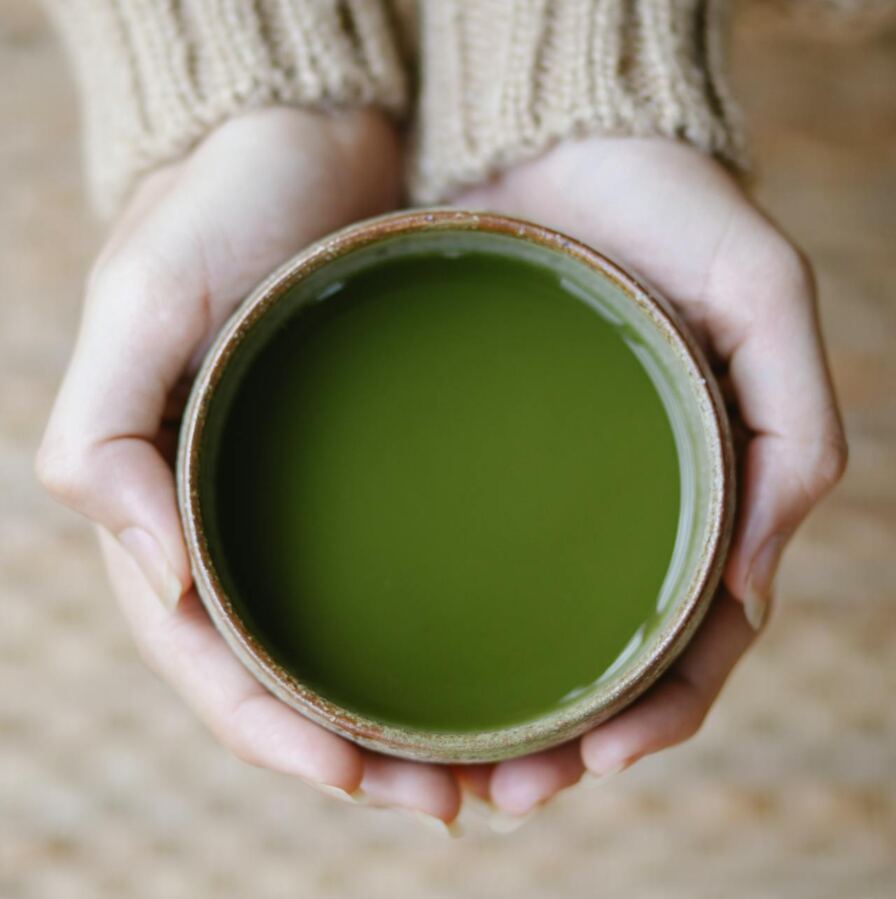
The powder is an implausible colour. Chlorophyll-dense, almost fluorescent, it turns water the shade of a well-lit aquarium when you whisk it in. Matcha has been drunk ceremonially in Japan for centuries, and in the last decade or so it has migrated to every coffee shop with exposed brickwork and a point to make. The stuff is dense with bioactive compounds: catechins, polyphenols, L-theanine, caffeine, a small pharmacopeia in a single ceramic bowl. What researchers at Hiroshima University now think it might also do, at least in mice, is turn down the volume on hay fever in the brain.
Allergic rhinitis affects somewhere between 10 and 40 per cent of the global population, depending on which estimate you trust and where. Sneezing, runny nose, itchy eyes, the sensation that your entire face is staging a revolt. The standard treatment is antihistamines, nasal corticosteroids, or for severe cases, allergen immunotherapy. All of them work by intervening in the immune cascade: the IgE antibodies that arm mast cells, the histamine release, the inflammatory surge. The assumption, mostly unchallenged, is that to stop allergic sneezing you have to stop the immune reaction that triggers it.
That assumption may not be entirely right. When Professor Osamu Kaminuma and colleagues at Hiroshima’s Research Institute for Radiation Biology and Medicine gave matcha to mice engineered to experience hay fever symptoms, the mice sneezed substantially less. Nothing unusual there, perhaps; several green tea compounds have shown similar effects in animal models before. What was unusual was that none of the expected immune markers changed. IgE levels were unaffected. Mast cell responses were unaffected. Inflammatory cell infiltration of the nasal mucosa was unaffected. The immune system was doing exactly what an allergic immune system does. The sneezing just wasn’t following instructions.
So where was the matcha acting? The team went looking in the brain.
Kaminuma’s group examined activity in a region of the brainstem called the ventral spinal trigeminal nucleus caudalis, or Sp5C. A key relay in the circuit that handles nasal sensory input, the Sp5C is more or less where the decision to sneeze is processed. The researchers tracked its activity using a molecular marker called c-Fos, a gene whose expression spikes when neurons fire in response to intense stimulation. In allergic mice, histamine exposure lit up c-Fos expression in the Sp5C as you’d expect. In mice that had received matcha, the same histamine exposure produced c-Fos activity close to baseline. Nearly abolished, in the language of the paper. The sneezing reflex, viewed from this vantage point, had been quieted directly. “Oral matcha reduced sneezing without clearly changing major immune markers,” Kaminuma said. “Instead, it strongly suppressed brainstem neuronal activation linked to the sneezing reflex.”
The finding matters because the prevailing model of allergic rhinitis has always been primarily immunological. Hay fever treatments work upstream: intercept the antibody, block the receptor, dampen the mast cell. The Hiroshima data, published in npj Science of Food, suggests there may be a parallel route, one that bypasses the immune machinery and acts directly on the neural reflex that makes you sneeze. Allergy without immunity, in a sense; the inflammatory signals are all still running, but the brainstem stops listening.
Why matcha rather than ordinary green tea? The short answer is that matcha is the whole leaf. When you drink standard infused green tea, you’re consuming the soluble extract (what leaches into hot water). The residue, which contains fibre, chlorophyll, and portions of the polyphenol content that don’t readily dissolve, gets discarded. Matcha is consumed as a full suspension of powdered leaf, extract and residue together, which means the bioavailable dose of various compounds is considerably higher. Several green tea components (epigallocatechin gallate, gallic acid, pyrogallol) have shown anti-allergic effects in rodent models, though typically through IgE suppression rather than the neural route observed here. The Hiroshima team found no evidence that these immune-modulatory compounds were responsible in this instance. Their dose of EGCG fell well below the threshold demonstrated to affect IgE in prior studies. Something else, apparently, was doing the work.
What, exactly, remains unknown. The researchers found that when they tested matcha extract on T cells in the lab, gene expression was barely changed: only 12 genes out of more than 9,000 stimulation-induced changes were significantly affected, and none of them were obvious immune regulators. The microbiome, another fashionable candidate for almost everything these days, also appeared uninvolved; matcha did not meaningfully alter gut bacterial diversity. The leading hypothesis involves crosstalk between the sensory and autonomic nervous systems. Matcha has a reasonably well-documented stress-reducing effect (in animals and in small human trials), and the compounds thought responsible (L-theanine, arginine, caffeine, EGCG in combination) are known to modulate autonomic activity. The sneeze reflex is influenced by the autonomic nervous system as well as by direct sensory input. It’s plausible, then, that something in matcha is dampening the autonomic component, which reduces the Sp5C’s responsiveness even when the nasal mucosa is awash in histamine. Plausible, but not yet established.
The study has limits that warrant mentioning. All the data come from mice, not people. The c-Fos immunohistochemistry was performed on three animals per group, which is quite a small number; the neural suppression findings are striking trends rather than clean statistical significance in every test. The specific compound responsible for the neural effect has not been identified. Kaminuma is straightforward about the gap between what the data show and what they imply: “Human studies suggest green tea may relieve allergic rhinitis, but how it works is unclear.” The goal here, it seems, is to close that mechanistic gap carefully rather than prematurely.
The research also raises a question that existing hay fever pharmacology hasn’t needed to ask much: what does it mean to suppress the sneeze reflex rather than the allergic response? In theory you could be leaving the underlying inflammation intact while silencing one of its most disruptive symptoms. That might be clinically useful (symptoms are what drive people to reach for medication) but it’s worth knowing whether the two strategies are genuinely independent or whether neural suppression of sneezing feeds back into the inflammatory process in ways that are harder to track. Those experiments, presumably, come next.
The antihistamine era has been enormously useful, but also frustrating. The drugs work, often well, yet they make some people drowsy, interact with other medications, and address only one component of a multi-pathway reaction. A food-based option that acted through an entirely separate mechanism and could be combined with standard care would be, if it proved out in humans, rather more interesting than another receptor antagonist. “The goal,” Kaminuma said, “is an evidence-backed, food-based option that complements standard care for allergic rhinitis symptoms.” The cup of matcha has been waiting in that role, ceremonially speaking, for several centuries. Whether it earns the designation pharmacologically depends on whether the mice are telling the truth.
DOI / Source: https://doi.org/10.1038/s41538-026-00777-9
Frequently Asked Questions
Not on the basis of this study alone. All the experiments were conducted in mice, and there’s no clinical trial data yet showing the effect translates to humans. The researchers are explicit that further work is needed before matcha could be recommended as a treatment or supplement for allergic rhinitis. If you already drink it and enjoy it, there’s probably no harm, but it’s not a substitute for antihistamines or other prescribed therapies.
The researchers think matcha acted directly on the neural circuit responsible for the sneeze reflex, specifically a brainstem region called the Sp5C that processes nasal sensory signals and effectively decides whether a sneeze should happen. Activity in that region, tracked via a molecular marker called c-Fos, was nearly returned to baseline by matcha even when the mice were exposed to histamine. The immune cascade (IgE, mast cells, inflammatory cells) was running normally throughout.
Matcha is powdered whole-leaf tea consumed as a suspension, meaning you ingest both the soluble extract and the leaf residue. Standard brewed green tea delivers only what dissolves into the water. The result is a higher effective dose of bioactive compounds, including catechins and amino acids, that simply aren’t available in equivalent quantities from a standard cup. Some of those compounds have been linked to stress reduction and autonomic nervous system effects, which may be relevant to the neural mechanism observed here.
That hasn’t been determined yet, and it’s one of the key open questions the researchers flag. Matcha contains dozens of bioactive compounds, and the usual immune-modulating suspects (epigallocatechin gallate, gallic acid) don’t appear to account for what was observed here, since IgE and mast cell responses were unchanged. The working hypothesis involves L-theanine, arginine, caffeine, and EGCG acting together on the autonomic nervous system, but identifying the specific compound or combination will require further experiments.
Could this lead to new types of allergy treatments that work differently from antihistamines?
That’s the broader implication the research points toward. Current hay fever medications mostly work by interrupting the immune reaction upstream: blocking histamine receptors, suppressing IgE production, or dampening mast cell activity. A drug or supplement that instead targeted the neural reflex directly would work by a completely different mechanism and could potentially be combined with existing treatments for a more complete effect. Whether matcha itself, or an extracted component of it, could form the basis of such a treatment depends on much more clinical work, including identifying the active compound and demonstrating safety and efficacy in humans.
Key Takeaways
- Matcha may help reduce sneezing in mice with hay fever by acting on the brain rather than the immune system.
- Researchers found that matcha suppressed neural activity linked to the sneeze reflex without altering immune markers.
- This suggests a new treatment approach for allergic rhinitis that targets neural pathways instead of immune responses.
- Matcha provides a higher concentration of bioactive compounds compared to regular green tea, which could be more effective.
- Further research is needed to confirm these findings in humans and identify the specific compounds responsible for the effect.