

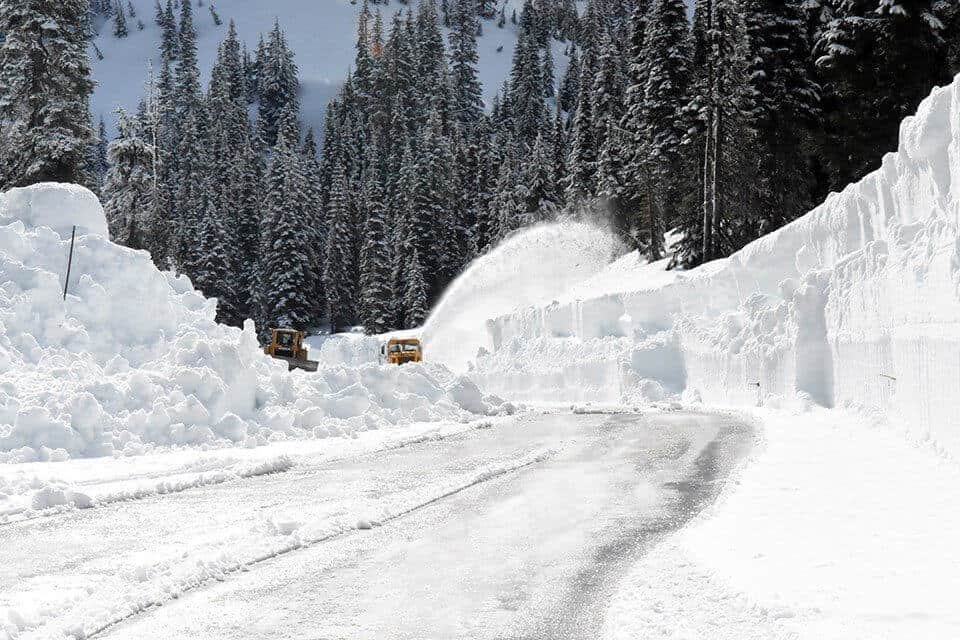
The mountain West has always made a sport of humbling forecasters, its snowpack shifting with every canyon kink and wind-scoured ridge, its storms producing featherlight powder one day and soggy concrete the next.
In new research from the University of Utah, scientists try to bring order to this unruly world by teaching an algorithm to understand the snow-to-liquid ratio, the deceptively simple number that decides how much snow actually piles up. The work uses six years of meticulous, manually gathered data from 14 high mountain sites and it challenges a century of rough guesses that shaped Western forecasts.
Learning To See What The Mountains Are Hiding
Weather models can estimate snowfall, but they struggle with the mathematics of snow density. Western storms do not behave like their Eastern counterparts, and the region’s steep terrain creates mile by mile variations that defy the old 10 to 1 rule of thumb. The research team leaned into this complexity, blending atmospheric inputs with hard won field measurements taken by ski patrols and avalanche professionals, people who literally shovel and weigh the storm as it falls.
“If you don’t have a good snow-to-liquid ratio, your snowfall forecasts are not going to be as good,” said Peter Veals, a research assistant professor of atmospheric sciences.
The scientists trained multiple linear regression and random forest models using temperature, wind speed, humidity, solar altitude, convective potential and high resolution precipitation forecasts. The variables read like a catalog of the ways storms build and collapse in complex terrain, yet the surprise is how much insight came from hand collected snow cores, not satellites or automated sensors. You sense a kind of quiet defiance in the study, as if the researchers are arguing that sometimes progress depends not on more circuitry but on more patience.
The random forest model emerged as the strongest performer, explaining nearly half of the variance in snow density. That may sound modest, but in a field where operational tools often capture less than a quarter of the variability, it is transformative. The model outpaces long standing operational techniques that wander between R2 values of 0.04 and 0.23. In the West, where storms can flip from fluff to slush within hours, that difference translates to better avalanche forecasting, smarter resource planning and safer travel in winter corridors.
The Craft Behind The Data
The true engine of this research is the labor behind the measurements. For every parameter fed into the machine learning model, someone had to stand in the cold and measure the storm by hand. The study depends on a kind of observational craftsmanship that is easy to overlook in an era that loves automation. The paper seems to suggest that these expert observers, perched on ridgelines and canyon mouths, are as essential as any algorithm.
“No one’s out there twice a day with a tube on a board, taking the core, weighing the snow, recording it, sweeping the board for the next day, recording the time they took the observation,” Veals said.
The data come from places where avalanches are a daily concern and where the snowpack is scrutinized not out of scientific curiosity but out of necessity. The precision is striking. Each site logged daily or twice daily observations over six winters, a rhythm of attention that would be impossible without skilled patrol teams committed to understanding how storms are building above their heads.
The resulting model is not perfect, and the researchers do not pretend otherwise. It is simply better, leaner and more practical than existing methods. One competing algorithm offered slightly more skill but demanded ten times the computational power, an extravagance incompatible with forecasts that must update every six hours. The random forest approach fits the tempo of real world forecasting, finishing its work in minutes rather than hours, a tempo that better matches the speed of mountain weather itself.
The study, published in Weather and Forecasting, marks a shift in how scientists think about snowfall prediction in the West. It accepts that these landscapes are unruly and that the snow they generate refuses to be simplified. Forecasting, in this view, becomes an act of listening more closely to the mountains, trusting the people who know them best and teaching the machines to follow their lead.