

In the clouded mountain forests of Central and South America, some of the fiercest duels are fought with beaks that double as spears.
In a new study led by scientists at the University of Washington’s Burke Museum and published in the Journal of Experimental Biology, researchers show that male green hermit hummingbirds have evolved bills that are not just for sipping nectar, but for stabbing rivals during high stakes mating battles. Their findings reveal that male bills are straighter, sharper and structurally stronger than those of females, boosting their performance as weapons without entirely sacrificing their role as feeding tools.
The green hermit hummingbird does not just defend flowers, it defends its place in a social arena. Males gather in forest clearings known as leks, where each bird claims a perch and sings for passing females, then lashes out at any rival that comes too close. For Alejandro Rico-Guevara, associate professor of biology at the University of Washington and curator of birds at the Burke Museum, the scene is closer to nightlife than to nature documentary.
“They gather together at a place in the forest that looks just like a singles bar,” said Alejandro Rico-Guevara, an associate professor of biology at the University of Washington. “They all have perches, and if someone else takes their perch, their place in the singles bar, they go bananas, and they fight.”
Those fights are not metaphorical. Males raise their long, needle thin bills and drive them toward an opponent’s throat in mid air jousts. Yet the same bills have to survive the impacts and still function as delicate pipettes, reaching deep into flowers for nectar. A broken bill could mean starvation as well as social defeat.
3D Bills, Virtual Stabbings
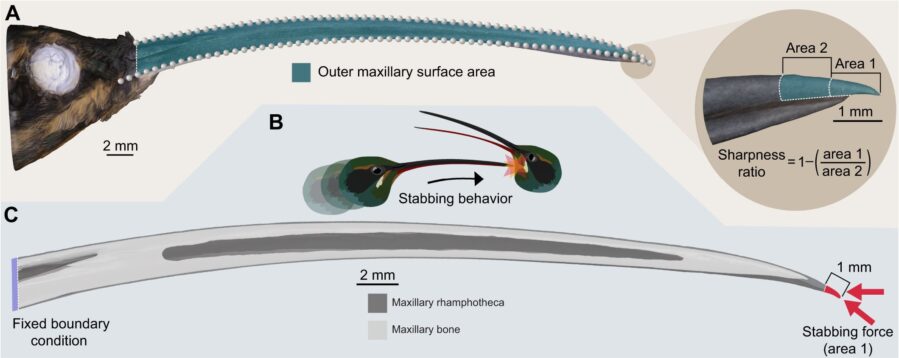
To understand how these conflicting demands have shaped bill evolution, the team turned to the Burke’s ornithology collection. They selected adult male and female green hermit specimens, then used high resolution photogrammetry to build three dimensional models of each upper bill. With those models, they could measure subtle differences in curvature, length, surface area and tip geometry that would be impossible to see with a ruler and calipers alone.
The numbers draw a clear dividing line between the sexes. Male bills are about 3 percent straighter and 69 percent sharper at the tip than female bills, with a distinctly dagger like point that females lack. Males also have larger bill surface area and slightly longer bills, pushing them toward a shape that is less curved, more spear like and more suited to reaching forward in a fight.
But the key question is not just shape, it is performance. To test that, the researchers CT scanned a representative male and female bill to capture their internal structure, then converted those scans into detailed computer models. Using finite element analysis, a technique borrowed from engineering, they simulated stabbing impacts at different angles and measured how stress and strain moved through each bill.
When they applied loads that mimicked a horizontal stab, the male bill clearly outperformed the female. In scaled comparisons that control for size, the male’s straighter bill expended 52.4 percent less energy in deformation, meaning more of the stabbing force is transmitted into the target instead of being lost in bending. It also experienced, on average, 39 percent less mechanical stress and was more resistant to breakage. In other words, the male bill is both stiffer and stronger as a stabbing weapon.
The straighter shape also gave males more leeway in how they strike. The simulations showed that male bills can handle a wider range of attack angles without a big drop in performance, which means a male does not have to be perfectly precise in the chaos of a mid air fight. Females, with their more curved bills, do not get the same margin for error.
Weapons Hidden In Plain Sight
For decades, differences in hummingbird bill shape have mostly been interpreted through the lens of feeding ecology. In many species, males and females use bills of different lengths or curvature to specialize on different flowers, easing competition between the sexes. The new study, however, shows that in the green hermit and its close relatives, social combat can be just as important as nectar when it comes to shaping bill anatomy.
Rico-Guevara sees the male bill as a tool that has been pushed in two directions at once, toward efficient nectar extraction and toward effective stabbing.
“Adult male green hermits have reinforced bills because they fight so much,” Rico-Guevara said. “It’s the same tool, but in very different contexts. This is an example of how much we can still learn from sexual dimorphism in nature.”
The work adds the green hermit to a short but intriguing list of birds with intrasexually selected weapons derived from existing body parts. It is also, the authors note, the first time finite element analysis has been used to test hypotheses about sexual selection in birds, offering a framework for uncovering other hidden weapons that might be lurking inside museum drawers.
Future field studies of lekking behavior and real world combat will be needed to link bill shape directly to reproductive success. For now, the combination of museum specimens, 3D modeling and virtual stabbing suggests that some hummingbirds have turned their nectar straws into finely tuned daggers, weaponizing a structure that most of us only ever see hovering politely at a flower.
Journal: Journal of Experimental Biology
https://journals.biologists.com/jeb/article/228/21/jeb250769/369723