

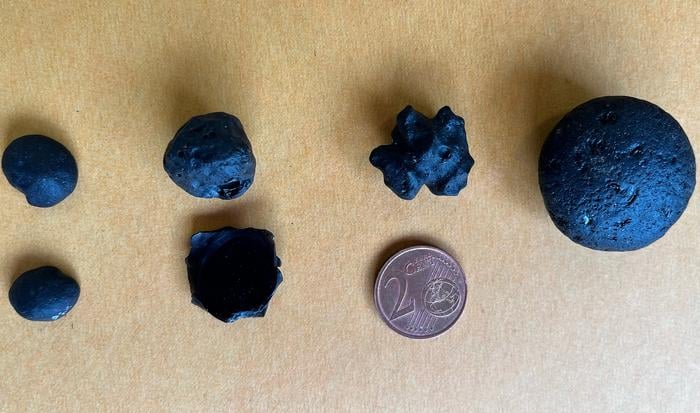
Scientists have discovered a mysterious type of glass scattered across South Australia that records evidence of a massive asteroid impact from 11 million years ago, yet the crater remains completely hidden from view.
The discovery centers on rare tektites, natural glasses formed when space rocks slam into Earth with such force that they melt surface material and hurl it hundreds or thousands of kilometers through the atmosphere. These newly identified tektites, dubbed “ananguites” after the Aboriginal Anangu people of the region, represent only the sixth confirmed tektite field worldwide.
“These glasses are unique to Australia and have recorded an ancient impact event we did not even know about,” said Professor Fred Jourdan from Curtin University’s School of Earth and Planetary Sciences.
The ananguites differ dramatically from Australia’s famous Australasian tektites, which formed 780,000 years ago from an impact that scattered debris across half the globe. Chemical analysis reveals these older glasses have an unusual composition suggesting their source crater lies not in Australia, but somewhere in the volcanic island arcs surrounding it, possibly in Indonesia, the Philippines, or Papua New Guinea.
A Chemical Fingerprint Points Offshore
Lead researcher Anna Musolino from Aix-Marseille University and her international team analyzed 14 specimens using advanced dating techniques and geochemical analysis. The glasses contain unusually high levels of nickel, chromium, and cobalt, reaching concentrations 15 times higher than typical crustal rocks. This chemical signature points to contamination from a chondritic meteorite, the most common type of space rock.
What makes the discovery particularly intriguing is the andesitic composition of the target rock, which matches active volcanic arcs rather than the continental crust typical of most impact sites. The team’s isotopic analysis narrowed potential source locations to three regions: the Luzon Arc in the Philippines, the Sulawesi Arc in Indonesia, and the Bismarck Arc near Papua New Guinea.
“While the Australasian tektites formed about 780,000 years ago and are spread across half the globe, these tektites are much older and their discovery suggests a previously unrecognized giant impact,” Musolino explained.
The researchers used magnetic susceptibility measurements and specific gravity tests to identify the specimens among thousands of tektites in museum collections. The ananguites consistently sank in heavy liquids that allowed normal tektites to float, revealing their higher density.
Missing Crater Raises Questions
Despite evidence for an impact powerful enough to create a 900-kilometer-wide debris field, the source crater remains elusive. The researchers estimate it should measure at least 26 kilometers in diameter based on the extent of the tektite distribution. Such a massive scar could easily have been overlooked in regions like Papua New Guinea, where circular geological features are commonly attributed to volcanic processes rather than impacts.
The team found subtle but systematic differences between tektites from the western and eastern parts of the field. Western specimens contain more gas bubbles and inclusions of lechatelierite, a form of shocked quartz glass, suggesting they experienced lower temperatures and may have landed closer to the impact site. This pattern could help pinpoint the crater’s location in future searches.
Precise argon-argon dating yielded an impact age of 10.76 million years ago, with an uncertainty of just 50,000 years. No known craters of compatible age and size exist anywhere near Australia, strengthening the case that the source lies in the offshore volcanic regions.
The discovery adds to growing evidence that large asteroid impacts may be more frequent than previously thought. Recent years have seen the confirmation of two additional tektite fields, bringing the global total from four to six confirmed strewn fields.
Understanding the frequency and magnitude of past impacts helps scientists assess future risks and develop planetary defense strategies. The ananguites serve as 11-million-year-old time capsules, preserving a record of cosmic violence that shaped Earth’s history in ways we’re only beginning to understand.
Earth and Planetary Science Letters: 10.1016/j.epsl.2025.119600