

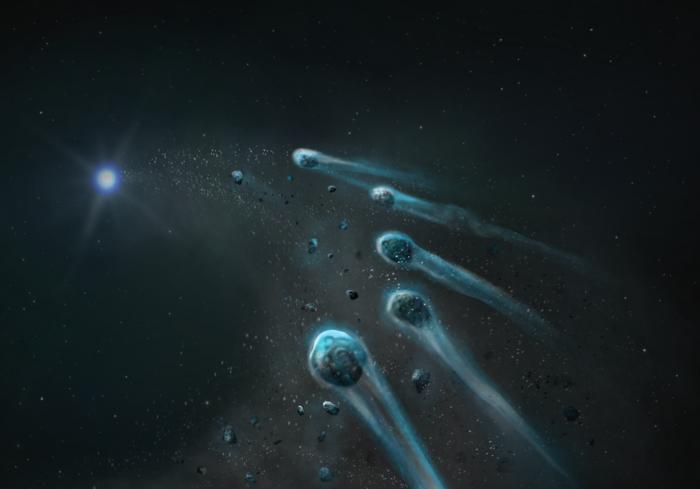
Astronomers have discovered a stellar crime scene 1,400 light-years away, where a white dwarf star is slowly consuming an icy planetary fragment remarkably similar to objects in our own solar system’s outer reaches. The find offers the first clear evidence that water-rich worlds exist beyond our cosmic neighborhood.
The white dwarf WD 1647+375 has been caught in the act of accreting material from what researchers believe was once a dwarf planet fragment, possibly similar to Pluto or a large comet. Using the Hubble Space Telescope’s ultraviolet spectroscopy capabilities, astronomers detected an unusual chemical signature that revealed the star’s cannibalistic feast.
“White dwarfs act like cosmic crime scenes – when a planetesimal falls in, its elements leave chemical fingerprints in the star’s atmosphere, letting us reconstruct the identity of the victim.”
Lead researcher Snehalata Sahu from the University of Warwick explained that while white dwarfs commonly show signs of rocky material being absorbed, finding evidence of volatile-rich debris has been confirmed in only a handful of cases. This particular discovery stands out for its exceptionally high nitrogen content.
A Stellar Autopsy Reveals Secrets
The key breakthrough came through detecting nitrogen, which comprised about 5% of the accreted material’s mass – the highest nitrogen abundance ever found in white dwarf debris. This chemical fingerprint, combined with oxygen levels 84% higher than expected from rocky material, painted a clear picture of an icy world meeting its demise.
The data suggests the consumed object was at least 3 kilometers across, though it could have been as large as 50 kilometers in diameter with a mass reaching a quintillion kilograms. More intriguingly, the planetesimal appears to have been 64% water ice, making it remarkably similar to Kuiper Belt objects like Pluto that orbit beyond Neptune in our solar system.
Professor Boris Gänsicke, the study’s second author, noted the significance extends beyond mere astronomical curiosity. The discovery provides compelling evidence that the building blocks necessary for life – water and volatile compounds – exist in planetary systems throughout the galaxy.
Thirteen Years of Cosmic Dining
Perhaps most remarkably, this stellar feast has been ongoing for at least 13 years, with the white dwarf consuming roughly 200,000 kilograms of material per second – equivalent to the weight of an adult blue whale every second. The prolonged feeding frenzy suggests the original object was substantial, possibly a fragment from a larger dwarf planet that wandered too close to its stellar grave.
“We think that the planetesimal being absorbed by the star is most likely a fragment of a dwarf planet like Pluto.”
The research team determined that the icy object had an ice-to-rock ratio of 2.5, higher than typical Kuiper Belt objects and consistent with material that might have originated from the crust or mantle of a Pluto-like world. Whether this doomed planetesimal formed within the original planetary system or represents an interstellar wanderer captured from deep space remains an open question.
This discovery highlights the unique power of ultraviolet spectroscopy in detecting volatile elements like carbon, sulfur, oxygen, and especially nitrogen in distant stellar systems. Such observations will prove crucial as astronomers continue searching for the chemical signatures that could indicate potentially habitable worlds orbiting other stars.
The findings suggest that icy, water-rich bodies – essential ingredients for life as we know it – may be common features of planetary systems beyond our own, offering new hope in the search for potentially habitable worlds scattered throughout the cosmos.
Monthly Notices of the Royal Astronomical Society: 10.1093/mnras/staf142