

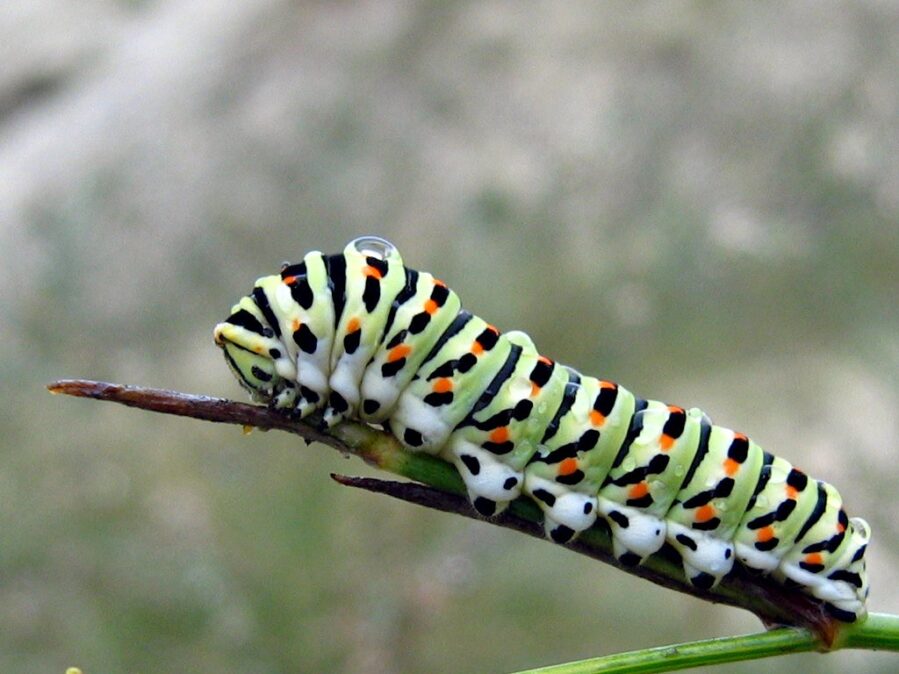
Soft robots are learning from caterpillars. Researchers at Chung-Ang University in South Korea have developed lightweight, paper-based soft robots that crawl forward using asymmetric bending motions powered by heat.
Their design, published in Advanced Functional Materials, uses simple copper-plated paper electrodes paired with liquid crystal elastomers to achieve controlled, directional locomotion without the complexity of conventional robotic heating systems.
Nature as a Blueprint for Robotics
Biological organisms have long inspired engineers designing flexible machines. Caterpillars, in particular, move efficiently by bending and stretching in sequence. The Chung-Ang team, led by Professor Suk Tai Chang and Assistant Professor Changyeon Lee, set out to replicate this natural motion in a robotic system that is low-cost, energy-efficient, and easy to fabricate.
Prof. Chang explained the inspiration directly:
“Our motivation for this work comes from the fascinating world of nature, specifically the crawling motion of caterpillars. We were intrigued by how such a simple organism could achieve highly efficient locomotion through sequential bending and stretching.”
Why Paper Works
Instead of using expensive substrates and complex heating circuits, the researchers turned to cellulose-based paper. This porous and flexible material allowed them to deposit copper electrodes asymmetrically through a simple plating process. By varying electrode widths, the team induced electrical resistance gradients, which in turn created temperature gradients across the paper. The liquid crystal elastomer bilayer bonded to the paper bent unevenly when heated, producing the alternating lift and push that drives crawling.
Prof. Lee highlighted the material advantage: “Cellulose-based paper substrates provide distinct advantages due to their porous structure, which enables facile electrode deposition via solution-based processes and offers high mechanical deformability.”
How the Robots Move
The design operates on three key steps:
- Electrode patterning: Copper is deposited on paper with asymmetric widths.
- Resistance gradients: Wider and narrower electrodes create differences in heat when current passes through.
- Asymmetric bending: The bonded liquid crystal elastomer bends unevenly, mimicking caterpillar crawling.
This system works at a low actuation voltage of just 0.5 volts, making it highly energy-efficient compared with existing soft robots that require higher inputs. The researchers demonstrated controlled directional motion with lightweight robots that are only a few millimeters thick.
Future Applications
The team envisions their crawling paper robots being deployed in environments unsafe or inaccessible for humans, such as collapsed structures, contaminated sites, or remote natural habitats. Because the paper-based electrodes are simple to produce and eco-friendly, the approach offers a pathway to scalable, sustainable soft robotics.
Prof. Chang emphasized the broader potential: “This novel mechanism enables directional and controlled movement for soft robots.” By marrying abundant materials with clever electrode design, the study suggests that soft robotics could soon become more affordable, adaptable, and widespread.
Looking Ahead
From environmental monitoring to medical exploration, these paper-based crawlers point to a future where soft robots extend human reach without heavy machinery. The team’s next step will be refining motion control and exploring multi-legged configurations for more complex navigation.
Journal: Advanced Functional Materials
DOI: 10.1002/adfm.202512328