

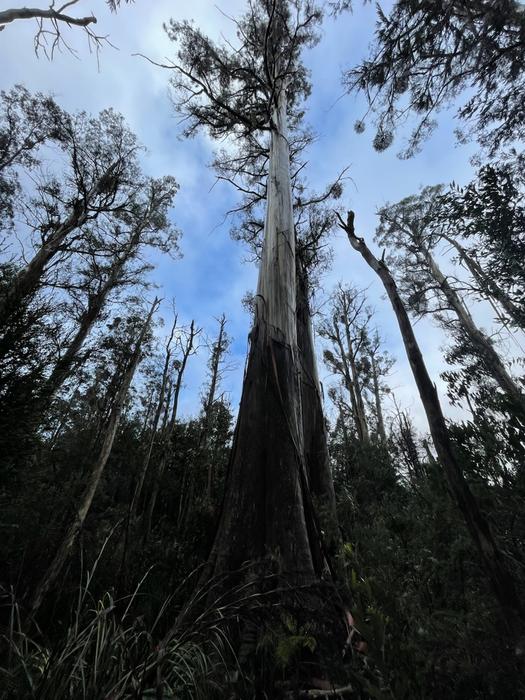
Ancient giants are falling silent in Australia’s highlands. New research shows that Victoria’s mountain ash forests, among the most carbon-dense ecosystems on Earth, are rapidly thinning as rising heat and water stress drive tree deaths.
Published in Nature Communications, the study finds that warming will cut tree density in these towering eucalyptus forests by nearly a quarter by 2080, turning them from carbon sinks into carbon sources. Drawing on five decades of monitoring data, researchers from the University of Melbourne and the University of New Hampshire warn that climate stress is reshaping forests once seen as powerful bulwarks against climate change.
Forests Under Pressure
The mountain ash (Eucalyptus regnans), native to southeastern Australia, grows taller than 90 meters and stores more carbon per hectare than the Amazon. But these forests are now losing trees faster than they can replace them. The research team analyzed long-term data from Victorian plots, showing that each degree of warming reduces forest carrying capacity by about 9 percent. A three-degree rise by 2080 could eliminate 240,000 hectares of mature forest carbon equivalent, or 108 million tonnes of carbon stock.
Lead author Dr Raphael Trouvé of the University of Melbourne explained how the process unfolds. Trees under heat and water stress enter fierce competition for limited resources. Larger individuals outcompete smaller ones, accelerating natural thinning. As dead trees decompose, the forests shift from absorbing carbon dioxide to emitting it, undermining global reforestation strategies.
“Australia’s mountain ash forests are one of the Earth’s most carbon-dense ecosystems, but our study reveals how climate warming could turn them from carbon sinks into carbon emitters,” said Dr Trouvé (University of Melbourne).
Carbon and Climate Consequences
The emissions impact is stark. Researchers estimate that decomposition from these losses could equal the output of one million cars each driving 10,000 kilometers a year for 75 years. These projections do not account for wildfires, which are expected to become more frequent and intense under climate change, further compounding the problem. Beyond carbon, the thinning has implications for water supply, since mountain ash forests regulate streamflow feeding Melbourne’s reservoirs.
Management Options and Limits
One approach under consideration is selective thinning to reduce competition. By deliberately removing some trees, managers could mimic natural self-thinning but accelerate it, helping the remaining trees survive droughts and heat waves. Studies worldwide have shown that carefully thinned forests often grow faster and endure better during dry spells. Still, even with interventions, the projected climate-driven declines suggest that massive new plantings would be needed to compensate for losses, straining the feasibility of tree-based climate solutions.
Key Findings
- Sample: Data from 112 plots, 1,302 measurements collected between 1947–2000 in Victoria, Australia.
- Main species: Mountain ash (Eucalyptus regnans), the world’s tallest flowering plant.
- Effect of warming: 9% tree density loss per 1 °C rise in temperature.
- Projection: 24% decline in tree density and carbon stock by 2080 under +3 °C warming.
- Carbon impact: Loss equivalent to 108 million tonnes, or emissions from one million cars driven 10,000 km per year for 75 years.
- Location: Central Highlands of Victoria, key source of Melbourne’s water supply.
- Management option: Selective thinning to increase resilience to drought and resource competition.
Global Implications
Forests worldwide are expected to experience similar stress. While cooler northern forests may temporarily gain capacity from longer growing seasons, those in warmer, drier regions are already losing carbon. The study highlights how climate change undermines large-scale reforestation initiatives, which assume static carrying capacity. Without adjusting for thinning under warming, projections for carbon storage may be overly optimistic.
Takeaway
Mountain ash forests, once among the planet’s most effective carbon sinks, are thinning rapidly under climate stress. By 2080, rising heat could turn them into carbon sources, releasing millions of tonnes of stored carbon and threatening water supplies. While management interventions like selective thinning may improve resilience, the findings underscore the fragility of tree-based climate solutions in a warming world.
Journal: Nature Communications
DOI: 10.1038/s41467-025-62535-x