

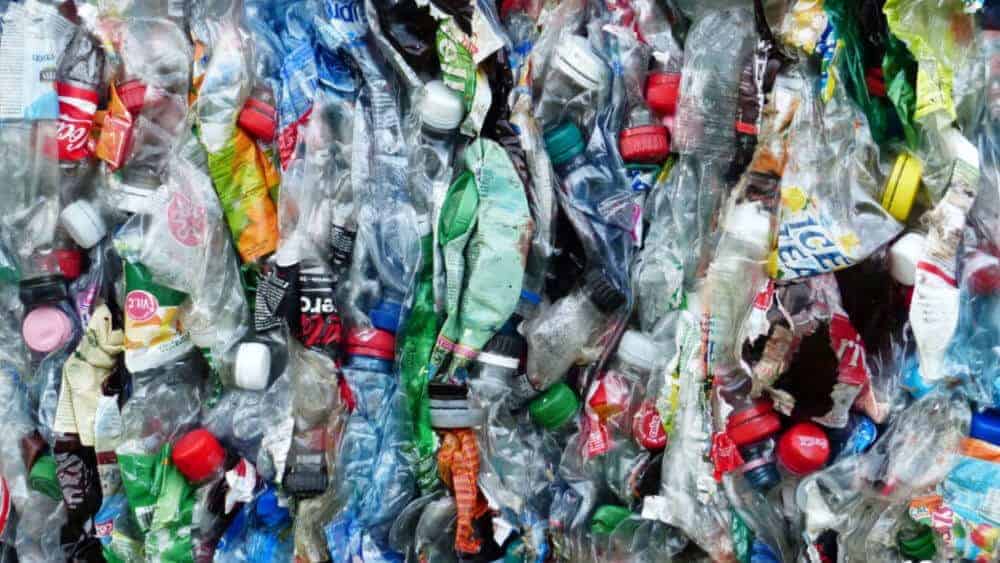
A stray plastic bottle on a mountain trail gave a chemist an idea about how plastics should die. In new work from Rutgers University, researchers report in Nature Chemistry that they have designed plastics whose molecular bonds can be programmed to fall apart under everyday conditions. The approach borrows a structural trick from natural polymers like RNA to let synthetic materials self destruct on schedule, without heat or harsh chemicals.
Copying Nature’s Quiet Clean Up
When Yuwei Gu went hiking in Bear Mountain State Park in New York, the polymer problem was impossible to ignore. Plastic bottles were scattered along the trail and floating on the nearby lake. Nature makes its own polymers, including proteins, DNA, RNA and cellulose, yet they do not accumulate like that. They do their job, then break down.
“Biology uses polymers everywhere, such as proteins, DNA, RNA and cellulose, yet nature never faces the kind of long-term accumulation problems we see with synthetic plastics,” said Gu, an assistant professor in the Department of Chemistry and Chemical Biology in the Rutgers School of Arts and Sciences. “I thought, what if we copy that structural trick? Could we make human-made plastics behave the same way?”
The answer, Gu realized on that trail, had to be in the chemistry. Natural polymers often carry small helper groups in just the right positions so that, when water or a tiny shift in shape nudges them, a crucial bond becomes easy to break. Synthetic plastics are built for durability, with strong bonds that rarely find themselves in such a vulnerable pose.
So Gu and colleagues asked a sharp question: instead of inventing completely new breakable bonds, what if they changed the way existing bonds sit in space? Their strategy, called conformational preorganization, is about how a polymer folds at the atomic level. By placing chemical neighbors in just the right orientation next to a cleavable bond, the team made that bond far more likely to snap when the time is right, even though its basic identity never changes.
Programming A Plastic’s Lifespan
In the new study, the researchers built model plastics whose backbones include a type of bond that can, in principle, be cleaved, but is usually quite stubborn. Then they engineered neighboring chemical groups so that, in some versions, these groups could swing into an attacking position, while in others they remained awkwardly out of reach.
Gu likens the effect to folding a sheet of paper along a crease so it tears cleanly later. By “pre folding” the polymer’s structure, the team created materials that fall apart thousands of times faster than similar plastics without that careful design. Yet until the trigger arrives, the plastics behave like conventional materials, strong enough for real world use.
“Most importantly, we found that the exact spatial arrangement of these neighboring groups dramatically changes how fast the polymer degrades,” Gu said. “By controlling their orientation and positioning, we can engineer the same plastic to break down over days, months or even years.”
This is where the work begins to look like a toolkit for reimagining everyday products. A take out container might be designed to hold its shape for hours, then crumble within days after disposal. A structural plastic in a car or building could be tuned to last for many years. The basic chemical scaffold stays the same, but subtle shifts in orientation set the clock.
The team pushed the idea across several levels of complexity. They showed that the same conformational trick works in flexible plastics dissolved in solvent and in rigid thermoset networks that normally resist deconstruction. They even engineered systems where light or metal ions act as switches, folding the polymer so that distant groups suddenly become neighbors and flip self deconstruction on or off.
From Pollution To Possibility
All of this is still early stage laboratory chemistry, not yet a ready made fix for the mountains of plastic waste in landfills and oceans. In initial tests, the liquid produced when the new plastics break down did not appear toxic, but the team is now studying the tiny fragments in more detail to be sure they are safe for living systems and the environment.
They are also exploring how to graft this molecular logic onto more familiar, commodity plastics and fit it into existing manufacturing processes. The same principles might someday underpin timed drug release capsules that vanish after delivering a dose, or self erasing coatings that peel themselves away when a device reaches the end of its life.
For Gu, the path forward is both technical and philosophical. Plastics will not disappear from modern life, but their afterlife can be rewritten.
“Our strategy provides a practical, chemistry-based way to redesign these materials so they can still perform well during use but then break down naturally afterward,” he said.
If that promise holds up outside the lab, the stray bottle on a mountain trail might eventually become a relic of older chemistry, a problem from the time before plastics knew how to leave.
Journal: Nature Chemistry
Article title: Conformational preorganization of neighbouring groups modulates and expedites polymer self-deconstruction
DOI: 10.1038/s41557-025-02007-3