
Potatoes may seem like distant cousins to tomatoes, but new research shows they’re much closer kin than anyone realized.
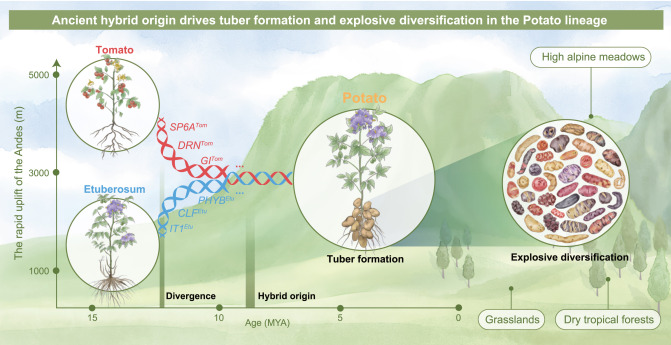
According to a study published in Cell, every potato on Earth owes its origin to a natural interspecies romance between a tomato-like plant and a wild South American relative about 9 million years ago. The offspring of that hybrid pairing not only survived—it evolved the game-changing ability to form tubers, a trait that helped potatoes thrive in harsh mountain climates and diversify into more than 100 wild species. This evolutionary mash-up ultimately gave rise to one of the world’s most important food crops.
Hybrid ancestry behind the tuber trait
For decades, scientists were puzzled by a contradiction in potato family history. The cultivated potato belongs to the Petota lineage, which looks almost identical to a group of Chilean plants called Etuberosum. But Etuberosum species don’t form tubers, the underground nutrient-storing organs that define a potato. Meanwhile, genetic studies consistently showed potatoes were more closely related to tomatoes than to tuberless Etuberosum.
To crack the case, researchers led by Sanwen Huang at the Chinese Academy of Agricultural Sciences analyzed 450 genomes from wild and cultivated potatoes. They discovered a consistent pattern: all potato species carry a stable mix of genes from both Etuberosum and tomato plants. The only explanation? Ancient hybridization between the two lineages.
Key findings from the study:
- Potatoes emerged from a hybrid of tomato and Etuberosum lineages about 9 million years ago
- The critical tuber-forming genes came from both parents: SP6A from tomatoes, IT1 from Etuberosum
- Tuberization allowed the new hybrid to thrive in the Andes during a period of rapid mountain uplift
- This innovation enabled asexual reproduction and survival in cold, dry environments
- The resulting lineage diversified into over 100 wild potato species across South and Central America
How a hybrid sparked a crop empire
So what made this ancient hybrid such a success story? It all came down to the tuber. Tuberization allowed early potatoes to survive harsh climates by storing energy underground and to reproduce without relying on seeds or pollination. In ecological terms, that was a superpower. As the Andes rose and new environments appeared, potatoes quickly spread into alpine meadows, grasslands, and dry forests—niches their tomato and Etuberosum ancestors could never reach.
“Evolving a tuber gave potatoes a huge advantage in harsh environments, fueling an explosion of new species and contributing to the rich diversity of potatoes we see and rely on today,” said Huang.
The genetic mix behind the tuber
The study also traced the tuber’s origin to a unique combination of parental genes. The SP6A gene, which tells a plant when to start forming tubers, came from the tomato side. The IT1 gene, which helps form underground stems, came from Etuberosum. Neither species had all the necessary pieces alone. Only in the hybrid did they come together—and only then did tuber formation become possible.
Further genetic analysis showed this wasn’t just a fluke. Many other tuber-related genes were selectively inherited from one parent or the other, forming a mosaic of regulatory pathways. Through CRISPR knockouts, researchers confirmed that disrupting some of these genes made potatoes either lose their tubers or grow them in the wrong places, reinforcing their essential role.
Implications for evolution and agriculture
The potato’s origin story illustrates how hybridization can do more than create genetic variety—it can trigger major innovations. The Petota lineage now includes 107 wild species, all with tubers, and the cultivated potato ranks as the world’s third most important staple crop after rice and wheat.
This hybrid-driven innovation also helped stabilize the early lineage. Since hybrid offspring often face fertility issues, the ability to reproduce asexually through tubers may have been key to survival. Over time, natural selection fine-tuned the hybrid genome, setting the stage for the incredible diversity and global importance of potatoes today.
As Huang put it, “We’ve finally solved the mystery of where potatoes came from.”
Journal: Cell
DOI: 10.1016/j.cell.2025.06.034
Title: Ancient hybridization underlies tuberization and radiation of the potato lineage
Published: July 31, 2025
ScienceBlog.com has no paywalls, no sponsored content, and no agenda beyond getting the science right. Every story here is written to inform, not to impress an advertiser or push a point of view.
Good science journalism takes time — reading the papers, checking the claims, finding researchers who can put findings in context. We do that work because we think it matters.
If you find this site useful, consider supporting it with a donation. Even a few dollars a month helps keep the coverage independent and free for everyone.
Yes. Potatoes, tomatoes, peppers, eggplants, and tobacco are all members of the same plant family, Solanaceae, commonly called the nightshade family.
Q: are potatoes, tomatoes,peppers egg plants all related to tobacco?