

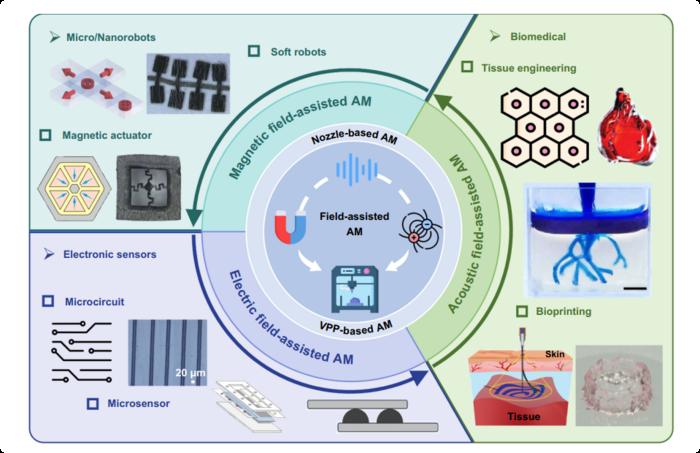
Imagine a 3D printer that not only builds shapes but programs their behavior. That vision is edging closer to reality thanks to a new study in the International Journal of Extreme Manufacturing, where researchers describe how magnetic, acoustic, and electric fields can guide materials as they solidify—turning printing into true matter reprogramming.
Known as Field-assisted Additive Manufacturing, or FAM, the technique integrates external fields directly into the printing process. Rather than shaping passive materials, these fields influence the very arrangement of atoms, particles, or cells inside the structure. The result: miniature devices whose physical, magnetic, or electrical properties can be designed on demand.
Building Function Into Form
The review paper, led by Prof. Qianqian Wang of Southeast University, examines how this fast-evolving field could redefine what 3D printing can do. Traditional additive manufacturing is celebrated for its geometric freedom, but its control over internal microstructure is limited. FAM seeks to change that by marrying form and function in a single, unified step.
“Traditional additive manufacturing can make complex shapes, but it doesn’t easily control what’s happening inside the material,” wrote Wang. “To make truly functional micro- or nanoscale devices, we need control over what happens inside the material. Field-assisted printing gives us that power.”
That power is transforming disciplines from microrobotics to biomedical engineering. In a magnetic field, for example, metallic particles can align into functional domains, giving microrobots predictable responses to external control. Acoustic fields—essentially sound waves—can gently organize living cells or nanoparticles into complex tissues without damaging them. Electric fields, meanwhile, can orient conductive or polarizable nanoparticles, creating flexible electronic circuits that stretch and sense like human skin.
The approach reframes manufacturing itself. Instead of printing a blank shell and adding function later, FAM builds both structure and behavior simultaneously. “It means we are no longer just making things,” as one co-author put it, “we are programming matter.”
Precision, Intelligence, and Integration
Prof. Zhiyang Lyu of Southeast University and Prof. Tianlong Li of Harbin Institute of Technology, who co-authored the study, see enormous potential in integrating multiple fields and intelligent control. The review maps out how FAM could evolve through AI-guided feedback systems capable of adjusting field intensity and direction in real time, enabling intricate fabrication at scales below a human hair.
“The future of FAM lies in intelligence and integration,” wrote Lyu. “We expect systems that use AI for real-time feedback, combine multiple fields to work synergistically, and enable high-throughput production for industrial and clinical use.”
Still, challenges remain. Maintaining field uniformity across a complex print area is notoriously difficult, and overlapping field effects can introduce unpredictable interactions. Moreover, scaling these techniques from laboratory demonstrations to mass production will require innovations in printer design, power control, and process modeling.
Yet the promise is too great to ignore. A small microrobot built by FAM could swim through the bloodstream, delivering drugs to a tumor. A tissue scaffold could align living cells into natural patterns for regeneration. A flexible sensor could record motion and temperature as precisely as human skin. Each example brings FAM closer to its central dream: engineering materials that think, move, and heal by design.
In this emerging landscape, manufacturing becomes less about sculpting and more about orchestrating invisible forces. It feels almost alchemical, this act of printing with fields. But as Wang and colleagues argue, it is simply the next logical step in a long human story—transforming matter not just by shape, but by intent.
International Journal of Extreme Manufacturing: 10.1088/2631-7990/ae098e