

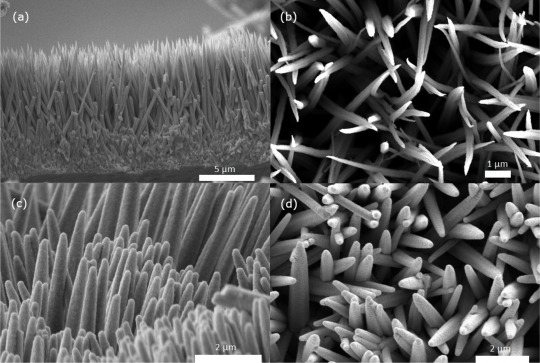
In a lab at the University of the Basque Country, a mat of pitch-black nanoneedles drinks light like a sponge. The material, copper cobaltate sculpted into needle-like forests and topped with an ultrathin aluminum-doped zinc oxide film, has now demonstrated solar absorption up to 99.5% under high-temperature, wide-angle tests. For concentrated solar power, where mirrors funnel sunlight into a central tower, that kind of near-total blackness is not a parlor trick. It is a cost lever.
The team’s study, published in Solar Energy Materials and Solar Cells, takes aim at a long-standing bottleneck for central-receiver systems: durable coatings that stay extremely dark at high temperatures and across steep angles of incoming light. Black silicon coatings now used on towers reach about 95% absorption. Carbon nanotube carpets can push toward 99%, but they degrade with heat and humidity, and often need protective layers that blunt their optical edge. The Basque group’s copper cobaltate nanoneedles, especially when conformally coated with conductive AZO, appear to thread the needle between optical performance and stability.
Why 0.5% More Black Could Matter
In central receivers, every fraction of a percent lost to reflection becomes heat that never reaches the molten salts inside. Those salts store the energy for after-dark generation, which is the signature advantage of tower-based concentrated solar power. The researchers report that the AZO overcoat not only preserves ultralow reflectance from ultraviolet through near-infrared, it also keeps absorption high even when light arrives at large off-normal angles, mimicking real heliostat fields where rays strike from many directions.
That angle robustness matters. CSP plants are not gentle optical benches; they are wind-battered, dust-swept fields that ask coatings to perform from sunrise skims to noon blasts. The team also measured emissivity up to 600 C and found unusually high hemispherical values, greater than 0.9 for AZO-coated samples. High emissivity can increase radiative heat loss, a potential efficiency tradeoff at receiver temperatures, but in tower designs operating at extreme solar concentration, improved solar absorptance often outweighs mid-infrared losses. The skeptical take: field trials will need to verify the true system-level gain once dust, cyclic heating, and weather enter the equation.
“The more we can achieve absorbing materials that are more effective, the more competitive the systems will be, and we will be opening up opportunities for this type of energy,”
said Iñigo González de Arrieta of EHU’s Thermophysical Properties of Materials group. He and colleagues emphasize that their lab is one of few equipped for high-temperature thermo-optical characterization, including bidirectional reflectance and emissivity under air. The visual is easy to picture: vertically aligned nanoneedles rising like dense, velvet-black bristles on an alloy plate, their AZO skin acting as a transparent conductor in the visible while soaking up infrared.
Beyond Carbon Nanotubes, With Caveats
Carbon nanotubes became the icon of ultrablackness, but they struggle on towers. The EHU team’s results echo that limitation plainly, and they point to copper cobaltate’s refractory spinel structure as a better high-temperature foundation. AZO’s role is twofold: an anti-reflection effect in the visible and continued absorption into the infrared thanks to free-carrier interactions. The authors argue this combination preserves blackness across spectrum and angle. Their analysis also shows thermal stability in air through 600 C, a crucial step toward receiver service temperatures envisioned by third-generation CSP programs.
“Carbon nanotubes absorb about 99% of the light, but they cannot be used on solar towers.”
That line, from the EHU release, captures the field’s frustration. Even if a coating is visually perfect, it must be manufacturable at scale, adherent on receiver alloys, resistant to abrasion and fouling, and compatible with maintenance cycles. Here the study is careful but aspirational. The AZO layer was deposited by atomic layer deposition, a gold-standard method for conformality, yet typically slow for very large parts. Real towers will need process routes that balance precision with throughput, or alternative conductive oxides that can be applied at scale without losing the angle-independent blackness observed in the lab. Durability under desert dust, salts, and steam will be decisive.
Still, the upside is clear. If a coating reliably turns 99.5% of concentrated sunlight into heat at the receiver, tower plants can run hotter with less aperture area, or hold output with fewer heliostats. That could nudge levelized costs toward targets set by DOE programs. The UC San Diego collaborators, including Renkun Chen, are already working with U.S. partners on potential deployment. Whether that momentum survives policy swings is anyone’s guess. What seems less uncertain is the optics: these nanoneedles are very black, very tough, and surprisingly angle-agnostic. If they survive the desert, they may pull towers into a brighter, cleaner, nighttime future.
Solar Energy Materials and Solar Cells: 10.1016/j.solmat.2025.113840